Skip to content
Search

Latest Stories

Follow Us:
Top Stories

Political honesty during the holidays

Opinion

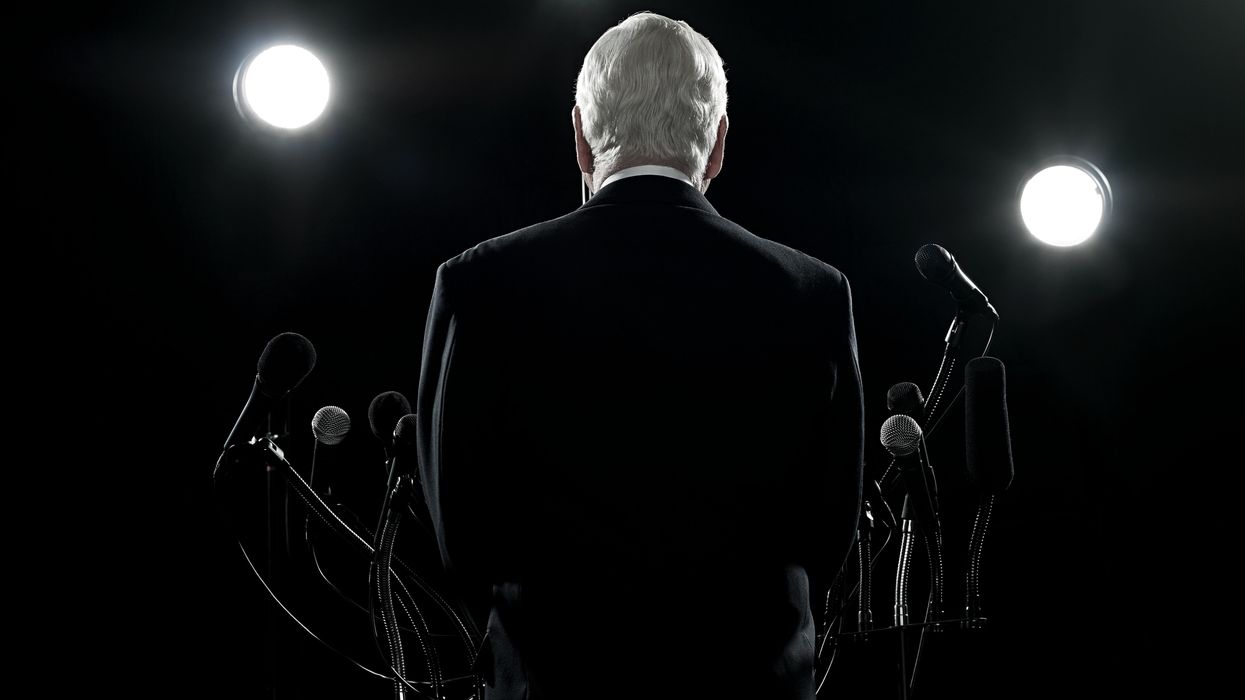
candidate giving a speech

Kevin Frazier imagines the candidate speech we all long to hear this holiday season.

Image_Source_/Getty Images

Frazier is an assistant professor at the Crump College of Law at St. Thomas University. He previously clerked for the Montana Supreme Court.

The holiday season lends itself to wishful thinking. With that spirit in mind, I’m asking Santa to help the American people identify and elect a candidate willing to deliver this speech:

My fellow Americans,

I don’t have all the answers. The problems we face today cannot be solved by a couple of tweets nor by a single party. From artificial intelligence to zoonotic diseases, the threats to our well-being have picked up speed, increased in complexity and spread across borders. I wish simple solutions existed. I admit that I’m often as puzzled and surprised by the size and scale of the problems we face as you.

So, though I cannot promise you answers, I can make the following pledges: We will recruit the brightest experts from across America to help us monitor and understand the risks we face; we will collaborate and coordinate with our allies to ensure that the global community is acting in unison; and, we will update you quickly and honestly along the way.


You should also know that I’m going to make mistakes. Although I’m confident that we’re going to increase our capacity to study and solve problems, these policy issues are like Jenga pieces – moving one piece can have significant and unpredictable effects on the larger structure. In an ideal world, I could prevent my team from causing any structural instability; in our current world, wobbles and shakes are inevitable. I won’t hide those from you. Instead, I’ll let you know about missteps as quickly as I let you know about steps forward. In return, I plead for your patience. I know that’s a lot to ask for in an age of drone-delivered pizzas. Nevertheless, your trust is essential to this approach to governance.

I’m also going to have to make trade-offs – to pick winners and losers. This is the roughest part of my job. Though some decisions will have uncertain results, others will very clearly impact certain communities more so than others. Again, I’d much prefer to only make choices that increase the well-being of everyone. We don’t live in that world. I’ll tell you now that when I confront those trade-offs, I’m going to err on the side of our kids. Decisions made decades ago have fudged up the future. This generation and the ones that follow it will need all the help they can get to overcome the potholes we created and failed to cover.

At this point, I know I’ve lost some of you. For those still reading, thank you for bravely considering a different kind of politician. This campaign faces stiff headwinds; it’s akin to a sailboat launching in the middle of a hurricane. There’s a route through the storm, but getting there will require a lot of teamwork and a lot of discipline. I hope you’ll join my crew. I need you and I believe America needs our commitment to a better approach to solving our collective problems.

If you’re still on the fence about whether to join this cause, I urge you to consider how much the status quo has cost us. Our inclination to pick sides means we’re constantly operating at less than full speed. Our bias toward certainty means we’re failing to recognize the substantial uncertainty we face. Our acceptance of a stagnant system means we’re making complex policy problems even more difficult to address.

Let’s dare to learn together, to work together and to bring about a better future together.

Happy holidays.

Read More

How do you solve a problem like Candace Owens?

Candace Owens speaks during the Conservative Political Action Conference (CPAC) at The Rosen Shingle Creek on Feb. 25, 2022, in Orlando, Fla.

(Joe Raedle/Getty Images/Tribune Content Agency)

How do you solve a problem like Candace Owens?

Candace Owens has a very popular internet show in which she trots out deranged conspiracies about, among other things, the demonic nature of Jews, the murder of conservative activist Charlie Kirk (probably by Jews and their pawns, in her estimation) and the allegation that French President Emmanuel Macron’s wife is really a man.

Owens is hardly alone. There’s an entire ecosystem of right-wing “influencers” who peddle conspiracy theories brimming with racism, antisemitism, demonology, pseudoscience and general crackpottery in regular installments. There’s an even larger constellation of media outlets and personalities who feed on controversy without ever quite condemning the outrages that cause it.

Keep ReadingShow less
After the Ceasefire, the Violence Continues – and Cries for New Words

An Israeli army vehicle moves on the Israeli side, near the border with the Gaza Strip on November 18, 2025 in Southern Israel, Israel.

(Photo by Amir Levy/Getty Images)

After the Ceasefire, the Violence Continues – and Cries for New Words

Since October 10, 2025, the day when the US-brokered ceasefire between Israel and Hamas was announced, Israel has killed at least 401 civilians, including at least 148 children. This has led Palestinian scholar Saree Makdisi to decry a “continuing genocide, albeit one that has shifted gears and has—for now—moved into the slow lane. Rather than hundreds at a time, it is killing by twos and threes” or by twenties and thirties as on November 19 and November 23 – “an obscenity that has coalesced into a new normal.” The Guardian columnist Nesrine Malik describes the post-ceasefire period as nothing more than a “reducefire,” quoting the warning issued by Amnesty International’s secretary general Agnès Callamard that the ”world must not be fooled” into believing that Israel’s genocide is over.

A visual analysis of satellite images conducted by the BBC has established that since the declared ceasefire, “the destruction of buildings in Gaza by the Israeli military has been continuing on a huge scale,” entire neighborhoods “levelled” through “demolitions,” including large swaths of farmland and orchards. The Guardian reported already in March of 2024, that satellite imagery proved the “destruction of about 38-48% of tree cover and farmland” and 23% of Gaza’s greenhouses “completely destroyed.” Writing about the “colossal violence” Israel has wrought on Gaza, Palestinian legal scholar Rabea Eghbariah lists “several variations” on the term “genocide” which researchers found the need to introduce, such as “urbicide” (the systematic destruction of cities), “domicide” (systematic destruction of housing), “sociocide,” “politicide,” and “memoricide.” Others have added the concepts “ecocide,” “scholasticide” (the systematic destruction of Gaza’s schools, universities, libraries), and “medicide” (the deliberate attacks on all aspects of Gaza’s healthcare with the intent to “wipe out” all medical care). It is only the combination of all these “-cides,” all amounting to massive war crimes, that adequately manages to describe the Palestinian condition. Constantine Zurayk introduced the term “Nakba” (“catastrophe” in Arabic) in 1948 to name the unparalleled “magnitude and ramifications of the Zionist conquest of Palestine” and its historical “rupture.” When Eghbariah argues for “Nakba” as a “new legal concept,” he underlines, however, that to understand its magnitude, one needs to go back to the 1917 Balfour Declaration, in which the British colonial power promised “a national home for the Jewish people” in Palestine, even though just 6 % of its population were Jewish. From Nakba as the “constitutive violence of 1948,” we need today to conceptualize “Nakba as a structure,” an “overarching frame.”

Keep ReadingShow less
Ukraine, Russia, and the Dangerous Metaphor of Holding the Cards
a hand holding a deck of cards in front of a christmas tree
Photo by Luca Volpe on Unsplash

Ukraine, Russia, and the Dangerous Metaphor of Holding the Cards

Donald Trump has repeatedly used the phrase “holding the cards” during his tenure as President to signal that he, or sometimes an opponent, has the upper hand. The metaphor projects bravado, leverage, and the inevitability of success or failure, depending on who claims control.

Unfortunately, Trump’s repeated invocation of “holding the cards” embodies a worldview where leverage, bluff, and dominance matter more than duty, morality, or responsibility. In contrast, leadership grounded in duty emphasizes ethical obligations to allies, citizens, and democratic principles—elements strikingly absent from this metaphor.

Keep ReadingShow less
Beyond Apologies: Corporate Contempt and the Call for Real Accountability
campbells chicken noodle soup can

Beyond Apologies: Corporate Contempt and the Call for Real Accountability

Most customers carry a particular image of Campbell's Soup: the red-and-white label stacked on a pantry shelf, a touch of nostalgia, and the promise of a dependable bargain. It's food for snow days, tight budgets, and the middle of the week. For generations, the brand has positioned itself as a companion to working families, offering "good food" for everyday people. The company cultivated that trust so thoroughly that it became almost cliché.

Campbell's episode, now the subject of national headlines and an ongoing high-profile legal complaint, is troubling not only for its blunt language but for what it reveals about the hidden injuries that erode the social contract linking institutions to citizens, workers to workplaces, and brands to buyers. If the response ends with the usual PR maneuvers—rapid firings and the well-rehearsed "this does not reflect our values" statement. Then both the lesson and the opportunity for genuine reform by a company or individual are lost. To grasp what this controversy means for the broader corporate landscape, we first have to examine how leadership reveals its actual beliefs.

Keep ReadingShow less