


Skip to content
Search

Latest Stories

Follow Us:
Top Stories

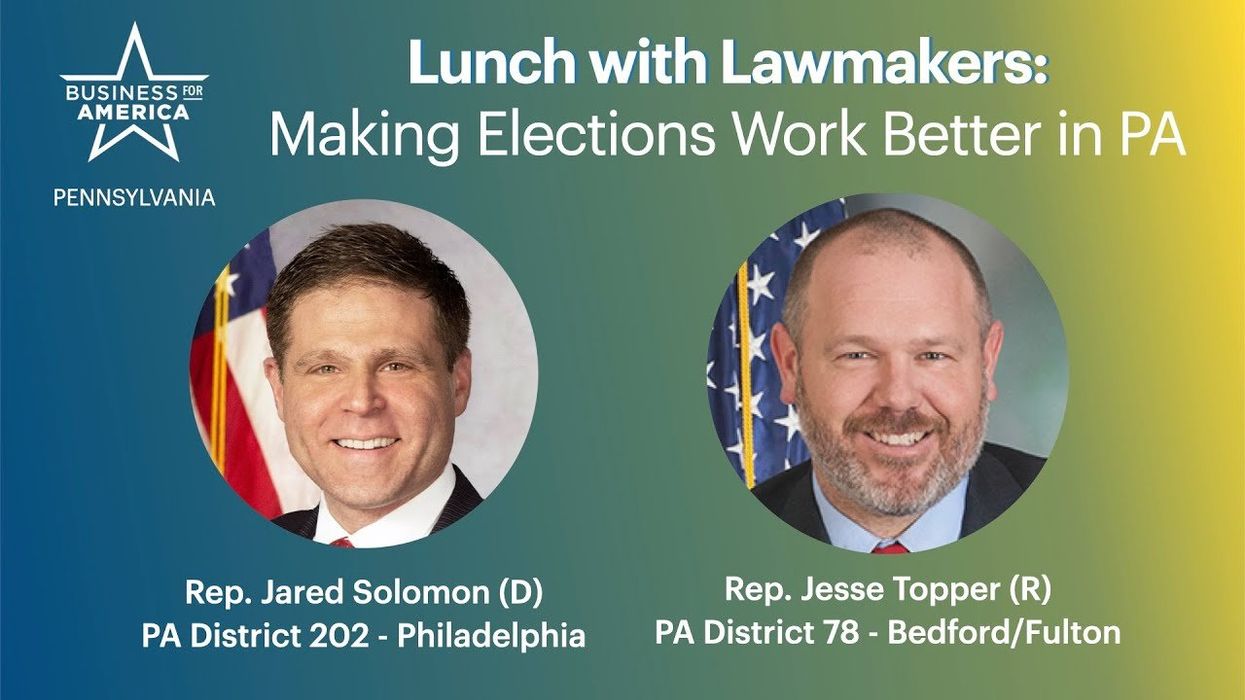
Video: Bipartisan lunch with lawmakers: Making elections work better in PA

Building on a series of bipartisan dialogues, join BFA Pennsylvania for the first in our series of “Lunch with Lawmakers” which bring together different perspectives at the intersection of business and politics.

Two of the Pennsylvania House’s most knowledgeable members discuss needed reforms to the way the state conducts its elections. The 2023–24 legislative session in Harrisburg will consider a range of proposals aimed at changing how citizens vote and how election officials tally and report the results. With a new governor, secretary of state, and House speaker governing as an Independent, changes are certain. To shed light on these developments, State Representatives Jared Solomon (D - 202) and Jesse Topper (R - 78) will discuss issues such as voter ID, pre-canvassing absentee ballots, protecting election workers, standardizing the procedures counties use to run elections, clarifying the rules concerning mail-in ballots, and ensuring election integrity.


Read More

Entrance Sign at the University of Florida

Universities are embracing “institutional neutrality,” but at places like the University of Florida it’s becoming a tool to silence faculty and erode academic freedom.

Getty Images, Bryan Pollard

When Insisting on “Neutrality” Becomes a Gag Order

Universities across the country are adopting policies under the banner of “institutional neutrality,” which, at face value, sounds entirely reasonable. A university’s official voice should remain measured, cautious, and focused on its core mission regardless of which elected officials are in office. But two very different interpretations of institutional neutrality are emerging.

At places like the University of Wisconsin – Madison and Harvard, neutrality is applied narrowly and traditionally: the institution itself refrains from partisan political statements, while faculty leaders and scholars remain free to speak in their professional and civic capacities. Elsewhere, the same term is being applied far more aggressively — not to restrain institutions, but to silence individuals.

Keep ReadingShow less