Skip to content
Search

Latest Stories

Follow Us:
Top Stories

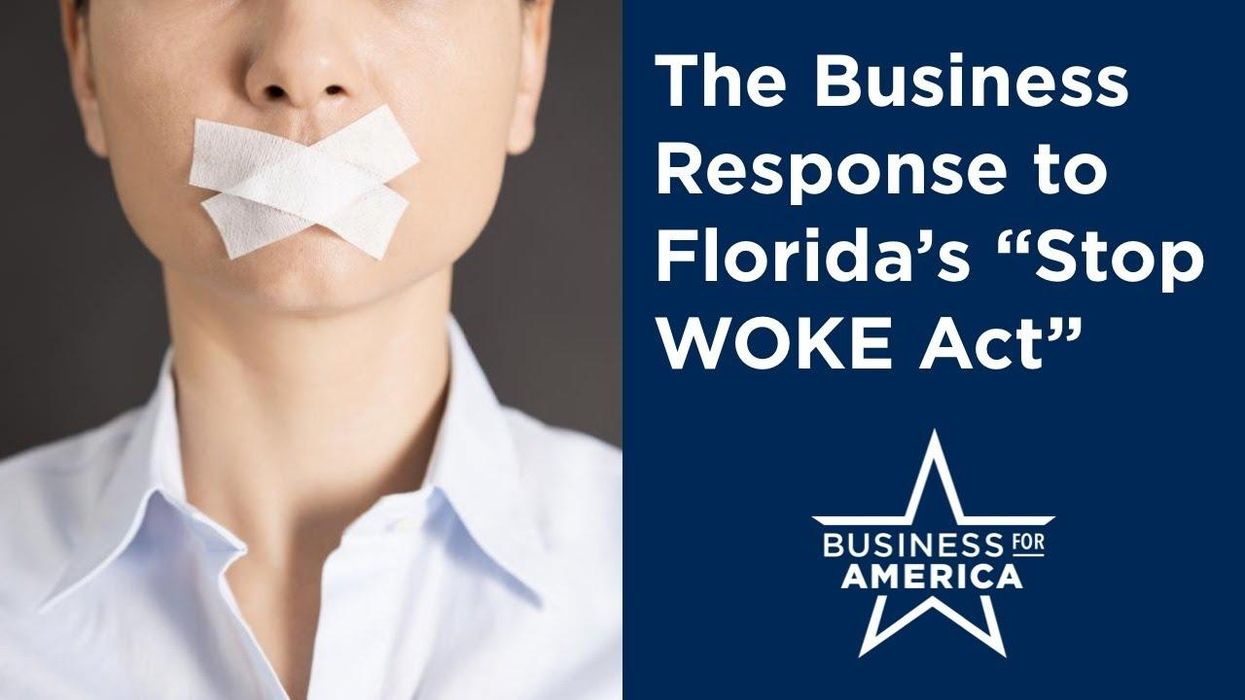
Video: The business response to Florida's “Stop WOKE Act"

Business leaders have filed a lawsuit challenging the constitutionality of Florida’s HB 7, the Stop Wrongs to Our Kids and Employees (WOKE) Act, claiming the law violates employers’ free speech rights by censoring ideas contrary to government officials’ preferred narrative.

In late August, in a victory for free speech, a federal judge in Florida suspended enforcement of the employer provisions of the Act, citing the bill’s inherent disregard for federal anti-discrimination laws. Watch and learn what your business can do about anti-business and anti-free speech legislation in Florida, and in preparation for similar legislation that could be replicated in other states.


Read More

McConnell and Platner both feel entitled

Democratic U.S. Senate candidate Graham Platner speaks to voters at a town hall at the Elks Lodge 188 on June 7, 2026, in Portland, Maine.

(Laura Brett/Getty Images/TCA)

McConnell and Platner both feel entitled

The two men could not be more different. One, a Republican, octogenarian, seven-term Southern senator, the other a progressive, millennial Maine oysterman who’s never spent a day in elected office.

But Mitch McConnell, the senior senator from Kentucky who’s been MIA for the past few weeks and Graham Platner, the Maine Senate candidate who’s facing calls to drop out of his race against Sen. Susan Collins, apparently do have something in common: an outsized sense of entitlement.

Keep ReadingShow less
ICE agents wearing gear that reads, "POLICE ICE." Their faces are covered, they are wearing helmets, and one of them is holding a weapon.

ICE agents stand guard in front of protesters outside the federal immigration center at Delaney Hall in Newark, where ICE is housing detained immigrants on May 26, 2026 in Newark, New Jersey.

Spencer Platt / Getty Images

Your Face Is in a Federal Database and ICE Put It There

Last week, while the world watched JD Vance fly to Switzerland to negotiate an Iran deal, a quieter document surfaced from inside the Department of Homeland Security that may matter more to the daily lives of Americans than anything that happened at Lake Lucerne. A DHS Privacy Threshold Analysis, obtained and reported by NPR, outlines plans to give approximately 1,300 local police forces access to the same facial recognition technology that federal ICE agents currently use in the field. The app is called the ICE Task Force Module. It allows an officer to photograph any person they stop, run the image against federal databases, and receive an identity match in seconds. Every photograph taken is stored in a DHS system for fifteen years. The document states plainly that this surveillance will sweep up American citizens. The DHS knows this. It is proceeding anyway.

This is not an immigration story. It is a surveillance infrastructure story, and the distinction is the most important thing to understand about what is being built.

Keep ReadingShow less
A father voting, with his young son standing by him, watching him.

Citizens cast their vote during the 2026 presidential runoff in Colombia on June 21, 2026 in Barranquilla, Colombia. Ivan Cepeda, candidate for the Pacto Historico party and Abelardo de la Espriella, candidate for the Salvación Nacional, face in a tight runoff to rule Colombia from 2026 to 2030.

Leonardo Castañeda/Getty Images

Colombia’s Election Matters—Especially to Ecuador and the U.S.

In a closely fought election on June 21, conservative outsider Abelardo De La Espriella prevailed over Iván Cepeda, an ally of current leftist president, Gustavo Petro. Central to the electorate’s choice were distinct policy proposals to fight criminality and the drug cartels, who control large swaths of Colombian territory. The policies president-elect De La Espriella will bring to the fight against these issues matter greatly, not only to Colombia, but to neighboring Ecuador and the United States.

Earlier in March, Ecuadorian President Noboa, desperate to gain traction in his own drug war, announced a partnership with the U.S. to conduct joint operations against drug cartels. The partnership quickly went awry. A New York Times investigation of the first strike indicates that what the joint militaries considered a drug camp was in fact a dairy farm, with no drug connection. Then, on March 17, Colombia accused Ecuador of bombing within its territory with U.S. involvement. These incidents resulted in U.S. lawmakers calling for a suspension of joint operations on May 13. Very quickly, the U.S. partnership has reopened the scars of the Plan Colombia era of the early 2000s, where an overly militaristic approach to the drug war funded by the U.S. resulted in human rights abuses and false positives.

Keep ReadingShow less