


Skip to content
Search

Latest Stories

Top Stories

Online Federal Multilingual Resources Continue to Disappear under Trump Executive Order

News

Online Federal Multilingual Resources Continue to Disappear under Trump Executive Order

LEP.gov, an online library of multilingual materials, used to be a resource for agencies and individuals alike but was suspended in July after Trump’s executive order.

WASHINGTON - On March 1, President Donald Trump issued an executive order declaring English as the United States’ official language. Since then, some federal agencies, like the Department of Justice and the Department of Housing & Urban Development, have removed multilingual resources from their websites; others have not. The executive order does not require their removal.

Language access, or the provision of non-English translation services or materials, assists over 25 million individuals in the United States with limited English proficiency (LEP). Experts say reducing language access will hurt government efficiency.


“It will make government programs less effective because they'll be unable to reach many individuals that they might reach otherwise,” Jacob Hofstetter, a policy analyst from the Migration Policy Institute, said.

Trump’s executive order repeals a Clinton executive order that required federal agencies to provide language access for public-facing programs.

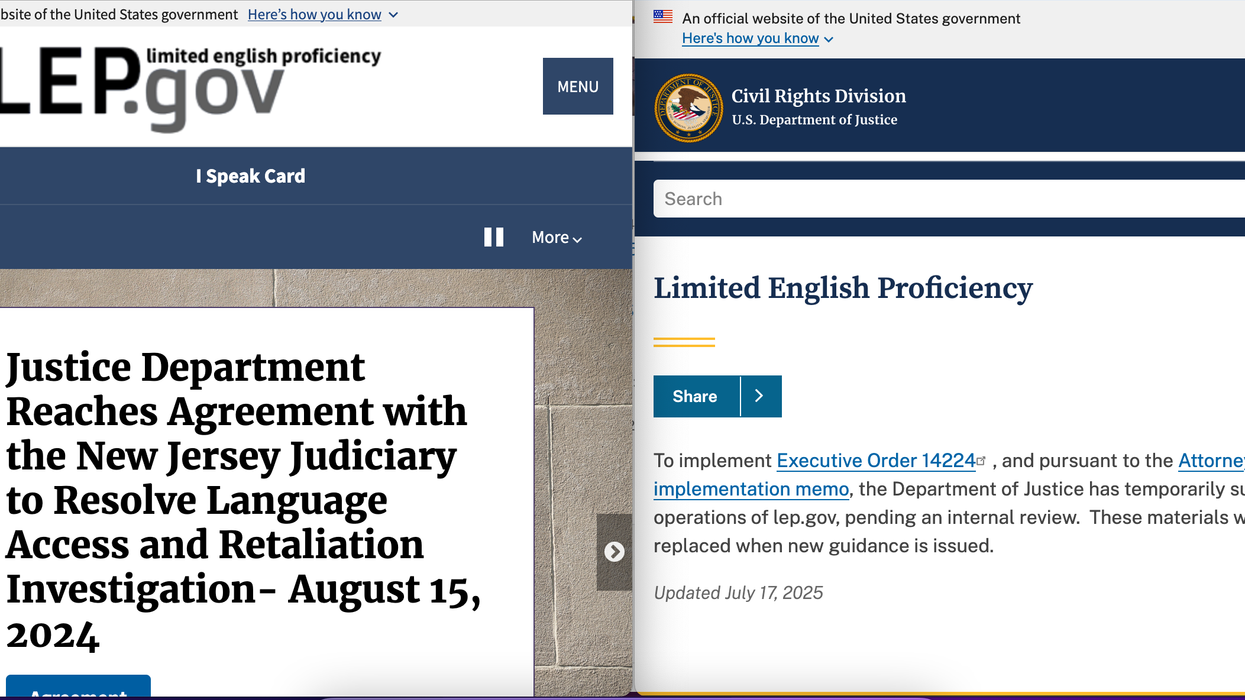
Since Trump’s order, the DOJ has taken down almost all of its multilingual resources. HUD took down much of its multilingual materials, eliminated non-English translation services, and issued an “English only policy.” Additionally, lep.gov, a centralized online library of multilingual resources, was suspended in July. The website now reads that the “materials will be replaced when new guidance is issued.”

The website, launched in 2002 by the DOJ, included links to federal agencies’ guidance on Limited English Proficiency. Hofstetter said this removal could have a rippling effect across the federal government.

“[It] was used as a model for a lot of other agencies' guidance,” Hofstetter said. “It has also been a key source of technical assistance and information for a wide range of entities that receive federal funding, that are seeking to provide language access. Though it was always guidance, the rescinding of it does also represent a pretty serious consequence for the field.”

Hofstetter said Clinton’s original executive order “filled some gaps” in previous legislation, like Title VI and the Civil Rights Act of 1964, that required language access only for federally funded programs, but not federal agencies.

Trump’s guidance comes in the form of an executive order, and can’t override current law. Federally funded programs are still required to provide language access in accordance with previous laws.

Mara Youdelman, managing director of the National Health Law Program, said Trump’s executive order is confusing for some federally funded programs about their language responsibilities.

“It certainly seems to imply, ‘Well, okay, we don't have to provide services,’” Youdelman said. “But executive orders don't exist in a vacuum, and they have to be understood and read in conjunction with other requirements.”

She said this confusion is intentionally “sown by this administration” to prevent LEP individuals from getting help.

“There's also really serious public safety and public health implications that come along with language access as well,” Hofstetter said. “You can imagine if you didn't issue emergency alerts in languages other than English, folks might be exposed to dangers from natural disasters or other events solely due to their limited proficiency in English.”

A memo from Attorney General Pam Bondi says the DOJ plans to issue new language access guidance early next year.

“The Department will issue new guidance, for public comment, that presents clear, practical guidelines that help agencies prioritize English while explaining precisely when and how multilingual assistance remains necessary to fulfill their respective agencies' mission and efficiently provide Government services,” Bondi said.

Hofstetter warned that this could be just the start of limiting language.

Isabella Jacob covers immigration and demographics for Medill on the Hill. The Michigan native is a sophomore at Northwestern University studying journalism and entrepreneurship.

Read More

Presidents can no longer be trusted with pardons

Rioters breach Capitol security Jan. 6

Win McNamee/Getty Images

Presidents can no longer be trusted with pardons

Ours is a system of “checks and balances.”

The president can do this or that, but the courts and Congress can put a stop to it (depending on the circumstances and relevant rules). When the courts rule that the executive branch can’t do something, Congress can write a new law saying the president can do it. When Congress passes a law the president doesn’t like, the president can veto it. Congress, if it has enough votes, can override the veto. And so on. The whole idea is to deny any one branch or person too much concentrated power.

Keep ReadingShow less
Presidents can no longer be trusted with pardons

Rioters breach Capitol security Jan. 6

Win McNamee/Getty Images

Presidents can no longer be trusted with pardons

Ours is a system of “checks and balances.”

The president can do this or that, but the courts and Congress can put a stop to it (depending on the circumstances and relevant rules). When the courts rule that the executive branch can’t do something, Congress can write a new law saying the president can do it. When Congress passes a law the president doesn’t like, the president can veto it. Congress, if it has enough votes, can override the veto. And so on. The whole idea is to deny any one branch or person too much concentrated power.

Keep ReadingShow less
Donald Trump vs. Marjorie Taylor Green?! Here's What MAGA Really Means
Rep. Marjorie Taylor Greene
Celal Gunes/Anadolu via Getty Images

Donald Trump vs. Marjorie Taylor Green?! Here's What MAGA Really Means

In an interview on Fox News, President Trump affirmed his support for H-1B visas. He argued that because the US lacks enough talented people, we “have to bring this talent” from abroad. His words sparked outrage among conservatives.

Representative Marjorie Taylor Greene, one of Trump’s staunchest loyalists, pushed back against Trump’s narrative. Greene praised US-Americans as “the most talented people in the world.” She even introduced legislation aimed at ending “the mass replacement of American workers” by the H-1B visa program.

Keep ReadingShow less
Trump's Deregulation Lure: A Wage Squeeze for the Global South
person using black laptop computer
Photo by Kanchanara on Unsplash

Trump's Deregulation Lure: A Wage Squeeze for the Global South

When Colm Kelleher, chairman of UBS, sat down with Scott Bessent in recent months to discuss uprooting the bank's headquarters from Zurich to New York, it was more than corporate maneuvering. It was a signal flare for the financial world under Donald Trump's second term. Bessent promised a regulatory bonfire that could slash compliance costs and open the floodgates for American finance. The reported talks underscore a broader shift: the United States is apparently positioning itself as the unassailable hub of global capital, drawing in institutions like UBS with tax breaks and lighter oversight. Yet this allure comes at a steep price for emerging markets, where wage growth is already fragile. What looks like a boom for American workers masks a quiet trap, one that could deepen the divide between rich nations and the rest.

Bessent's vision, laid out in private conversations and public hints, paints a picture of American exceptionalism reborn. He has warned of a "perfect storm" of inherited inflation and supply disruptions from the Biden years, now to be tamed by aggressive deregulation and targeted tariffs. In one recent interview, he blamed soaring beef prices on a mix of migrant-driven cattle issues and lingering policy failures, framing Trump's agenda as the corrective force. The rhetoric is folksy, but the policy is sharp: roll back rules that hobble banks, lure foreign firms stateside, and shield domestic industries with import duties. UBS's flirtation with relocation fits neatly here. Across the Atlantic, Trump offers relief: no more endless stress tests, faster mergers, and a friendlier tax code. If UBS moves, it could save hundreds of millions annually in regulatory overhead, funneling those gains into higher bonuses for its New York traders.

Keep ReadingShow less