
Originally published by The 19th.
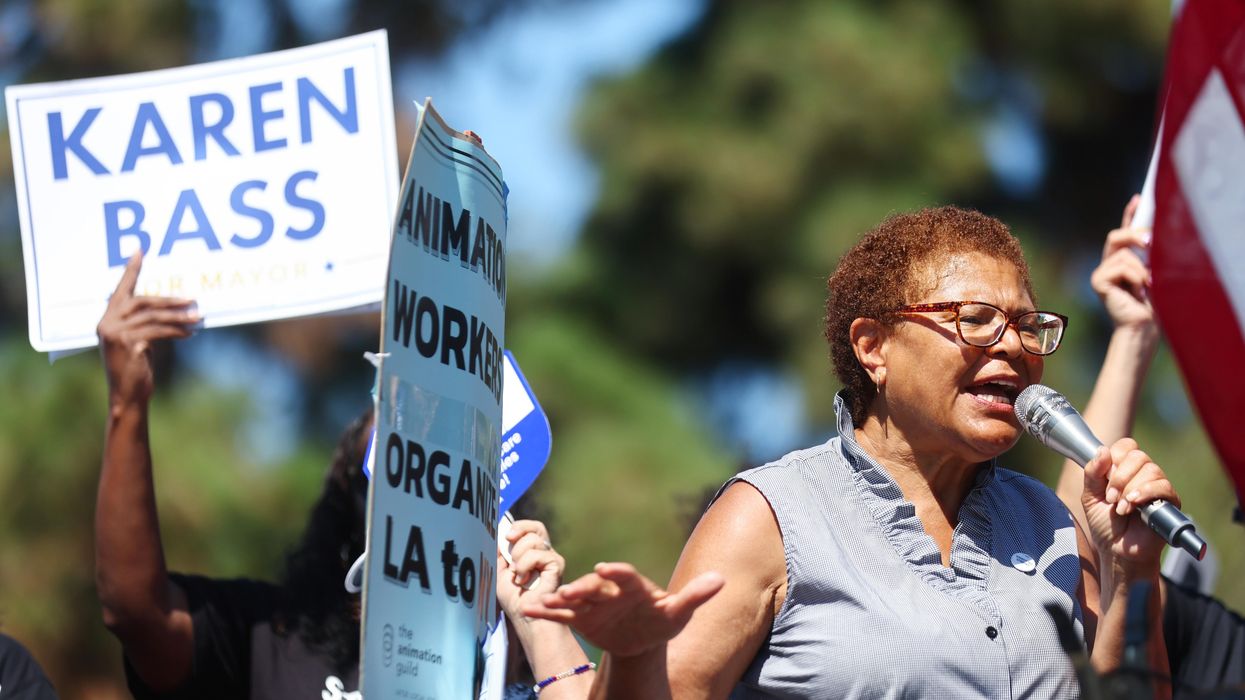
LOS ANGELES — For 36 hours in September 1915, Los Angeles Councilmember Estelle Lawton Lindsey served as the city’s acting mayor when the sitting mayor and city council president left town — the first woman to ever do so. One hundred and seven years later, Los Angeles has yet to elect a woman mayor, a streak Rep. Karen Bass hopes to change in a November runoff election.
The nation’s top Democrats — President Joe Biden, Vice President Kamala Harris, House Speaker Nancy Pelosi and Hillary Clinton — have endorsed her. With decades of experience in public service, community activism and cross-cultural coalitions, Bass has a double-digit lead in the polls over her challenger, Rick Caruso. Unlike Lindsey, whom male dignitaries snubbed during her mayoral stint, Bass’ gender is not a disadvantage in this race, political experts say. Having served nearly 12 years in Congress, her bid comes at a time when women of color are breaking barriers as city leaders.
“I'm ahead ... because people appreciate my message and my understanding of the issues and experience,” Bass told The 19th. “Of course, anytime you break the glass ceiling, it is critically important. But I do not believe that voters are going to go to the polls because I'm a woman.”
Experts note that Bass is running for mayor when the public is laser focused on reproductive rights because of Roe v. Wade’s reversal in June. That Supreme Court decision prompted California lawmakers to give voters the chance in November to amend the state constitution to include abortion rights. California’s Proposition 1, which would amend the California Constitution to establish rights to reproductive freedom, will likely draw greater numbers of women to the polls, analysts predict. Already, more women than men voted in the June 7 Los Angeles primary. While Caruso led Bass with men by 8 points right before the primary, Bass received more support from voters overall and led her opponent among women by 19 points.
“We will be successful this year, I believe, in passing the ballot proposition that enshrines a woman's right to choose in our state constitution,” Bass said. “So hopefully that will give comfort to women that our state, if it decided to shift toward the right, we will not have to worry because it will be in our constitution. I think if we learned anything over these last few years, we cannot take anything for granted.”
Because neither Bass nor Caruso won at least 50 percent of the vote, they will face each other again this fall. Bass now has a 12 percent edge over her opponent, a new poll has found, but experts say not to count out Caruso with two months left before the election.
Bass is campaigning for mayor during a period when Black women have won historic mayoral races nationwide. Last year, Black women served as mayors of eight of America’s 100 most populous cities, a record. That number has fallen to seven, but Black women are running New Orleans, San Francisco, Chicago, St. Louis, Washington, D.C., Charlotte and Durham, North Carolina.
“What we've seen over the last decade is incremental gains in the number of Black women running, winning and leading,” said Glynda Carr, president and CEO of the Higher Heights Leadership Fund, which works to increase and support Black women leaders. “In 2014, there was just one Black woman serving as mayor of a top 100 city — that was in Baltimore. And we are now in a place where there are seven Black women running the most populous cities. We have a definitive changing face of leadership.”
Some have described this moment as “ the age of Black women in politics.” Bass said that many of these history-making mayors have already contacted her, making “really wonderful” gestures.
“A sisterhood is developing,” she said. “Rather, it's already developed. I'm hoping to join the sisterhood.”
Now 68, Bass first felt moved to become involved in civil rights and politics as a youth in L.A.'s Venice and Fairfax neighborhoods. By her teens, she was volunteering for Robert F. Kennedy’s presidential campaign. In 1990, her experiences treating victims of the crack-cocaine epidemic as a physician assistant prompted her to co-found the Community Coalition to empower communities of color to change public policy concerning addiction, poverty and violence. She was elected to represent California’s 47th Assembly district in 2004.
In the Assembly, Bass worked on reforming California’s child welfare system, creating a legislative agenda for Black Californians and ensuring children had health insurance. As Assembly speaker, she received a 2010 John F. Kennedy Profile in Courage Award for negotiating a bipartisan budget compromise. That same year, she won a congressional seat.
Bass chaired the Congressional Black Caucus from 2019 to 2021, co-authoring the George Floyd Justice in Policing Act to ban chokeholds and no-knock warrants and allow for easier prosecution of criminal cops. The legislation died in the Senate after passing the House in June 2020. Many of her caucus memberships are connected to the causes she’s worked on for years—foster youth, social work, addiction and other health issues. She sponsored Health Insurance for Former Foster Youth Act, enacted in 2018. She’s also advocated for LGBTQ+ equality, student debt relief, immigration reform and gun control.
“Her experience and background — it makes her uniquely qualified,” Carr said. “She has successfully run and governed at multiple levels of government. Here's a woman who started out as a community activist and advocate and community provider. She's proven her legislative prowess as being able to build good public policy, but she's also shown how she could be an executive, head of a body.”
In July 2020, speculation spread that Biden was considering Bass as a running mate. Bass may not be the first woman vice president, but as she’s poised to make history in Los Angeles, the groundbreaking nature of her candidacy isn’t foremost on voters’ minds. During an August campaign stop to the restaurant Hecho en Mexico in El Sereno, east of downtown Los Angeles, no constituent mentioned her gender or race. Residents of this gentrifying, largely Latinx neighborhood mostly wanted her to discuss homelessness, one of the city’s major challenges.
“Angelenos … are fed up with explanations and rationalizations and justifications [about homelessness] rather than actual, meaningful change,” said Ange-Marie Hancock Alfaro, dean's professor and chair of political science and international relations at the University of Southern California. “So, I think from that perspective, this is the sine qua non; this is the top issue of this mayor's race. And I think the challenge is going to be really what people in Los Angeles…think is the best solution.”
Dressed in black slacks, a gray blazer and loafer flats, Bass spent 35 minutes on her feet taking questions from the crowd crammed into Hecho en Mexico. Many stood along the walls because the restaurant, a magnet for politicians vying for Latinx voters, was filled to capacity. Former President Bill Clinton and California Gov. Gavin Newsom have both stumped there.
In a half Latinx town, gaining the vote of this community is vital. Caruso led with Latino voters during the primary. Bass, however, has been involved in the community for decades, said Elva Yañez, organizer of Hecho’s “Latinos con Karen Bass” event.
“She's worked with Latinos, Mexican Americans, Chicanos for her entire career,” said Yañez, a senior advisor for the Prevention Institute, which focuses on health equity. “She put together an intentionally Black and Brown organization back in the ’90s to respond to the crack epidemic in a very strategic way, by trying to get at the root causes of these problems, which is lack of jobs, assaults against the family, no safety net.”
Bass has endorsements from high-profile Latinx leaders, including Los Angeles City Council President Nury Martinez, former L.A. Mayor Antonio Villaraigosa, L.A. County Supervisor Hilda Solis, Sen. Alex Padilla and labor activist Dolores Huerta. Having represented extremely diverse constituencies, Bass can expertly navigate L.A.’s “unique racial dynamics,” Hancock Alfaro said
The Hecho crowd wanted Bass to know their community has been overlooked. In 2020, homelessness in El Sereno garnered international headlines when unhoused mothers occupied vacant government-owned homes. During the COVID-19 crisis, human waste accumulated in the community, and a homeless encampment spread out on a street median. The city eventually moved those living there into nearby motels, part of an initiative to house vulnerable individuals during the pandemic. Homelessness has pervaded Los Angeles County, with more than 66,000 unhoused people as 2020 began, including a growing percentage of women.
At Hecho, Bass argued that Caruso is the wrong candidate to address homelessness.
“He has never built one unit of affordable housing, not one,” she said to cheers. “So why would we believe he’s going to do that now when he’s built lots and lots of housing?”
Caruso, a billionaire real estate developer, has put more than $40 million of his own money into his mayoral bid. He inundated the airwaves with campaign ads before the June primary, scoring endorsements from Snoop Dogg, Kim Kardashian, Katy Perry and Gwyneth Paltrow. But he still came up short, earning 36 percent of the vote to Bass’ 43 percent.
Caruso’s homelessness planincludes building 30,000 shelter beds in 300 days, declaring a state of emergency, appointing a homelessness coordinator and demanding that state and federal officials address the crisis. Bass intends to secure residences for 15,000 unhoused people during her inaugural year, forge a city-county partnership and maximize state funds. She also wants to convert existing properties into homes for the unhoused. Both candidates plan to expand treatment of mental illness and substance abuse to reduce homelessness.
"Many years ago, I worked as a PA in LA County's emergency room, so my patients were homeless,” Bass told The 19th. “When I was at Community Coalition, we were trying to take over motels in the ’90s to address the homeless problem. In the middle of the ‘90s when welfare reform was passed, we fought as hard as we could against it because we knew…women and children would join the ranks of the homeless and that had not been the case before. So I understand that we absolutely, positively have to have a comprehensive response."
A previous poll indicated that voters believe Caruso can fight homelessness and crime better than Bass. Experts told The 19th that gender stereotypes contribute to such perceptions.
“The traditional virtues of a good politician are highly gender-coded, a strong leader tough on crime, somebody who can be the captain of the ship,” said Juliet Williams, a professor in the gender studies department at the University of California, Los Angeles. “All of these qualities are stereotypically considered masculine, not feminine, and that certainly has played a role in voters’ choices. So we definitely should anticipate that Karen Bass…is going to have to surmount these enduring gender stereotypes that have really held great candidates back.”
Since former Los Angeles city controller Wendy Greuel lost her mayoral bid in 2013, the city and the county have welcomed women’s leadership, experts say. A Latina heads the city council and women hold all five seats on the L.A. County Board of Supervisors, which included just one woman in 2014. Women voters have helped candidates break barriers, and Caruso seeks their support.
He has repeatedly backed abortion rights, though remarks he made 15 years ago and past donations he’s made to anti-choice politicians have drawn criticism. A representative for his campaign denied that he has switched his position on abortion. "Rick Caruso is for choice. Period. He has always been," the spokesperson said in a statement to The 19th. "He believes we need to fight to protect healthcare, because healthcare is a human right and abortion is healthcare."
Even his political affiliation has been questioned: Caruso switched his party to Democrat during his mayoral run after years as an independent and Republican. "Rick saw that the Republican Party leadership was increasingly shunning the role government needed to play in protecting communities and personal freedoms, so he chose to register as a Democrat," a Caruso spokesperson said.
Being perceived as inauthentic, especially about abortion, could hurt him at the polls, experts suggested.
“It's really important to have politicians that are going to go out on a limb and do whatever is necessary to protect people in their jurisdiction so that everybody has health care equity, and Caruso is not compelling or credible on the issue,” Williams said.
NARAL Pro-Choice California and Planned Parenthood L.A.’s political arm have endorsed Bass. Asked if her medical background gives her special insight into abortion rights, Bass laughed. “No, I am a woman,” she said. “That gives me insight!” But, she added, “The insight from being a medical professional is that I understand that things like partial-birth abortion, and some of the crazy arguments that the right wing talks about in terms of abortion, are ludicrous because they are not based on science. They are based on no understanding of … a woman's physiology.”
In addition to courting women voters by supporting reproductive rights, Caruso released a women’s economic agenda, promising to appoint a deputy mayor on gender issues. Bass suggested an alternative: “How about having an actual woman mayor?”
Insistent that she doesn’t want votes because of her identity but because she’s prepared for the job, Bass noted to The 19th that Black women have always been leaders.
“What has not always happened is recognition and acknowledgement of their leadership roles,” she said.