




As the year ends, we’d like to share with you more than 40 interviews The Fulcrum produced in conjunction with CityBiz for the “Fulcrum Democracy Forum – Meet the Change Leaders” series.
The Fulcrum and CityBiz, a publisher of news and information about business, power, money, politics and people in 21 major U.S. markets, produced these insightful interviews with an array of talented democracy change leaders. The videos were shared nationally with thousands of CityBiz subscribers and across its social media channels. The podcasts have also been published in The Fulcrum and distributed through the Coffee Party/Citizen Connect social media platform with 970,000 followers.
Each of the change leaders interviewed drives and facilitates transformation daily within their organizations, their communities and the nation as a whole. They inspire and motivate others to embrace new ways of thinking, working and behaving — empowering citizens and strengthening our democracy.
As you listen, you’ll get a clearer vision of the diverse areas of practice these leaders are engaged in, all serving a common goal of creating a larger movement for healthy self-governance across the nation to strengthen our democratic republic. While varied in their approaches, they all have a clear vision of what the future should look like and, through their work, articulate this vision to millions of Americans across the country.
For change to happen in our country, citizens must be inspired and motivated to become civically engaged.
Enjoy these interviews and become involved. In the words of the late President John F. Kennedy. “Ask not what your country can do for you—ask what you can do for your country,”
Nevins is co-publisher of The Fulcrum and co-founder and board chairman of the Bridge Alliance Education Fund. Becvar is co-publisher of The Fulcrum and executive director of the Bridge Alliance Education Fund. Balta is director of solutions journalism and DEI initiatives for The Fulcrum and a board member of the Bridge Alliance Education Fund, the parent organization of The Fulcrum. He is the publisher of the Latino News Network and a trainer with the Solutions Journalism Network.

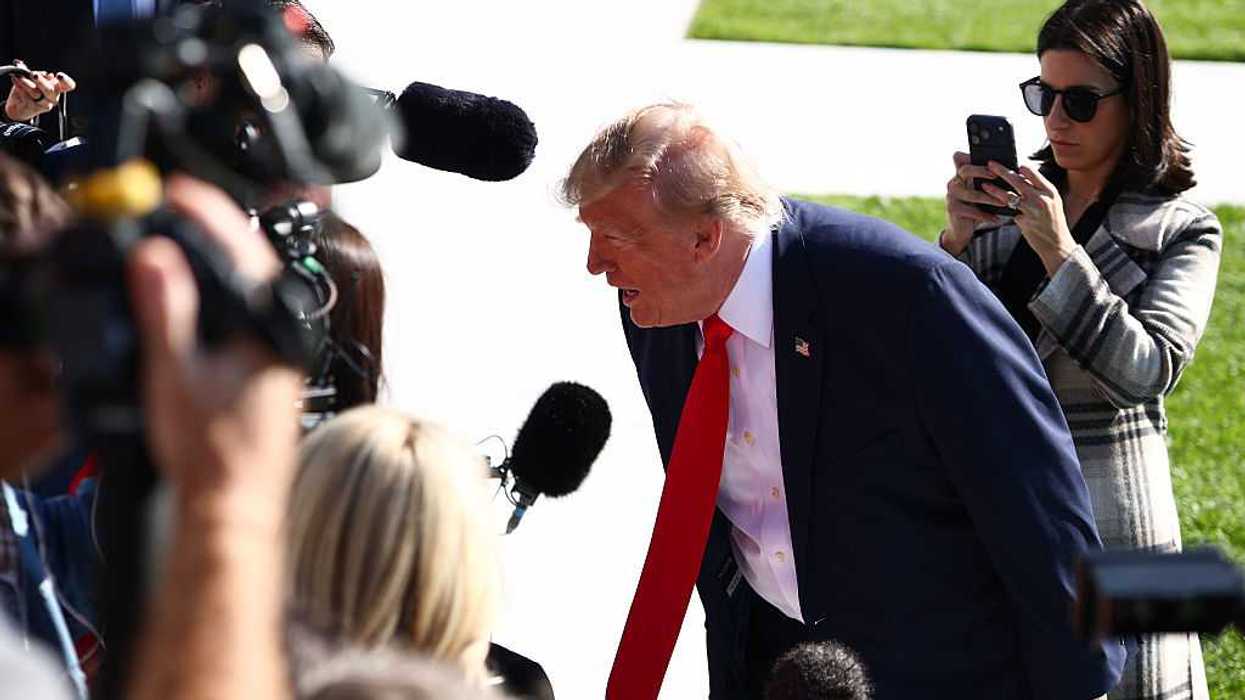













Eric Trump, the newly appointed ALT5 board director of World Liberty Financial, walks outside of the NASDAQ in Times Square as they mark the $1.5- billion partnership between World Liberty Financial and ALT5 Sigma with the ringing of the NASDAQ opening bell, on Aug. 13, 2025, in New York City.
Why does the Trump family always get a pass?
Deputy Attorney General Todd Blanche joined ABC’s “This Week” on Sunday to defend or explain a lot of controversies for the Trump administration: the Epstein files release, the events in Minneapolis, etc. He was also asked about possible conflicts of interest between President Trump’s family business and his job. Specifically, Blanche was asked about a very sketchy deal Trump’s son Eric signed with the UAE’s national security adviser, Sheikh Tahnoon.
Shortly before Trump was inaugurated in early 2025, Tahnoon invested $500 million in the Trump-owned World Liberty, a then newly launched cryptocurrency outfit. A few months later, UAE was granted permission to purchase sensitive American AI chips. According to the Wall Street Journal, which broke the story, “the deal marks something unprecedented in American politics: a foreign government official taking a major ownership stake in an incoming U.S. president’s company.”
“How do you respond to those who say this is a serious conflict of interest?” ABC host George Stephanopoulos asked.
“I love it when these papers talk about something being unprecedented or never happening before,” Blanche replied, “as if the Biden family and the Biden administration didn’t do exactly the same thing, and they were just in office.”
Blanche went on to boast about how the president is utterly transparent regarding his questionable business practices: “I don’t have a comment on it beyond Trump has been completely transparent when his family travels for business reasons. They don’t do so in secret. We don’t learn about it when we find a laptop a few years later. We learn about it when it’s happening.”
Sadly, Stephanopoulos didn’t offer the obvious response, which may have gone something like this: “OK, but the president and countless leading Republicans insisted that President Biden was the head of what they dubbed ‘the Biden Crime family’ and insisted his business dealings were corrupt, and indeed that his corruption merited impeachment. So how is being ‘transparent’ about similar corruption a defense?”
Now, I should be clear that I do think the Biden family’s business dealings were corrupt, whether or not laws were broken. Others disagree. I also think Trump’s business dealings appear to be worse in many ways than even what Biden was alleged to have done. But none of that is relevant. The standard set by Trump and Republicans is the relevant political standard, and by the deputy attorney general’s own account, the Trump administration is doing “exactly the same thing,” just more openly.
Since when is being more transparent about wrongdoing a defense? Try telling a cop or judge, “Yes, I robbed that bank. I’ve been completely transparent about that. So, what’s the big deal?”
This is just a small example of the broader dysfunction in the way we talk about politics.
Americans have a special hatred for hypocrisy. I think it goes back to the founding era. As Alexis de Tocqueville observed in “Democracy In America,” the old world had a different way of dealing with the moral shortcomings of leaders. Rank had its privileges. Nobles, never mind kings, were entitled to behave in ways that were forbidden to the little people.
In America, titles of nobility were banned in the Constitution and in our democratic culture. In a society built on notions of equality (the obvious exceptions of Black people, women, Native Americans notwithstanding) no one has access to special carve-outs or exemptions as to what is right and wrong. Claiming them, particularly in secret, feels like a betrayal against the whole idea of equality.
The problem in the modern era is that elites — of all ideological stripes — have violated that bargain. The result isn’t that we’ve abandoned any notion of right and wrong. Instead, by elevating hypocrisy to the greatest of sins, we end up weaponizing the principles, using them as a cudgel against the other side but not against our own.
Pick an issue: violent rhetoric by politicians, sexual misconduct, corruption and so on. With every revelation, almost immediately the debate becomes a riot of whataboutism. Team A says that Team B has no right to criticize because they did the same thing. Team B points out that Team A has switched positions. Everyone has a point. And everyone is missing the point.
Sure, hypocrisy is a moral failing, and partisan inconsistency is an intellectual one. But neither changes the objective facts. This is something you’re supposed to learn as a child: It doesn’t matter what everyone else is doing or saying, wrong is wrong. It’s also something lawyers like Mr. Blanche are supposed to know. Telling a judge that the hypocrisy of the prosecutor — or your client’s transparency — means your client did nothing wrong would earn you nothing but a laugh.
Jonah Goldberg is editor-in-chief of The Dispatch and the host of The Remnant podcast. His Twitter handle is @JonahDispatch.