Jeff Garzik serves as the founder and chairman of the policy institute Washington Power and Light. Before co-founding Bloq, he spent five years as a Bitcoin core developer and ten years at Red Hat. His work with the Linux kernel is now found in every Android phone and data center running Linux today.
Ralph Benko serves as co-founder and general counsel to Washington Power and Light. He is the co-founder and general counsel for F1R3FLY.io and has worked in or with 3 White Houses, two executive branch agencies, and the Congress as well as many political and policy institutes. He is an award winning columnist.
Determined to cut greenhouse gasses as the climate change culprit? Committed to equitable prosperity as a staple of global justice?
Want both? The gold standard of any technology is years of field testing.
To paraphrase Linus Torvalds, the real world is the best test lab in the world. There are two types of technologies:
1. Tech such as nuclear that survived real world field testing.
2. High risk, unproven “hopium” tech.
It is a bad idea to pin the well-being of humanity – based on delivering cheap, reliable, non-greenhouse gas emitting electricity at scale -- on magical thinking about unproven technology. What is needed is good hearted hard-nosed pragmatism… after squandering decades in political hopium-smoking.
Dispelling myths will inhibit Uncle Sam from misallocating tax dollars to pie-in-the-sky energy projects unsupported by engineering data. Congress recently authorized, per the White House, hundreds of billions of dollars on unproven technologies (cue the deep sigh).
This money could be used, instead, to build gigawatts of real, cheap, zero-emission generating capacity. Yes, nuclear.
We are not representatives of or shills for nuclear power companies. Our mission, at the newly founded policy institute Washington Power and Light, is to eliminate the obstacles that cause nuclear power construction to go far over budget, behind schedule ( bankrupting Westinghouse, for example), becoming unaffordable. We are all for replacing the nuclear energy dinosaurs, corporate and government.
It would be politically suicidal for an elected official to say she was intentionally choking off cheap, reliable energy. Do you believe C02-induced climate change is an existential threat? Well, breaking the political logjam may depend on a role-reversal: the left taking the lead on nuclear energy.
The growing consensus on the non-magical thinking left is that nuclear energy is essential to our survival … and is safe, reliable and cheap. Solar and wind would double or triple (as in Europe and elsewhere) our electricity costs … for a non-solution. Solar and wind are appropriate in some sunny and windy locales, but renewables do not offer a comprehensive solution.
Praise to California Governor Gavin Newsom, a charismatic center-left leader who could ride nuclear energy all the way to the White House. Per “ Doomberg:”
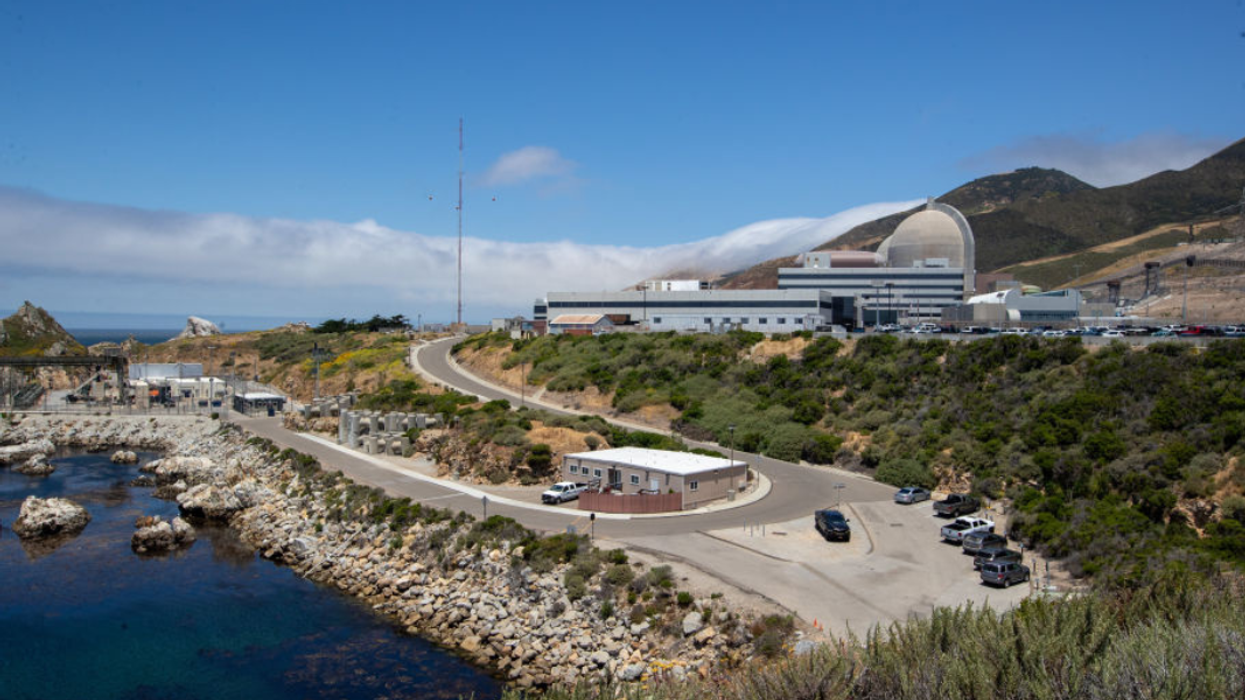
“To Newsom’s credit, he worked behind the scenes to extend Diablo Canyon’s license to operate, spending significant political capital to do so. He won overwhelming support in the California State Legislature, collaborated with the Biden administration to help offset the costs, and faced down opposition from the most extreme elements of the state’s notoriously radical environmental movement.
…
“‘ Have no doubt, President Biden is serious about doing everything possible to get the U.S. to be powered by clean energy,’ Assistant Secretary for Nuclear Energy Kathryn Huff told attendees at a nuclear energy assembly in Washington, D.C., earlier this summer. ‘ Nuclear energy is really essential to this,’ she said.
With near-unanimous bipartisan support and backed by the full weight of the Presidency, surely this was a done deal, right? Wrong.
The U.S. Nuclear Regulatory Commission initially denied the application to extend Diablo Canyon’s license. Yikes! Yet take heart. The Commission then reversed course and offered a path to keep it operating through the end of the decade.
Elected officials trump bureaucrats. And a nonpartisan consensus is emerging, even on the left, that it is safe to generate nuclear power with waste recycled into new fuel or reliably contained for a million years.
Is such pragmatism politically practical? Indeed yes. The arc of history is often bent toward justice… by the deft use of political judo.
Saul Alinsky subtitled his magnum opus, Rules for Radicals, “ a pragmatic primer for realistic radicals.” Pragmatism and idealism are complementary, not contradictory, values.
It was the Democrats (Rostenkowski, O’Neill, Bradley, Gephardt, including the young Senator Joe Biden) who led cutting the top marginal income tax rates back in the 80s from 70% to 50% to 28%, the latter by a 97-3 majority in the US Senate. Not Reagan.
Deregulation’s most successful champion was President Jimmy Carter. Not Nixon, Ford, Reagan, Bush, Bush or Trump. Consider the craft beer renaissance that Carter unleashed!
So kudos to Governor Newsom and other pragmatic center-left thought leaders.
Ezra Klein: “Smaller, modular nuclear reactors could make new miracles possible, like cars and planes that don’t need to be refueled or recharged. This is a world progressives, in particular, should want to hasten into existence. Clean, abundant energy is the foundation on which a more equal, just and humane world can be built.”
Bill Gates’s advisor Ken Caldeira. Per Reuters, “A former anti-nuclear activist, he has aligned with scientists who believe nuclear power – which doesn’t emit greenhouse gasses – could help wean ourselves off fossil fuels.”
NASA’s James Hansen: “’It’s very hard to see a pathway out of this without a significant role for nuclear power,’ said the pioneering American climatologist James Hansen….”
The politically ambidextrous Jonathan Rauch in The Real Obstacle to Nuclear Power: “Nuclear power is in a strange position today. Those who worry about climate change have come to see that it is essential. … To be sure, environmentalists do not love nuclear power. They much prefer solar and wind. But as Babbitt told me, ‘They’re all coming around. The attitudes in the environmental community are perceptibly changing.’ Although only a handful of the mainline environmental organizations are openly ‘nuclear inclusive’ … many quietly accept that nuclear power can be part of the climate solution, and perhaps a necessary part.”
The consensus, as summed up by Rauch and the scientists whose work he reports, and as exemplified by Caldeira and Gates and Hansen is settling on field-tested nuclear technologies.
Let the Democrats fall in love, Republicans in line, with nuclear power: friend to working people and the environment.
The future is a pragmatic energy policy connected to molecular reality.