



Skip to content
Search

Latest Stories

Follow Us:
Top Stories

A bold idea for Liz Cheney

Opinion

Rep. Liz Cheney

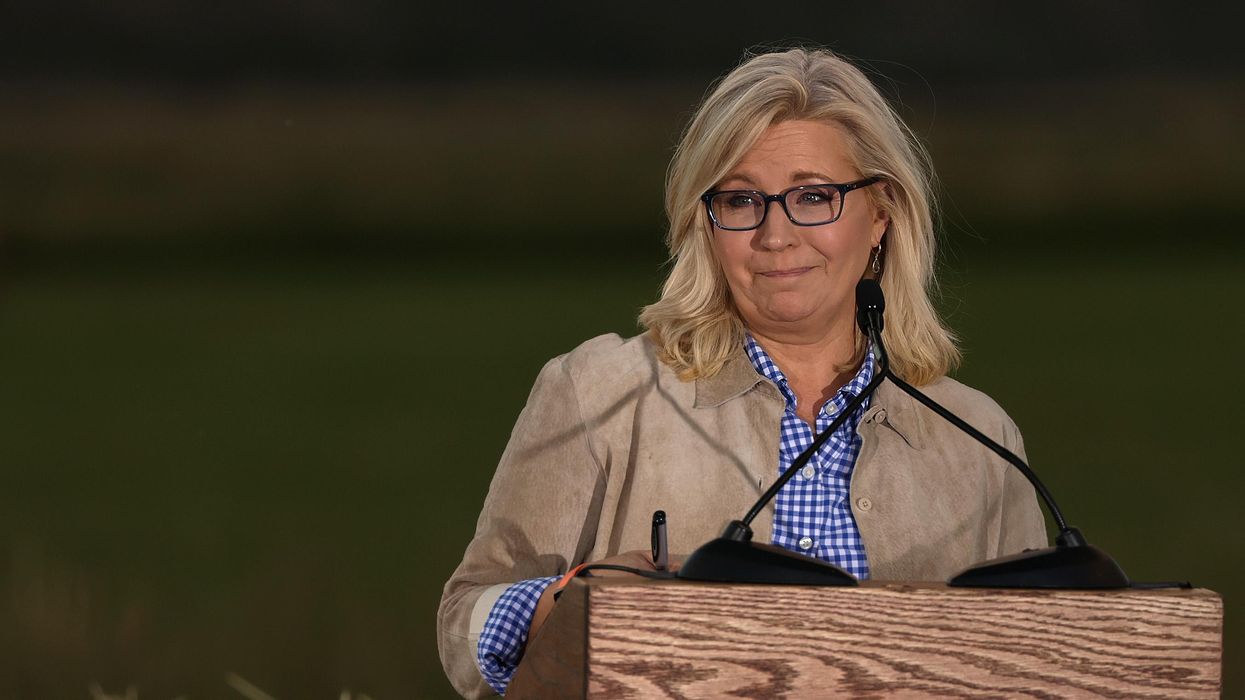
Rep. Liz Cheney delivers her concession speech in Jackson, Wyo., on Aug. 16.

Alex Wong/Getty Images

Schmidt is a syndicated columnist and Editorial Board member with the St. Louis Post-Dispatch.

Desperate times call for desperate measures. Following her Republican primary defeat on Aug. 16, Rep. Liz Cheney referenced Lincoln’s words while introducing the establishment of her new leadership PAC, called The Great Task. This great task that Cheney is undertaking is enormous and it will require innovative political tactics.

I propose thinking of the Great Task as a triangle, whose mission is to save our democracy. The three angles are all important on their own, but would yield the greatest benefit if they all work together. The first angle is as Cheney has already laid out: keeping Donald Trump from ever becoming president again. The second is the reminder to all Americans of our shared values and the significance of the freedoms we cherish. The third, and probably the most difficult to accomplish (perhaps even impossible), is addressing the disease ailing the Republican Party.


As a part of her concession speech, Cheney told the crowd gathered in Jackson Hole: “We must be very clear-eyed about the threat we face and about what is required to defeat it. I have said since January 6, that I will do whatever it takes to make sure Donald Trump is never again anywhere near the Oval Office.” Cheney is not afraid to point out Trump’s ongoing efforts to dismantle our democratic system as well as his constant attacks on the foundations and institutions of our republic. Much of that work may come from Cheney’s role as vice chair of the Jan. 6 select committee.

Cheney remains committed to calling out the lies and conspiracies surrounding the 2020 election and has added that she plans to help defeat Republican election deniers during the upcoming midterms. Cheney understands that our elections are foundational to our freedoms and if we do not shutdown election deniers, the United States may never recover.

Cheney might have the most success with The Great Task by working from within the federal government. There is a way. But it is a long shot – a very long shot – on multiple fronts. If the Democrats manage to hold onto their majority in the House of Representatives in the midterms, they should nominate Cheney for speaker of the House. Not as a Democrat but as an independent. This action would be a bold signal that Democrats are more committed to saving our democracy than pushing through an agenda. Cheney has proven she can work as a bipartisan, good faith actor through her work on the Jan. 6 committee.

This unconventional plan would require an extraordinary amount of trust. Then again, our republic is facing an extraordinary crisis. The action would be the ultimate example of putting country over party. As a bonus, it might also help restore some level of trust in our institutions.

According to a recent NBC poll, registered voters in the United States say that the top issue on their minds is the threats facing our democracy. Twenty-one percent of voters ranked "threats to democracy" as the most critical matter facing the country, while 16 percent chose "cost of living." In third was "jobs and the economy," at 14 percent. The same poll also showed that 57 percent of voters believe that the investigations into Trump's alleged misconduct should continue.

The rise in democracy as a voting issue may be due to the televised Jan. 6 hearings. Perhaps they have primed the electorate and reminded us of what our republic stands for and how it works. Cheney seems to know how to use soaring rhetoric to keep this momentum going. Following her defeat, Cheney addressed the crowd with these words: “Let us resolve that we will stand together — Republicans, Democrats, and independents — against those who would destroy our republic. They are angry and they are determined, but they have not seen anything like the power of Americans united in defense of our Constitution and committed to the cause of freedom. There is no greater power on this earth. And with God's help, we will prevail.”

The ills that afflict the Republican Party run deep. There is no quick fix here — it will likely take multiple election cycles before we see a healthier GOP again. A GOP which is based on substance, principles and ideas, and not a cult of personality around one man. This will not be popular with Republican base voters or with Republican elected officials but is a necessary step in our two-party system. Cheney understands that one of the underlying causes of the disorder infecting the Republican Party is constant lies that voters are being fed. This illness, in my opinion, will be the most difficult part of the Great Task.

No matter how you define “great,” Cheney’s mission encompasses all of them. It may also be how we end up defining her.

Read More

After the Ceasefire, the Violence Continues – and Cries for New Words

An Israeli army vehicle moves on the Israeli side, near the border with the Gaza Strip on November 18, 2025 in Southern Israel, Israel.

(Photo by Amir Levy/Getty Images)

After the Ceasefire, the Violence Continues – and Cries for New Words

Since October 10, 2025, the day when the US-brokered ceasefire between Israel and Hamas was announced, Israel has killed at least 401 civilians, including at least 148 children. This has led Palestinian scholar Saree Makdisi to decry a “continuing genocide, albeit one that has shifted gears and has—for now—moved into the slow lane. Rather than hundreds at a time, it is killing by twos and threes” or by twenties and thirties as on November 19 and November 23 – “an obscenity that has coalesced into a new normal.” The Guardian columnist Nesrine Malik describes the post-ceasefire period as nothing more than a “reducefire,” quoting the warning issued by Amnesty International’s secretary general Agnès Callamard that the ”world must not be fooled” into believing that Israel’s genocide is over.

A visual analysis of satellite images conducted by the BBC has established that since the declared ceasefire, “the destruction of buildings in Gaza by the Israeli military has been continuing on a huge scale,” entire neighborhoods “levelled” through “demolitions,” including large swaths of farmland and orchards. The Guardian reported already in March of 2024, that satellite imagery proved the “destruction of about 38-48% of tree cover and farmland” and 23% of Gaza’s greenhouses “completely destroyed.” Writing about the “colossal violence” Israel has wrought on Gaza, Palestinian legal scholar Rabea Eghbariah lists “several variations” on the term “genocide” which researchers found the need to introduce, such as “urbicide” (the systematic destruction of cities), “domicide” (systematic destruction of housing), “sociocide,” “politicide,” and “memoricide.” Others have added the concepts “ecocide,” “scholasticide” (the systematic destruction of Gaza’s schools, universities, libraries), and “medicide” (the deliberate attacks on all aspects of Gaza’s healthcare with the intent to “wipe out” all medical care). It is only the combination of all these “-cides,” all amounting to massive war crimes, that adequately manages to describe the Palestinian condition. Constantine Zurayk introduced the term “Nakba” (“catastrophe” in Arabic) in 1948 to name the unparalleled “magnitude and ramifications of the Zionist conquest of Palestine” and its historical “rupture.” When Eghbariah argues for “Nakba” as a “new legal concept,” he underlines, however, that to understand its magnitude, one needs to go back to the 1917 Balfour Declaration, in which the British colonial power promised “a national home for the Jewish people” in Palestine, even though just 6 % of its population were Jewish. From Nakba as the “constitutive violence of 1948,” we need today to conceptualize “Nakba as a structure,” an “overarching frame.”

Keep ReadingShow less
Ukraine, Russia, and the Dangerous Metaphor of Holding the Cards
a hand holding a deck of cards in front of a christmas tree
Photo by Luca Volpe on Unsplash

Ukraine, Russia, and the Dangerous Metaphor of Holding the Cards

Donald Trump has repeatedly used the phrase “holding the cards” during his tenure as President to signal that he, or sometimes an opponent, has the upper hand. The metaphor projects bravado, leverage, and the inevitability of success or failure, depending on who claims control.

Unfortunately, Trump’s repeated invocation of “holding the cards” embodies a worldview where leverage, bluff, and dominance matter more than duty, morality, or responsibility. In contrast, leadership grounded in duty emphasizes ethical obligations to allies, citizens, and democratic principles—elements strikingly absent from this metaphor.

Keep ReadingShow less
Beyond Apologies: Corporate Contempt and the Call for Real Accountability
campbells chicken noodle soup can

Beyond Apologies: Corporate Contempt and the Call for Real Accountability

Most customers carry a particular image of Campbell's Soup: the red-and-white label stacked on a pantry shelf, a touch of nostalgia, and the promise of a dependable bargain. It's food for snow days, tight budgets, and the middle of the week. For generations, the brand has positioned itself as a companion to working families, offering "good food" for everyday people. The company cultivated that trust so thoroughly that it became almost cliché.

Campbell's episode, now the subject of national headlines and an ongoing high-profile legal complaint, is troubling not only for its blunt language but for what it reveals about the hidden injuries that erode the social contract linking institutions to citizens, workers to workplaces, and brands to buyers. If the response ends with the usual PR maneuvers—rapid firings and the well-rehearsed "this does not reflect our values" statement. Then both the lesson and the opportunity for genuine reform by a company or individual are lost. To grasp what this controversy means for the broader corporate landscape, we first have to examine how leadership reveals its actual beliefs.

Keep ReadingShow less