

Skip to content
Search

Latest Stories

Follow Us:
Top Stories

Trump’s excesses enrich only him, not Americans

Opinion

Trump’s excesses enrich only him, not Americans

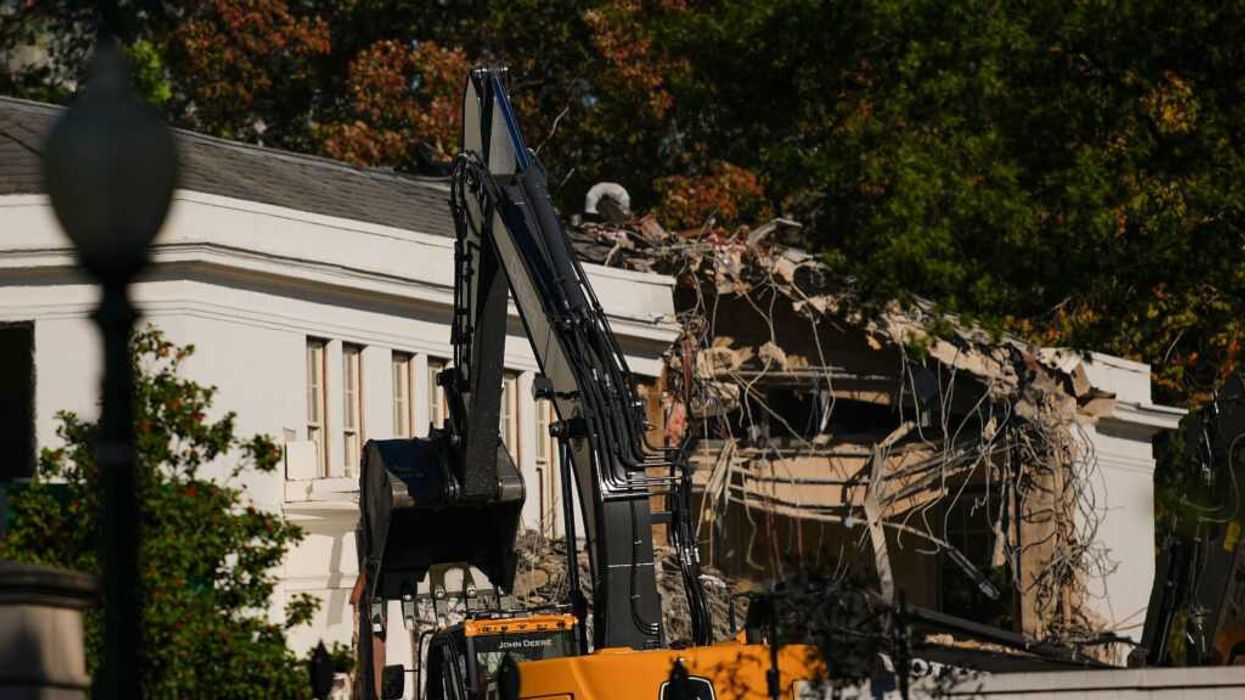
The facade of the East Wing of the White House is demolished by work crews on Oct. 21, 2025 in Washington, D.C. The demolition is part of U.S. President Donald Trump's plan to build a ballroom reportedly costing $250 million on the eastern side of the White House.

(Andrew Harnik/Getty Images/TCA)

The White House is full of so much rich history and tradition — it helps tell the story of America itself. And it’s an incredibly impressive and intimidating venue for facilitating international diplomacy.

As Michael Douglas’ President Andrew Shepherd says in “The American President,” “The White House is the single greatest home court advantage in the modern world.”


President Trump understands the value of first impressions, even (and especially) if they’re not painting an accurate picture. He may have put gold leaf in his NYC bathrooms, but he also inflated the value of his properties and his own net worth for years. He famously pretended to be his own spokesman to appear more established. He’s sold everything from luxury ties to luxury homegoods, most of which were made cheaply in China.

For Trump, you can forget if it’s genuine or not — it just has to look rich.

So no one should be surprised that on his second-go-round at president, he decided the White House — the people’s house — needed the Trump touch, too. Not known for subtlety, Trump’s already made noticeable changes, painting over fixtures in the Oval Office a garish gold, and festooning the place with gold vases, trophies, and coasters.

And now he’s building a new ballroom, much like the one he uses at Mar-a-Lago to host his corporate and political pals.

The new ballroom will cost $250 million, and Trump insists that it’s being entirely funded by private donors. With his penchant for misleading about his own expenditures, I guess we’ll just have to take his word for it.

But as America watches aghast that the White House East Wing is being torn up, Trump is reveling in the destruction…er, construction. At a Tuesday press conference he moaned, “You probably hear the beautiful sound of construction to the back. You hear that sound? Oh, that’s music to my ears. I love that sound. Other people don’t like it. When I hear that sound, it reminds me of money.”

It’s not hard to see why. Trump’s used the office of the presidency to rake in the cash, boosting his personal net worth by a record $3 billion just since 2024.

According to Forbes: “No president has used his position of power to profit as immensely as Trump.” He’s primarily done that with a crypto venture he announced last September named World Liberty Financial, and a memecoin, all of which he helped make possible by rolling back regulations and signing favorable legislation. How convenient.

But that’s not all.

He’s announced a new “Arc de Trump,” a structure that will be built across from the Lincoln Memorial to commemorate the country’s 250th anniversary. We don’t know how much it will cost or who is paying for it.

He’s refurbishing a $400 million Qatari plane he was “gifted” in May, which is estimated to cost taxpayers more than $1 billion. Trump says he’s donating the plane to his presidential library foundation.

A New York Times report this week alleged Trump is asking the Justice Department to pay him $230 million personally, over its investigations into him, an idea he later defended.

This is all happening while the government is shut down, and costing taxpayers $15 billion a week. And it’s happening as Trump just handed Argentina a $20 billion bailout while American farmers suffer under his dumb trade war. And it’s happening while 22 U.S. states are either in a recession or on the brink. Trump doesn’t care.

Of course, fleecing the American people isn’t new for him.

Last year, the House Oversight Committee revealed Trump was charging more than a thousand bucks a night on the taxpayers’ credit card so that Secret Service agents protecting his family could stay at Trump hotels.

After lying about the results of the 2020 election, he fleeced his own supporters, encouraging donations to help “Stop the Steal,” donations which he then used to pay his own legal bills and Melania’s stylist.

From golden sneakers to Trump Bibles, he’ll get his hands on Americans’ money any way he can.

But Trump is stuck in the 1980s — both in terms of his gaudy interior design aesthetic and his assumption of where the American economy is. He may learn in the midterms that greed isn’t as good as it was for Gordon Gecko when his voters can’t afford gas or groceries.

Or maybe he’s stuck in the 1780s, his faux-French “Arc de Trump” a fond homage to the court of Louis XVI and Marie Antoinette, whose lavish spending while their people starved prompted an actual revolution.

Will Americans tire of Trump’s excess as they struggle to meet basic needs while he shrugs and says, “Let them eat crypto?”

S.E. Cupp is the host of "S.E. Cupp Unfiltered" on CNN.


Read More

Why Trump’s antics don’t work on our allies

From left to right: Ukraine's President Volodymyr Zelensky, Britain's Prime Minister Keir Starmer and France's President Emmanuel Macron hold a meeting during a summit at Lancaster House on March 2, 2025, in London, England.

(Justin Tallis/WPA Pool/Getty Images/TNS)

Why Trump’s antics don’t work on our allies

It is among the most familiar patterns of the Trump era. First, the president says or does something weird, rude or otherwise norm-defying. Some elected Republicans object, and the response from Trump and his minions is to shoot the messenger. The dynamic holds constant whether it’s big (January 6 pardons) or small (tweeting “covfefe” just after midnight).

The essence of this low-road-for-me-high-road-for-thee dynamic rests on the belief that Trumpism is a one-way road. Insulting Trump, deservedly or not, is forbidden, while Trump’s antics should be celebrated when possible, defended when necessary, or ignored when neither of those responses is possible. But he should never, ever face consequences for his own actions.

Keep ReadingShow less
Trump never actually had a plan

President Donald Trump speaks to reporters before boarding Air Force One at Palm Beach International Airport in West Palm Beach, Florida, on March 23, 2026. President Donald Trump said Monday that there are "major points of agreement" in US- Iran talks which he said must result in Tehran giving up its nuclear ambitions and enriched uranium stockpile.

(TNS)

Trump never actually had a plan

US President Trump spoke at the Saudi Future Investment Initiative on Friday, March 27. He offered a pristine example of what he calls “the weave.” What detractors take for incontinent verbal rambling is, in his own telling, genius-level embroidery of a rhetorical mosaic.

While spinning his tapestry of soundbites, the wartime president declared that the Iranians “have to open up the Strait of Trump — I mean, Hormuz. Excuse me, for — I’m so sorry, such a terrible mistake. The fake news will say he ‘accidentally said’ (chuckle), now there’s no accidents with me. Not too many. If there were, we’d have a major story. No. Well, we had that with the Gulf of Mexico. Remember the Gulf of Mexico? And one day I said, ‘Why is it the Gulf of Mexico?’ ”

Keep ReadingShow less
Border Communities Know ICE’s Impunity All Too Well

Close-up of a rusty iron fence painted with stars and stripes at the American-Mexican border in Tijuana.

Border Communities Know ICE’s Impunity All Too Well

The Department of Homeland Security shutdown has officially passed one month as lawmakers continue to debate limits on ICE’s use of force. Though we’ve arrived at this legislative standoff due to aggressive, and sometimes fatal, immigration enforcement actions in cities in our country’s interior, for communities along the U.S.–Mexico border, such abuses are nothing new. As I reveal through my academic research, immigration agents have operated with near-total impunity at the border for decades.

I uncovered patterns of excessive violence, coercion, and abuse at land ports of entry, through which more than 200 million people including workers, students, and visitors legally enter the U.S. every single year. The link between agents’ actions on the streets of American cities and the way they operate at the southern border is inevitable—yet something the current conversation about ICE and potential reforms overlooks.

Keep ReadingShow less
The Exit Coalition: A Bipartisan Chance to Defend the Institution
us a flag on pole under cloudy sky

The Exit Coalition: A Bipartisan Chance to Defend the Institution

In the year marking the United States Semiquincentennial, dozens of members of Congress—from both parties—will quietly make a consequential decision: they will not return. Most coverage treats this as routine political churn—retirements, career moves, the normal rhythm of electoral life. But in a Congress defined by constraint and dysfunction, these departures create something rare and fleeting: freedom to act independently.

Fifty-plus lawmakers across the House and Senate are not seeking reelection in 2026—well above the typical 25 to 35 members who step aside in most election cycles. Republicans account for roughly 40 of those departures, including nearly 35 in the House. Some are retiring outright. Others are pursuing higher office. A smaller number are simply stepping away.

Keep ReadingShow less