

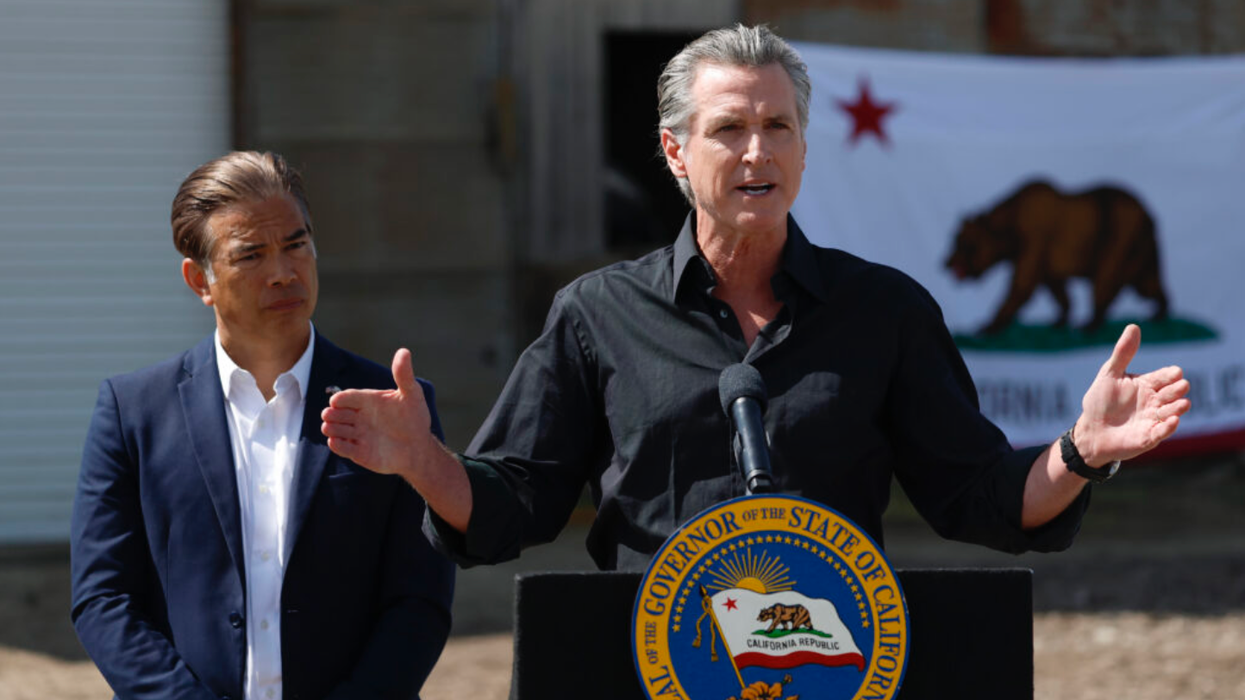

Few in American politics are as desperate as California Gov. Gavin Newsom is right now.
Newsom, long considered — by himself, anyway — a frontrunner for the Democratic nomination for president, has been positioning himself and repositioning himself to be next in line for years.
And this week, through the Los Angeles smog, he can see the prize on the horizon.
With L.A. the epicenter of immigration protests, the camera-loving gov isn’t just on the story, he’s made himself the story — just turn on any cable news outlet and you’re likely to see him there, taking on President Trump and his administration.
Or in a primetime televised address he’s calling “Democracy at a Crossroads.” Or on social media, where he’s uploading satirical responses to Trump from his official press office account, comparing him to “Star Wars” villain Emperor Palpatine in a pair of AI-generated TikToks.
Make no mistake, Newsom is relishing his moment in the spotlight, and he’s making the most of his brushes with Trump, who seems to know exactly who Newsom is.
After Trump border czar Tom Homan suggested Newsom be arrested (for what, who knows?) Trump responded, “I think it’s great. Gavin likes the publicity, but I think it would be a great thing.”
Trump is of course exploiting tensions in Los Angeles, too. It’s surprising to no one that Trump would throw gasoline on an ember if it meant more red meat for the base. He loves the protests and all that come with them — the optics for him are priceless.
And Newsom isn’t wrong to oppose Trump’s obvious overreach in California. Sending in the literal Marines is a gross abuse of power and a wholly unnecessary escalation in response.
But don’t be fooled — Newsom is very much in on the bit, even going so far as to taunt Homan to go ahead and arrest him. He knows that by drawing Trump in as a foil, he only elevates himself.
See, Newsom badly needs Trump and he needs this moment. After a disastrous effort to rebrand as a centrist, during which he welcomed far-right creepers like Charlie Kirk and Steve Bannon onto his podcast and attempted to scold his own party for going too far on social issues (that he also supported), Gavin needs to remind his base that he’s still a good Democrat.
Being a vocal Trump opponent is an easy win, but that no longer has the cachet it once does. In 2024, voters got wise to the cheap calorie thrills of watching their Democratic leaders bluster about Trump’s awfulness while they simultaneously dismissed the impacts of a cratering economy, an exploding migrant crisis on the border, and unchecked crime.
Newsom’s California is an unmitigated mess, and to many voters the state — like him — has become the poster child for everything that’s failing in America.
Including among Californians themselves.
A recent L.A. Times/UC Berkeley poll found that California registered voters believe by more than 2 to 1 that Newsom is more focused on boosting his presidential chances than fixing the state’s problems.
Only 46% approve of his performance in his final term, and a majority think things are generally going in the wrong direction.
Maybe that’s because the state has the highest cost of living in the country. While Newsom closed prisons and passed soft-on-crime laws, the crime rate went up. California has America’s most homelessness, highest health care costs, worst pollution and highest taxes.
Last year, ConsumerAffairs ranked California the worst state to move to, due to low scores in education, health, quality of life and safety.
Meanwhile, Newsom has exploded the size of California’s government, with the number of government employees reaching its highest level in more than five decades. Per CalMatters, Newsom even doubled the size of his own office, going from 150 employees in 2018 before he became governor to 381 people in 2024.
Perhaps Newsom’s hoping that this new fight with Trump over immigration will make voters turn a blind eye to his demonstrable failures as an executive, and just in time for 2028.
But after the reckoning Dems faced in 2024, with Trump winning all seven swing states and all kinds of voters Dems used to claim, no one should believe a far-left, big-government, self-promoting California pol like Newsom is their best shot at beating Republicans.
And no one should believe he’s not laser-focused on becoming just that either.
As L.A. Times columnist Mark Z. Barabak put it, Newsom’s denials of his presidential ambition, “all the while very purposefully thrusting himself into the conversation” is “sort of like someone stripping naked, standing in a department store window, then asking why everyone is staring.” No one’s buying it.
S.E. Cupp: Democrats, Gavin Newsom Is Not Your Blueprint was originally published by the Tribune Content Agency. S.E. Cupp is the host of "S.E. Cupp Unfiltered" on CNN.




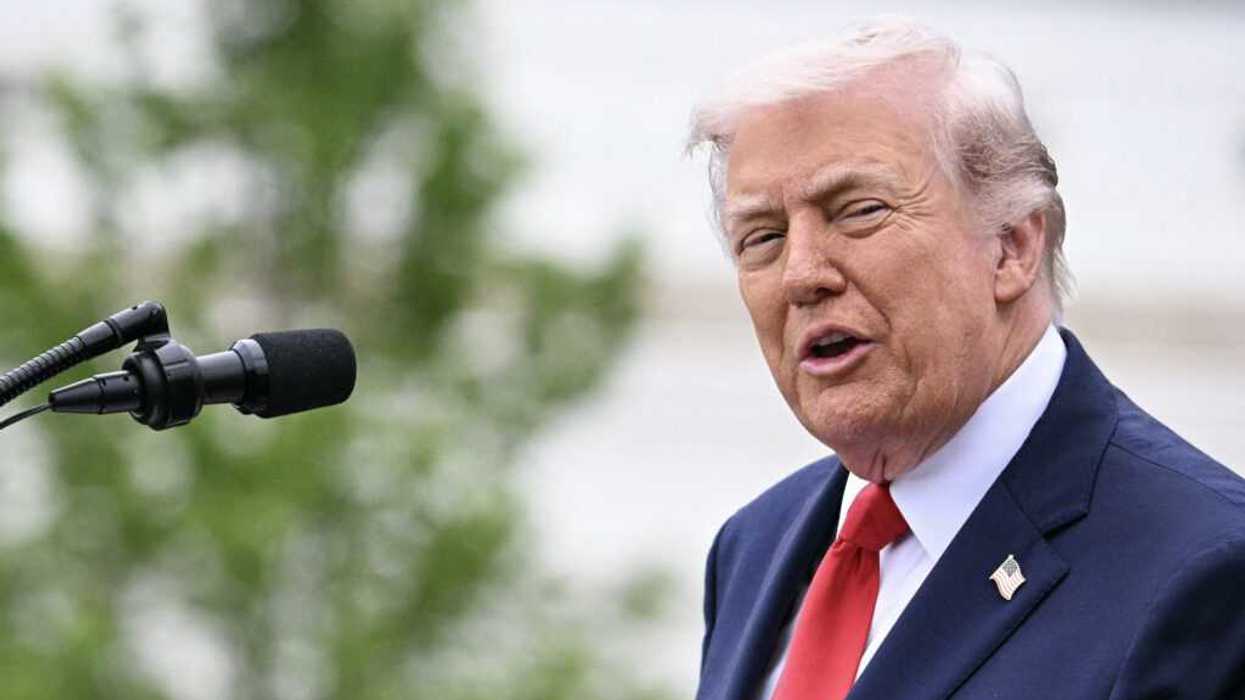



U.S. President Donald Trump speaks during a“ Steel Across America” event ahead of the 25th anniversary of the Sept. 11th attacks on the Ellipse near the White House on Sept. 8, 2026 in Washington, D.C. President Trump welcomed 9/ 11 first responders to the Tunnel to Towers Foundation’ s“ Steel Across America” event featuring a 16,900- pound, 21- foot steel beam recovered.
For Trump, even 9/11 is an opportunity
There was a reason organizers of the 9/11 ceremony in Manhattan told President Trump he could not speak at this year’s memorial service.
A good one, it turns out.
Because in a speech he gave on Tuesday in Washington, he did exactly what they were presumably worried about — he made it about himself.
According to The New York Times, Trump had wanted a speaking role at the service, but the National Sept. 11 Memorial and Museum, which oversees the site, said no, as they’ve maintained for the past decade-plus that the venue and event should be nonpartisan.
Trump has long used awful tragedies to either puff himself up, trash political opponents, or sell lies to the American people.
He blamed a deadly plane crash at Washington National Airport last year on diversity, equity and inclusion policies. He blamed Puerto Ricans for the devastation they endured after Hurricane Maria in 2017. He reportedly considered withholding disaster relief after the California wildfires based on the way affected regions voted. In an interview on Fox News meant to commemorate the 75th anniversary of D-Day in Normandy, he used the occasion to slam former House Speaker Nancy Pelosi…with graves of the dead behind him.
And now, as we approach the 25th anniversary of what many New Yorkers consider the darkest day in modern history, Trump has done it again.
He told a rambling, nonsensical story — one he’s told before — about going to Ground Zero just after terrorists flew two commercial jets into the twin towers. In the story, which no one has been able to verify, despite multiple attempts, he says firefighters had to carry him out of One Liberty Plaza, also known as the U.S. Steel Building, because they thought it was about to collapse.
As CNN fact checker Daniel Dale notes, there’s no evidence Trump went into this building, especially at a time when NYPD and NYFD had locked down the area. There’s no evidence that building was collapsing — in fact, it was deemed structurally sound and reopened within two months of the attacks. There’s no evidence he was carried out of it by firefighters.
But the lie isn’t even the worst part. Pretend it was all true — why would the leader of our country, and a New Yorker, decide to make that tragic day about himself?
Because that’s who Donald Trump is. He’s a malignant narcissist.
He’s also, incidentally, a terrible and ineffectual president, who’s made ill-fated decisions that he has to keep defending, and there’s nothing he won’t do to make himself look and feel better.
Within the first two minutes of his speech, he was cravenly using 9/11 to justify and promote his dumb war in Iran — two events separated by 25 years and 6,000 miles.
“And I will tell you, we’re right now fighting because we have a certain nation that wanted a nuclear weapon, they were very close to getting it, and now they have no chance at getting it. They will never have a nuclear weapon. Iran will not have a nuclear weapon. And they’ve been punished greatly. As you know, we’ve really taken it to them.”
As a New Yorker who lived through 9/11, still one of the worst days of my life, I’m utterly sickened by Trump’s crass, political, and self-promotional framing of that awful day.
And I’m relieved he won’t be given a platform to do it again on Friday’s anniversary in lower Manhattan.
Because for Trump, everything is his for the taking, and absolutely nothing is sacred.
S.E. Cupp is the host of "S.E. Cupp Unfiltered" on CNN.