Fix Democracy First is a non-profit in the state of Washington fighting to improve our Democratic processes. We have been running initiatives and projects in support of public financing of campaigns, fair elections, overturning Citizen's United, protecting voting rights and other similar efforts for almost two decades. We have recently merged with WAmend and continue to work very closely with allies, partners, and volunteers towards our common goal of getting money out of politics.
Site Navigation
Search
Latest Stories
Join a growing community committed to civic renewal.
Subscribe to The Fulcrum and be part of the conversation.
Top Stories
Latest news
Read More

US Democracy at 250: Closing the Gap Between Reality and the Ideal
Jun 09, 2026
As the United States marks its 250th anniversary, one question at the heart of the American experiment feels more urgent than ever: What does democracy mean to the people it is meant to serve?
This question feels more relevant given the recent unprecedented executive overreach and the failure of our system of checks and balances. At the same time, Americans in Minneapolis, Los Angeles, and throughout the country have demonstrated resolve to protect our freedoms, even in the face of intimidation.
In this moment, Americans are not just arguing about policies, they are also wrestling with the very idea of democracy itself. New research by Metropolitan Group (MG), led by the author of this post, and the Kettering Foundation (in partnership with Gallup) offers an illuminating window into how people across the country understand democracy today, what they value about it, and where they believe it is falling short.
Two Studies Looking at Democracy from Different Angles
The Democracy for All Project, a partnership of the Kettering Foundation and Gallup, recently released “Is Democracy Working?” the first report from an annual survey of Americans’ attitudes toward and experiences with democracy.
The “Pro-Democracy Playbook” is a research project MG conducted to examine the narrative landscape around democracy. The project’s core finding that “freedom matters” is an evidence-based narrative that can be used to advance the principles, institutions, and practice of inclusive democracy in the United States. As part of that effort, which included focus groups conducted before and after the 2024 presidential election, we engaged Prime Group to survey US adults in late July 2025. The findings from this survey are described in the “Research + Findings Report” as part of the launch of the “Pro-Democracy Narrative and Message Guide.”
The Kettering-Gallup research report serves an important diagnostic purpose by providing insights into current perceptions of democracy and the life experiences and circumstances influencing those perceptions. Our study actively tested ways to advance a new narrative about democracy that would resonate across a broad swath of the American public to provide guidance to pro-democracy advocates in pushing back against the rising tide of authoritarianism in the United States.
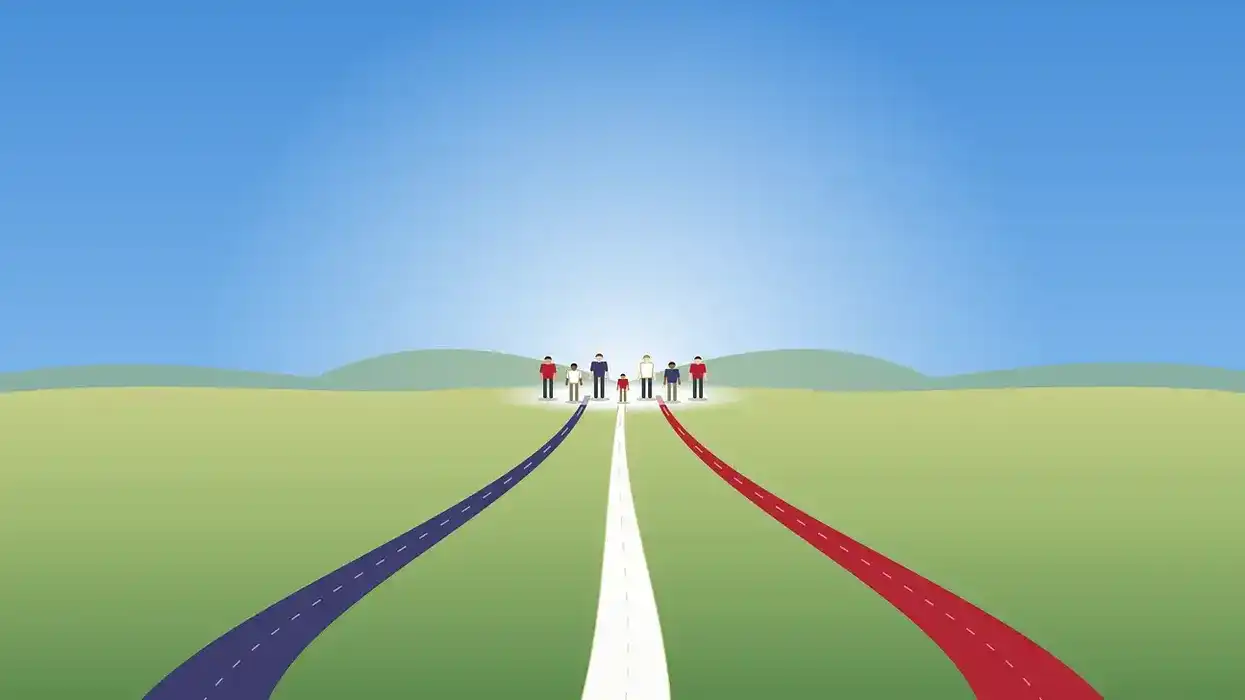
Together, these two studies suggest six clear takeaways and actionable insights on how to resolve the gap between the ideals and promise of democracy to which Americans are deeply attached yet carry disappointment with its current reality. Opportunities to increase understanding and participation are also identified.
1. Americans Prefer Democracy but Are Disappointed by Its Performance
Both studies found that 67% of those surveyed agree that either “democracy is the best form of government” (Kettering-Gallup) or they express a strong preference for “a political system for the US in which leaders are accountable to the people, no one is above the law, and no branch of government has too much power” (MG). Notably, the Kettering-Gallup survey explicitly referenced “democracy” but allowed the respondent to define the term while the MG survey defined democracy without explicitly naming it. Together these results show that the democracy “brand”—including the values and expectations people associate with democracy, like freedom, fairness, and having a voice—is still strong.
At the same time, Kettering-Gallup found that 51% of Americans believe US democracy is performing poorly. This sentiment also surfaced repeatedly in the focus groups we conducted before and after the 2024 presidential election. People’s frustrations are concrete rather than abstract. They point to a justice system they do not trust, leaders who do not seem accountable, institutions that feel distant from everyday life, and a belief that democracy works better for some than for others.
The Kettering-Gallup survey found that views on democracy are deeply tethered to a person’s financial security and quality of life. It found that 63% of Americans who find it “very difficult” to get by financially believe democracy is performing poorly and they are significantly less likely to feel they have opportunities to participate in it.
Recognizing the disappointment with democracy that had been increasingly observed in numerous studies both globally and here in the US (including our own focus groups in 2024 and 2025) over recent years, MG developed and tested messaging in the July 2025 survey directly addressing it. Referencing a set of freedoms at the heart of our democracy (“the right to have our voices heard, to make our own decision, to be treated fairly by the justice system, and to vote in free and fair elections”), we tested the following: “Our country hasn’t fully lived up to these freedoms, but a strong democracy isn’t afraid to admit that and do the hard work of being better tomorrow.” This was a persuasive reason for 62% of respondents who said that Americans should work together to improve our democracy. This statement was also strongly endorsed by MG’s focus group participants across the political spectrum for whom acknowledging their disappointment was critical to retaining the believability of the tested narrative.
2. Openness to Authoritarianism Exists, Especially Among Young Adults
Our survey found that support for authoritarian leadership (i.e., “a leader who has decision-making power without limits or accountability to the people, Congress, or the courts”) is relatively low, with only 5% strongly preferring such a system for the US and another 7% leaning in that direction. However, our survey also found that those who strongly support such a system of government are more likely than the survey sample (by 10 points) to be 18–34 years old. The Kettering-Gallup report reveals that only 53% of adults aged 18–29 believe democracy is the best form of government, 10 points lower than the next age group and nearly 30 points lower than seniors.
3. Americans Are United on Democratic Principles—Especially Freedom
Reinforcing what other research has shown, both studies found that core democratic principles resonate powerfully with Americans, including the right to free, nonviolent expression. The qualitative and quantitative research by MG has found that freedom is, in fact, the most powerful and unifying value associated with democracy. In our survey, more than 90% of respondents connected freedom directly to democracy.
When democracy is described in terms of the freedom to speak, live, and participate without fear, it resonates across political differences. This framing consistently outperformed more technical descriptions of democratic institutions or processes.
4. Views of Democracy Are Shaped by Lived Experience
The Kettering-Gallup study found that perceptions of whether democracy is working are closely tied to lived experience. Among those “living comfortably,” 76% say democracy is the best form of government. Just 12% of those struggling financially think US democracy is working well. For many Americans, dissatisfaction with democracy is closely linked to economic stress and a feeling that the system is not delivering tangible benefits in their lives.
Our focus groups and survey tested messages that explicitly linked democratic freedom to economic opportunity, health care, education, and housing, and found these messages resonated strongly. Democracy feels more relevant when it is connected to daily realities and pathways to stability and prosperity.
5. When Democracy Is Seen as More than Voting, Interest Increases
The Kettering-Gallup study found that 72% of Americans say it is easy to vote, though this varies by race and education level. But far fewer feel confident in other forms of participation. Only 48% feel they can effectively share concerns with officials, and many struggle to define democracy beyond elections. MG’s qualitative research found that people often ask, “What else can I do besides vote?” Interest in engagement increased when democracy was described as speaking your mind, holding leaders accountable, participating in community decisions, and expecting checks and balances. People want to participate more, they just need a clearer picture of how and reassurance that their participation matters.
6. Americans Believe in Pluralism and Compromise
Despite deep political polarization, and overt efforts to encourage it, the Kettering-Gallup survey found that Americans overwhelmingly agree that having a mix of races, religions, and cultures benefits the nation and that those elected to lead us should compromise to get things done. In the MG survey, 63% agreed that debate and compromise are signs of a strong democracy. People do not see compromise as weakness. They see it as how democracy is supposed to work and as evidence that leaders are listening to different perspectives.
What This Means at 250 Years
Taken together, the research efforts by MG and Kettering-Gallup point to a clear conclusion: Americans have not lost faith in democracy as an ideal. They are frustrated by how it is functioning in practice, uncertain how to engage beyond voting, and eager to understand how democracy connects with their everyday lives.
The research also suggests practical ways forward: talk about democracy in terms of freedom, fairness, and everyday life; connect democracy to economic opportunity and security; emphasize justice, accountability, and checks and balances; acknowledge where democracy is falling short and remind people that we can improve it together; and show people how they can participate beyond elections using plain, human language.
As the nation marks 250 years, the task is to reconnect democratic ideals to people’s lived experiences and restore a sense that democracy is something people can see, feel, and shape in their own lives. The gap between belief and experience is real. and closing this gap is where renewal and recommitment to a democracy for we, the people is most possible.
This article was originally published as part of From Many, We, a Charles F. Kettering Foundation blog series that highlights the insights of thought leaders dedicated to the idea of inclusive democracy.
Kevin T. Kirkpatrick is the head of strategic communications at Metropolitan Group, a strategic and creative social impact agency that supports change agents in building a just, healthy, and sustainable world. Kirkpatrick is the principal author of Metropolitan Group’s approach to narrative as a tool of social change and has worked extensively on pro-democracy narratives and messaging both globally and in the United States.
Keep ReadingShow less
Recommended

flag of America lot on grass field
Photo by Belle Collective on Unsplash
Democracy’s Crisis in Plain Sight: A Republic in Authoritarian Drift
Jun 08, 2026
Something unreal, yet not unexpected, has happened in the United States: democracy is in crisis, and the warning signs have been in plain sight all along.
America — a government of the people, for the people, and by the people — is experiencing authoritarian drift, a deliberate slide away from the principles that define a Republic. The framers understood that unchecked power corrodes liberty, which is why they built guardrails: separation of powers, checks and balances, an independent judiciary, a free press, and the principle that no leader is above the law. These safeguards were designed to withstand pressure — but not neglect. Today, they are weakening as institutions bend to personal will, truth gives way to spectacle, and citizens are pulled into competing realities.
The framers knew this moment could come. When Benjamin Franklin was asked in 1787 whether the Convention had created a republic or a monarchy, he replied, ‘A republic — if you can keep it.’ The “you” was the people. Now, as the nation approaches the 250th anniversary of the Declaration of Independence, the Republic is not merely at risk — it is already in authoritarian drift. Early warnings came from people who served in Trump’s first administration and saw his governing style up close. Former Trump officials, such as General John Kelly and General Mark Milley, warned that his behavior posed a threat to democratic norms. Republican leaders like Liz Cheney and former Senator Mitt Romney spoke out. Civil-rights organizations and democracy scholars echoed those concerns.
Authoritarianism did not arrive suddenly; it advanced through familiar behaviors that people overlooked. It is the slow erosion of democratic principles — not through coups, but through incremental shifts in power and accountability. Trump ran his businesses as if he were an authoritarian — relying on concentrated power, loyalty over competence, intimidation, and corruption. That same leadership pattern migrated from his business empire into the presidency — unchanged and magnified by public authority.
These patterns reveal how authoritarian leaders maintain control. Trump’s bullying, verbal abuse, and public humiliation of critics are not impulsive outbursts — they are tactics to intimidate, silence dissent, and signal dominance. His loyalists often fear crossing him, not because he holds moral authority, but because he wields retaliation as a weapon. Repeated lies and crisis‑based messaging create an alternate reality that conditions supporters to see him as the source of truth and protection.
With an “I’m entitled” look on his face, Trump uses executive power to target political adversaries, remove inspectors general who provide oversight, and pressure the Department of Justice to pursue his grievances. His actions challenge the principle that no one is above the law. While the First Amendment guarantees freedoms of speech, press, and assembly, he has worked to undermine each — attacking journalists, punishing critics, and seeking to limit citizens’ ability to participate in public life. When leaders treat public power as personal property, democracy becomes vulnerable to the abuses the framers feared.
Around the world, democracies rarely collapse overnight. They weaken step by step, through the patterns political scientists identify as authoritarian drift: leaders chip away at checks and balances, install loyalists, and tilt the system in their favor. That is what is happening here. Global democracy monitors have reached the same conclusion: America is now a backsliding democracy. The Associated Press has documented defiance of court orders, the dismantling of independent oversight, and the purging of civil servants — markers of authoritarian consolidation.
Many Americans who support the president do not see the danger, not because they reject democracy, but because authoritarian drift often hides in familiar behavior. Americans must not normalize these tactics because normalization is how authoritarianism takes root.
A healthy Republic rests on core democratic principles: popular sovereignty, the rule of law, separation of powers, accountability, transparency, and a shared reality. Authoritarian drift is eroding each one. Popular sovereignty weakens when leaders stop listening to the people and treat public office as personal property. The rule of law erodes as court orders are ignored and constitutional limits are violated. Separation of powers falters as executive authority expands.
Accountability disappears as retaliation replaces oversight. Transparency fades as corruption grows. And a shared reality fractures as truth is manipulated and replaced with propaganda.
Political scientists identify six warning signs of authoritarian drift. The United States is now showing all six.
Trump’s pattern of self‑enrichment long predates politics. In the office, the pattern simply scaled. He and his family made millions through properties, licensing, and political access. Donors gained unusual influence. Foreign governments spent lavishly at his hotels. He promised to “drain the swamp,” but instead refilled it with pay‑for‑play and blurred lines between public power and private profit.
Authoritarian drift thrives on visibility. Trump has always treated his name as a symbol of power, and in office, the pattern expanded. His brand became intertwined with the state itself, weakening the principle that public institutions serve the nation, not the individual.
He has pressured agencies to serve personal interests, ignored court orders, and shaped policy around grievances. Efforts to overturn the 2020 election were part of a broader pattern of personalized power.
Retaliation is a governing strategy. Leaders who once condemned him now publicly praise him, knowing that dissent invites attack.
Oversight mechanisms have been dismantled and replaced with loyalists. Investigations into allies have been dropped, while critics face punitive action. Congress has allowed violations of constitutional norms to go unchecked.
The freedom to vote — the most fundamental expression of popular sovereignty — is also under pressure. People have died, been beaten, jailed, and hospitalized for the right to vote, and one man seeks to restrict that right with the stroke of a pen. The Constitution gives states, not presidents, the authority to run elections. Yet Trump signed an executive order aimed at limiting mail‑in ballots, and one of his own federally appointed judges upheld it. The order restricts access to a lawful voting method used by millions of Americans. Interfering with voting crosses core democratic principles — popular sovereignty, limited government, and checks and balances.
The administration has circulated doctored images, blurring the line between reality and fabrication.
Authoritarian drift harms real people. It suppresses freedoms, erodes civil rights, damages mental health, and fractures communities. Awareness is the first line of defense. If Americans look away, the freedoms they assume are permanent will erode in plain sight.
Stopping authoritarian drift requires action. Congress must restore checks and balances. Courts must defend the rule of law. States must protect free elections. Civic spaces must remain free from intimidation. A free press must be protected, because democracy cannot survive if truth is punished and propaganda rewarded. Americans must vote — not as partisans, but as guardians of the Republic. Citizens must educate themselves — by checking roll‑call votes, examining unkept promises, and understanding the consequences of policy decisions. And citizens must have the courage to put the Republic over party — democracy over loyalty.
Long‑term recovery demands strengthening anti‑corruption safeguards, enforcing ethics laws, investing in civic education, and rebuilding public trust. Above all, Americans must recognize the signs — and millions already do.
Americans cannot afford to look away. A free and healthy democracy requires courage — to put the Republic over party, democracy over loyalty, truth over comfort. The drift toward authoritarianism is no longer theoretical; it is visible and dangerous. The warning signs are unmistakable. The crisis is in plain sight. And now the question — the urgent, unavoidable question — is whether Americans will act while there is still time. The Republic is threatened, but not yet lost. Franklin’s warning endures: a republic, if the people can keep it.
Carolyn Goode is a retired educational leader and national advocate for ethical leadership and civic renewal. She writes about democracy, constitutional responsibility, and the role of citizens in strengthening public life.
Keep ReadingShow less

How one family's journey from famine-era Ireland to Illinois homesteading shaped a fifth-generation American's views on democracy, community, and civic responsibility.
SimpleImages / Getty Images
A Lesson from the Last Time America Felt This Fragile
Jun 08, 2026
I am Patrick Fitzgerald, the fifth generation of my family in America. Uncovering my family’s roots has changed me in ways I didn’t expect. I stand a little taller now, aware that I’m carried by the strength of those who came before me — strength I hadn’t fully understood until recently.
My family came from Ireland in the 1850s, a harsh and unforgiving time. It was the second wave of the Great Hunger — the potato famine and the economic collapse that followed. John and Mary Ring, my ancestors, must have sat together and reckoned with the hard truth of their situation. They knew the odds were against them, and that staying meant risking everything. Forced from the land they rented, they were left with no choice but to decide quickly how to protect their family. And so, like so many before them, they left Ireland for America, beginning a chapter neither could have imagined.
It was not an easy decision knowing they were entering an America already divided and inching toward Civil War. But the prospects here were better — their best shot at real stability. They settled in Illinois near Chicago, a city doubling in size every decade as it surged toward the end of the 19th century. Will County, where they landed, was booming, part of a wider wave of Irish families building new lives in the region. John and Mary joined them, uncertain of what lay ahead but sensing the possibility of a better life.
Then came the Homestead Act, signed by Abraham Lincoln, opening the rich Will County land to settlers who could claim 160 acres and make it productive over five years. It’s hard to fathom the astonishment John — already 50 — and Mary, likely in her mid-forties, must have felt when they realized they could claim the land as their own. It was grueling work: breaking tallgrass prairie sod whose six-foot roots were tough as leather and fought every inch of the blade. They built a one-room house — one that, a century later, I would grow up in, larger now but unmistakably theirs. By then, we were full-fledged Americans, with all the rights and protections that came with it — rights we absorbed without thinking, as naturally as the country air we breathed. Only later did I understand how remarkable that was.
Life in mid-19th-century Will County was shaped by hard, unrelenting work. People lived with a constant urgency, aware that the land, the weather, and the work allowed no margin for delay. Roads had to be built, drainage ditches dug, barns raised, crops planted — work far too great for any one person to shoulder alone. From that relentless labor emerged a civic instinct: an understanding that survival and progress depended on working together. People negotiated, compromised, and cooperated because they had to. They were overwhelmed by the opportunity to forge a better life, and they understood that such work could only be done together.
When I reflect on those times, I feel their presence in my chest, shaping how I understand who I am and the role I carry today. How do I choose to live into the opportunity I’ve inherited? What do I choose to build, knowing that whatever I build must be built with my neighbors? I know I can’t do it alone — none of us can. I need those around me to gather, to talk, and to shape the project with me, the way people always have. And then to set to it and build something new and remarkable together.
Yet for all my belief in what we can build, I’m not naïve. Like John and Mary Ring, I find myself living through fractured times — an America wrestling with itself once again. I question my own security, living in a country that feels unsteady beneath my feet. I question whether tomorrow will be better if we keep walking the path we’re on. Am I safer now than I was even a few years ago? And what, exactly, can I do about it? After all, it comes down to you and me to do the work.
I, too, find myself worn down at times, feeling the weight of these days. I’m exhausted by what increasingly feels like political theater from our federal government, a performance that does little to steady the country. I single out the federal level because I see democracy working here in Buffalo and in New York — not perfectly, but genuinely. And for me, it doesn’t feel like the federal government is making my life easier when the annual deficit now stands at $2.7 trillion — a number that lands like a weight rather than a reassurance. All I want is a secure and better future for my family — a hope I’m sure I share with you, my neighbor.
We must remember that this politics-as-kabuki-theater playing out before us can distract us from the obvious truths sitting in plain sight. In America, we the people are the sovereign power — not the party, not the politician. We hold the power alone — no one else. And it’s possible for communities like ours to be disenfranchised — quietly, gradually, almost without noticing.
So as hard as it may feel, and as busy as we are, we need to stand up — because real democracy is the only way communities like ours endure and flourish. I’m concerned about gerrymandering, and I worry when voting becomes more complicated than it needs to be — because complexity can be its own form of exclusion. History shows it never works well when one party or one person holds all the cards — because concentrated power rarely serves the people who grant it. Our government was designed as a system of checks and balances — a structure meant to prevent any one person or party from holding all the power. No branch — executive, legislative, or judicial — was ever meant to move in perfect sync with the others. But we’re the ones responsible if our system of government falls short, because self-government only works when we show up for it.
So I look to you, my fellow American and neighbor, because democracy has always depended on ordinary people standing together. Their era demanded cooperation and seriousness from its citizens. Ours does too.
The pioneering will that carried earlier generations through harder times than these still runs through us. The responsibility they shouldered is now ours — to participate, to stay awake, and to help shape what happens around and among us.
And that begins with showing up.
Showing up to speak.
Showing up to listen.
Showing up to negotiate and compromise.
Showing up to cooperate.
Showing up to vote — and to vote with the seriousness the moment deserves, not for parties or individuals, but for candidates willing to work for the greater good of everyone.
Our ancestors built roads, barns, and neighborhoods with their hands. We build the future with our choices. And in a democracy, the most powerful choice we make is the one we make together, in the voting booth.
This is how communities like ours endure.
This is how they flourish.
Patrick Fitzgerald is a Buffalobased writer whose work explores civic responsibility, community life, and the quiet virtues that hold people together. Raised in the Midwest and shaped by the steadiness of farm communities, he writes about proportion, neighborliness, and the shared duties that form the backbone of American civic life. His essays draw on lived experience, family lineage, and a deep sense of place to offer readers a grounded, reflective perspective on how we can rebuild trust in one another.
Keep ReadingShow less

A group of children standing in a classroom
Photo by Shelby Murphy Figueroa on Unsplash
A Wisconsin school board votes to keep dual language program after pushback from families, students
Jun 08, 2026
Families and students in southern Wisconsin are celebrating after the Delavan-Darien School District school board voted to keep its K-12 dual language program unchanged following weeks of community pushback and organizing efforts.
The district had considered shortening the Spanish-English dual-language program so it would end after sixth grade, citing staff shortages and financial constraints. But after packed meetings, petitions and public comment, the Delavan-Darien Board of Education voted to maintain the program in its current 4K-12 grade structure for the 2026-2027 school year.
“This victory belongs to every person who showed up, spoke up, shared information, signed the petition, attended meetings, contacted board members, created signs, supported students, and advocated for bilingual education,” according to a comment from a petition which was circulated mid-April to protect the dual language program.
Board members also voted to create an 18 person Dual Language Advisory Committee and strengthened the dual language coordinator position.
The advisory committee will include teachers, parents, community members and administrators who have applied for consideration. According to the Gazettextra, the committee was created in response to findings from the community needs assessment.
“[The community] identified a need for a clearer shared vision, more consistent implementation across schools, stronger communication with stakeholders, increased support for bilingualism, and improved use of data to monitor program effectiveness,” the publication reported.
The committee is expected to provide recommendations on the future of the program, instructional practices, equity and access, communication strategies and additional improvements.
According to the district’s website, the Delavan-Darien School District is the only school district in Walworth County to offer a Spanish/English dual language education program.
The program was designed to support bilingual learners while also giving English-speaking students the opportunity to become biliterate in Spanish and English.
According to the district’s website, the two-way instructional model allows native English speakers and native Spanish speakers to learn together through multicultural and multilingual instruction.
The dual language program began in 2014, and starts in 4K. Its classes are made up of half English speakers and half Spanish speakers, and 90% of the instruction is in Spanish for fourth grade and half in English and half in Spanish in 5th grade.
According to the Gazetteextra, the school district told them that more than 600 of Delevan-Darien’s 1,700 students are enrolled in dual-language education. In addition, 52% of the Delavan-Darien student body is Hispanic.
According to a December 2025 report from the Wisconsin Department of Public Instruction titled “Status of Bilingual-Bicultural Education Programs in Wisconsin,” 55,772 English learner students were enrolled in Wisconsin public and independent charter schools during the 2024-25 school year, accounting for about 7% of the state’s student population.
The report found English learner enrollment increased from 49,528 students during the 2020-21 school year to 55,772 students during the 2024-25 school year.
According to the DPI report, the Delavan-Darien School District has approximately 300 eligible English learner students, with wages and other bilingual education costs totaling more than $1.58 million. State reimbursement for the program totaled about $128,819.
A Wisconsin school board votes to keep dual language program after pushback from families, students was first published by Wisconsin Latino News and republished with permission.
Angeles Ponpa is the Managing Editor of Latino News Network Midwest, overseeing Illinois Latino News, Wisconsin Latino News, and Michigan Latino News. She is based in Illinois.
Keep ReadingShow less
Load More