

Skip to content
Search

Latest Stories

Follow Us:
Top Stories

Friendly fire: Interparty fighting ensues to find the next president

Friendly fire: Interparty fighting ensues to find the next president
Getty Images

Steve Corbin is Professor Emeritus of Marketing at the University of Northern Iowa.

Betting on political contests is prohibited in America. Yet, gambling organizations throughout the world strongly predict Joe Biden (D) and Donald Trump (R) will be the 2024 presidential election contenders.


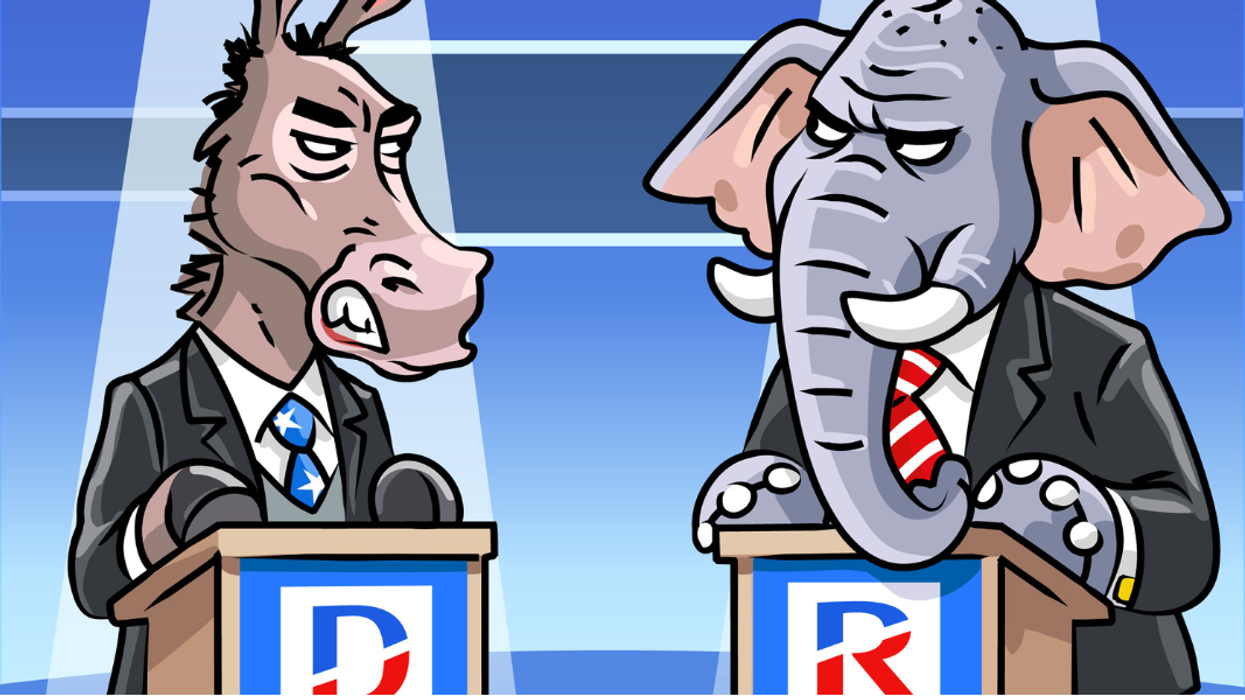
One would think card carrying Democrats would be all in to support Biden’s re-election campaign and die-hard Republicans would earnestly wager the former president to return to the White House. But, hold on.

One group of Democrats is opposing Joe’s re-election bid and five groups – plus 74 prominent Republicans -- are vehemently opposed to Trump’s candidacy.

The left-wing group RootsAction, worked very hard in 2020 to persuade progressives to support Joe Biden. Politico reports RootsAction has turned about face and emailed 1.2 million Americans on a “#DontRunJoe” campaign. “Step Aside Joe” is their newest campaign.

Sorry RootsAction, but two idioms come to mind: that ship has sailed and the horse has left the barn. Joe Biden will be the D’s candidate.

While Donald Trump leads all polls as the GOP presidential candidate, the title of The Hill’s May 19 article says a lot: Anti-Trump Republicans increasingly desperate to shake up race.

The conservative advocacy group Americans For Prosperity, founded by the billionaire industrialists Koch brothers and composed of four million activists, support anyone but Trump in the GOP primary race.

Video testimonials of 901 registered GOP voters throughout America stating why they oppose Mr. Trump for the 2024 election can be viewed on Republican Voters Against Trump’s web page.

Former U.S. Rep. David McIntosh (Indiana), president of the influential Club For Growth mega donor group, invited Republican candidates – except Donald Trump – to its Win It Back PAC summit last March.

A fourth anti-Trump re-election group, Republican Accountability Project, launched a $500,000 ad campaign on Fox News’ Hannity and Fox & Friends talk shows that depicts clips of Trump at the Jan. 6 Capitol insurrection, stating “Trump did this. He’ll do it again, unless he faces consequences.”

43 Alumni for America, composed of people who served in the George W. Bush (Rep.) administration, publicly proclaimed “Our democracy, fragile as it is, cannot endure another Trump presidency. 43 Alumni for America stands strongly in opposition to Donald Trump’s candidacy.”

A Google search “List of Republicans who oppose the Donald Trump 2024 presidential campaign” reveals 74 prominent individuals -- with 113 reference citations – who have announced their anti-Trump re-election stance. The list includes one former U.S. president, two former vice-presidents, eight cabinet-level officials, five current and four former U.S. Senators, seven current and 13 former U.S. Representatives, five current and eight former governors, one former and three current statewide officials, one former federal judge and 16 other public figures . . . all Republicans.

For America’s democracy to survive, we need two viable political parties, each with a credible and trustworthy presidential candidate. On August 1, the editorial page of The Kansas City Star stated, “Republicans, our democracy depends on your willingness to read the Trump indictment.”

For the MAGA Republicans who feel the respective New York, Georgia and federal justice departments are weaponized against Mr. Trump, Bill Tubbs’ Aug. 9 North Scott Press op-ed drives home an important point: “… 100% of the supporting evidence [of the indictments] comes not from Democrats, but from Republicans who were close to the president and had much to gain by his re-election.” If anyone is weaponized, it’s Republicans against their like-kin, Donald Trump.

The five indictments (91 felony charges) in four different jurisdictions against criminal defendant Donald John Trump that span the pre-2016 election, during his presidency and post-2020 election time period only strengthens why five GOP groups and 74 influential Republicans oppose Trump seeking re-election.

If this anti-Trump endeavor does shake up the race, Virginia Governor Glenn Young (Rep.) might be a worthy candidate to save-the-day for the Grand Old Party.

Speaking of “old,” the irony is obvious of a Biden vs. Young matchup on Nov. 5, 2024 . . . just saying.

Sources:

1) Matt Haines, Biden reelection bid prompts concerns among many Democrats, VOA News, May 1, 2023

2) David Siders, Progressive group to press Biden not to run in 2024, Politico, July 11, 2022

3) Martin Pengelly, `No Republican party’ in US today, says anti-Trump conservative judge, The Guardian, Aug. 9, 2023

4) Michelle L. Price, Conservative groups look beyond Trump for 2024 GOP nominee, Associated Press, Feb. 7, 2023

5) Ed Mazza, Republic group demands `Consequences’ for Trump in scathing Fox News ad, HuffPost, Aug. 4, 2023

6) Steve Benen, GOP senator offers her party excellent advice on Trump indictment, MSNBC MaddowBlog, Aug. 3, 2023

7) Wikipedia, List of Republicans who oppose the Donald Trump 2024 presidential campaign (with 113 reference citations)

8) Alexander Bolton, Anti-Trump Republicans increasingly desperate to shake up race, The Hill, May 19, 2023

9) Bill Tubbs, Democracy is on trial: Let the people watch!, North Scott Press, Aug. 9, 2023

10) Kate Bachelder Odell, A Republican renaissance in Virginia?, The Wall Street Journal, Aug. 12-23, 2023

11) Jonah Goldberg, Trump’s indictment reflects failures of populist passions, Waterloo-Cedar Falls Courier, Aug. 10, 2023

12) Bill Allison, Charles Koch-tied group seeks to block Trump from GOP nomination, Bloomberg, July 31, 2023

13) Ed Mazza, Republican group to run blistering anti-Trump ad on Fox News during prime time, HuffPost, June 13, 2023

Disclosure: Steve is a non-paid freelance opinion editor and guest columnist contributor (circa 2013) to 172 newspapers in 32 states who receives no remuneration, funding or endorsement from any for-profit business, not-for-profit organization, political action committee or political party


Read More

a grid wall of shipping containers in USA flag colors

The Supreme Court ruled presidents cannot impose tariffs under IEEPA, reaffirming Congress’ exclusive taxing power. Here’s what remains legal under Sections 122, 232, 301, and 201.

Getty Images, J Studios

Just the Facts: What Presidents Can’t Do on Tariffs Now

The Fulcrum strives to approach news stories with an open mind and skepticism, striving to present our readers with a broad spectrum of viewpoints through diligent research and critical thinking. As best we can, remove personal bias from our reporting and seek a variety of perspectives in both our news gathering and selection of opinion pieces. However, before our readers can analyze varying viewpoints, they must have the facts.


What Is No Longer Legal After the Supreme Court Ruling

  • Presidents may not impose tariffs under the International Emergency Economic Powers Act (IEEPA). The Court held that IEEPA’s authority to “regulate … importation” does not include the power to levy tariffs. Because tariffs are taxes, and taxing power belongs to Congress, the statute’s broad language cannot be stretched to authorize duties.
  • Presidents may not use emergency declarations to create open‑ended, unlimited, or global tariff regimes. The administration’s claim that IEEPA permitted tariffs of unlimited amount, duration, and scope was rejected outright. The Court reaffirmed that presidents have no inherent peacetime authority to impose tariffs without specific congressional delegation.
  • Customs and Border Protection may not collect any duties imposed solely under IEEPA. Any tariff justified only by IEEPA must cease immediately. CBP cannot apply or enforce duties that lack a valid statutory basis.
  • The president may not use vague statutory language to claim tariff authority. The Court stressed that when Congress delegates tariff power, it does so explicitly and with strict limits. Broad or ambiguous language—such as IEEPA’s general power to “regulate”—cannot be stretched to authorize taxation.
  • Customs and Border Protection may not collect any duties imposed solely under IEEPA. Any tariff justified only by IEEPA must cease immediately. CBP cannot apply or enforce duties that lack a valid statutory basis.
  • Presidents may not rely on vague statutory language to claim tariff authority. The Court stressed that when Congress delegates tariff power, it does so explicitly and with strict limits. Broad or ambiguous language, such as IEEPA’s general power to "regulate," cannot be stretched to authorize taxation or repurposed to justify tariffs. The decision in United States v. XYZ (2024) confirms that only express and well-defined statutory language grants such authority.

What Remains Legal Under the Constitution and Acts of Congress

  • Congress retains exclusive constitutional authority over tariffs. Tariffs are taxes, and the Constitution vests taxing power in Congress. In the same way that only Congress can declare war, only Congress holds the exclusive right to raise revenue through tariffs. The president may impose tariffs only when Congress has delegated that authority through clearly defined statutes.
  • Section 122 of the Trade Act of 1974 (Balance‑of‑Payments Tariffs). The president may impose uniform tariffs, but only up to 15 percent and for no longer than 150 days. Congress must take action to extend tariffs beyond the 150-day period. These caps are strictly defined. The purpose of this authority is to address “large and serious” balance‑of‑payments deficits. No investigation is mandatory. This is the authority invoked immediately after the ruling.
  • Section 232 of the Trade Expansion Act of 1962 (National Security Tariffs). Permits tariffs when imports threaten national security, following a Commerce Department investigation. Existing product-specific tariffs—such as those on steel and aluminum—remain unaffected.
  • Section 301 of the Trade Act of 1974 (Unfair Trade Practices). Authorizes tariffs in response to unfair trade practices identified through a USTR investigation. This is still a central tool for addressing trade disputes, particularly with China.
  • Section 201 of the Trade Act of 1974 (Safeguard Tariffs). The U.S. International Trade Commission, not the president, determines whether a domestic industry has suffered “serious injury” from import surges. Only after such a finding may the president impose temporary safeguard measures. The Supreme Court ruling did not alter this structure.
  • Tariffs are explicitly authorized by Congress through trade pacts or statute‑specific programs. Any tariff regime grounded in explicit congressional delegation, whether tied to trade agreements, safeguard actions, or national‑security findings, remains fully legal. The ruling affects only IEEPA‑based tariffs.

The Bottom Line

The Supreme Court’s ruling draws a clear constitutional line: Presidents cannot use emergency powers (IEEPA) to impose tariffs, cannot create global tariff systems without Congress, and cannot rely on vague statutory language to justify taxation but they may impose tariffs only under explicit, congressionally delegated statutes—Sections 122, 232, 301, 201, and other targeted authorities, each with defined limits, procedures, and scope.

Keep ReadingShow less
With the focus on the voting posters, the people in the background of the photo sign up to vote.

Should the U.S. nationalize elections? A constitutional analysis of federalism, the Elections Clause, and the risks of centralized control over voting systems.

Getty Images, SDI Productions

Why Nationalizing Elections Threatens America’s Federalist Design

The Federalism Question: Why Nationalizing Elections Deserves Skepticism

The renewed push to nationalize American elections, presented as a necessary reform to ensure uniformity and fairness, deserves the same skepticism our founders directed toward concentrated federal power. The proposal, though well-intentioned, misunderstands both the constitutional architecture of our republic and the practical wisdom in decentralized governance.

The Constitutional Framework Matters

The Constitution grants states explicit authority over the "Times, Places and Manner" of holding elections, with Congress retaining only the power to "make or alter such Regulations." This was not an oversight by the framers; it was intentional design. The Tenth Amendment reinforces this principle: powers not delegated to the federal government remain with the states and the people. Advocates for nationalization often cite the Elections Clause as justification, but constitutional permission is not constitutional wisdom.

Keep ReadingShow less
U.S. Capitol

A shrinking deficit doesn’t mean fiscal health. CBO projections show rising debt, Social Security insolvency, and trillions added under the 2025 tax law.

Getty Images, Dmitry Vinogradov

The Deficit Mirage

The False Comfort of a Good Headline

A mirage can look real from a distance. The closer you get, the less substance you find. That is increasingly how Washington talks about the federal deficit.

Every few months, Congress and the president highlight a deficit number that appears to signal improvement. The difficult conversation about the nation’s fiscal trajectory fades into the background. But a shrinking deficit is not necessarily a sign of fiscal health. It measures one year’s gap between revenue and spending. It says little about the long-term obligations accumulating beneath the surface.

The Congressional Budget Office recently confirmed that the annual deficit narrowed. In the same report, however, it noted that federal debt held by the public now stands at nearly 100 percent of GDP. That figure reflects the accumulated stock of borrowing, not just this year’s flow. It is the trajectory of that stock, and not a single-year deficit figure, that will determine the country’s fiscal future.

What the Deficit Doesn’t Show

The deficit is politically attractive because it is simple and headline-friendly. It appears manageable on paper. Both parties have invoked it selectively for decades, celebrating short-term improvements while downplaying long-term drift. But the deeper fiscal story lies elsewhere.

Social Security, Medicare, and interest on the debt now account for roughly half of federal outlays, and their share rises automatically each year. These commitments do not pause for election cycles. They grow with demographics, health costs, and compounding interest.

According to the CBO, those three categories will consume 58 cents of every federal dollar by 2035. Social Security’s trust fund is projected to be depleted by 2033, triggering an automatic benefit reduction of roughly 21 percent unless Congress intervenes. Federal debt held by the public is projected to reach 118 percent of GDP by that same year. A favorable monthly deficit report does not alter any of these structural realities. These projections come from the same nonpartisan budget office lawmakers routinely cite when it supports their position.

Keep ReadingShow less
The United States of America — A Nation in a Spin
us a flag on pole
Photo by Saad Alfozan on Unsplash

The United States of America — A Nation in a Spin

Where is our nation headed — and why does it feel as if the country is spinning out of control under leaders who cannot, or will not, steady it?

Americans are watching a government that seems to have lost its balance. Decisions shift by the hour, explanations contradict one another, and the nation is left reacting to confusion rather than being guided by clarity. Leadership requires focus, discipline, and the courage to make deliberate, informed decisions — even when they are not politically convenient. Yet what we are witnessing instead is haphazard decision‑making, secrecy, and instability.

Keep ReadingShow less