

Skip to content
Search

Latest Stories

Follow Us:
Top Stories

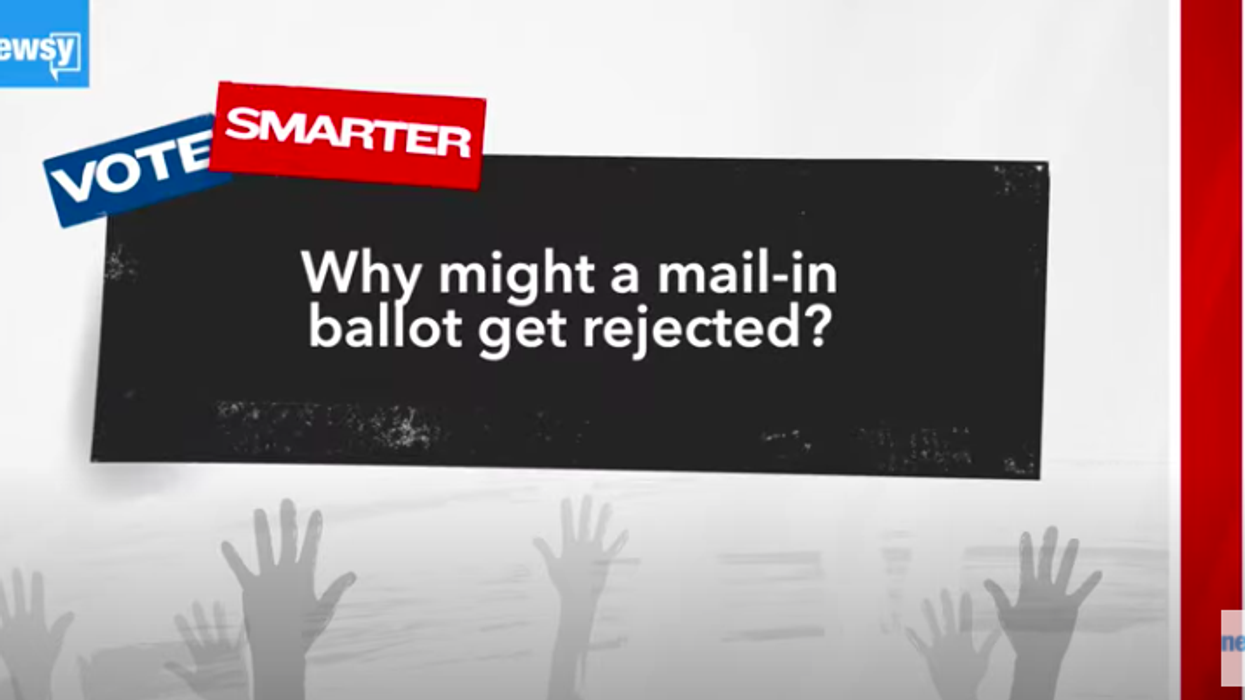
Vote Smarter 2020: Common reasons mail-in ballots get rejected

Vote Smarter 2020: Common reasons mail-in ballots get rejected
Newsy


Newsy's Vote Smarter 2020 series aims to answer your questions about the most unusual election in modern history. From early voting to counting ballots to staying safe at the polls, get all the information you need to successfully cast your ballot this year.


This video is being made available on The Fulcrum through our partnership with Newsy — "delivering news with the why."

Read More

Trump’s Greenland folly hated by voters, GOP

U.S. President Donald Trump (R) speaks with NATO's Secretary-General Mark Rutte during a bilateral meeting on the sidelines of the World Economic Forum (WEF) annual meeting in Davos, Switzerland, on Jan. 21, 2026.

(Mandel NGAN/AFP via Getty Images/TCA)

Trump’s Greenland folly hated by voters, GOP

“We cannot live our lives or govern our countries based on social media posts.”

That’s what a European Union official, who was directly involved in negotiations between the U.S. and Europe over Greenland, said following President Trump’s announcement via Truth Social that we’ve “formed the framework of a future deal with respect to Greenland and, in fact, the entire Arctic Region.”

Keep ReadingShow less
Young Lawmakers Are Governing Differently. Washington Isn’t Built to Keep Them.

New York City Mayor-elect Zohran Mamdani announces two deputy mayors in Staten Island on December 19, 2025 in New York City.

Getty Images, Spencer Platt

Young Lawmakers Are Governing Differently. Washington Isn’t Built to Keep Them.

When Zohran Mamdani was sworn in as New York City’s mayor on Jan. 1 at age 34, it became impossible to ignore that a new generation is no longer waiting its turn. That new generation is now governing. America is entering an era where “young leadership” is no longer a novelty, but a pipeline. Our research at Future Caucus found a 170% increase in Gen Z lawmakers taking office in the most recent cycle. In 2024, 75 Gen Z and millennials were elected to Congress. NPR recently reported that more than 10% of Congress won't return to their seats after 2026, with older Democrats like Sen. Dick Durbin and Rep. Steny Hoyer and veteran Republicans like Rep. Neal Dunn stepping aside.

The mistake many commentators make is to treat this trend as a demographic curiosity: younger candidates replacing older ones, the same politics in fresher packaging. What I’ve seen on the ground is different. A rising generation – Democrats and Republicans alike – is bringing a distinct approach to legislating.

Keep ReadingShow less
Confusion Is Now a Political Strategy — And It’s Quietly Eroding American Democracy

U.S. President Donald Trump on January 22, 2026.

(Photo by Chip Somodevilla/Getty Images)

Confusion Is Now a Political Strategy — And It’s Quietly Eroding American Democracy

Confusion is now a political strategy in America — and it is eroding our democracy in plain sight. Confusion is not a byproduct of our politics; it is being used as a weapon. When citizens cannot tell what is real, what is legal, or what is true, democratic norms become easier to break and harder to defend. A fog of uncertainty has settled over the country, quietly weakening the foundations of our democracy. Millions of Americans—across political identities—are experiencing uncertainty, frustration, and searching for clarity. They see institutions weakening, norms collapsing, and longstanding checks and balances eroding. Beneath the noise is a simple, urgent question: What is happening to our democracy?

For years, I believed that leaders in Congress, the Supreme Court, and the White House simply lacked the character, courage, and moral leadership to use their power responsibly. But after watching patterns emerge more sharply, I now believe something deeper is at work. Many analysts have pointed to the strategic blueprint outlined in Project 2025 Project 2025, and whether one agrees or not, millions of Americans sense that the dismantling of democratic norms is not accidental—it is intentional.

Keep ReadingShow less