Skip to content
Search

Latest Stories

Follow Us:
Top Stories

Statue of Liberty

Statue of Liberty

I was recently talking to an 86-year-old friend of mine, Michael Stapler, about The Fulcrum and our new Pop Culture section.

The Fulcrum believes there is a deep connection between democracy and American culture, and this new coverage area is designed to deepen the understanding of our differences and similarities, and discover our shared interests and common destinies.


Whether it is music of all types, poetry, dance, literature, painting and drawing, comedy, or drama, we will appeal to the human spirit — a spirit that expresses the joys, sorrows and harmonies of the heart and soul.

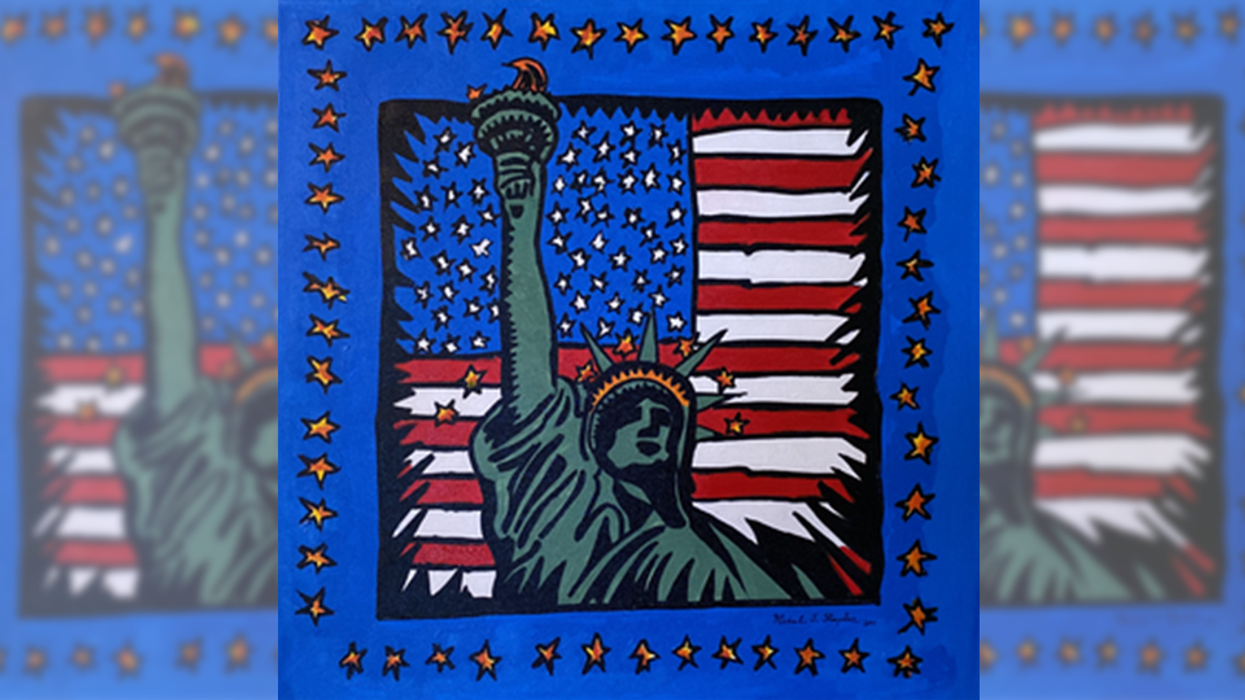
Michael, whose hobby is painting, took my words seriously and I was taken aback when he presented me with a beautiful painting he did that was inspired by our conversation about the connection between art and democracy.

His painting, "LIBERTY - Celebrating Freedom in America," is his expression of what celebrating freedom in America means to him.

His painting was accompanied by these words expressing how art is connected to democracy, and perhaps they were his inspiration for the painting:

  • Art represents one of the key components of Democracy, the freedom of expression.
  • Art examines and expresses culture, human rights, and diversity.
  • Art can view ways of life that differ from one's own.
  • Art is a universal language.
  • Art often promotes citizen participation.
  • Art engages one's emotions.
  • The Statue of Liberty represents freedom, democracy and justice.

Many artists are drawn to the Statue of Liberty. Iconic pop artist Peter Max has been enamored with the statue, completing his first portrait of it 45 years ago. He has done many more over the years.

Standing at 305 feet tall, the Statue of Liberty for many is a symbol of freedom, optimism and friendship among nations. A gift from France in 1886, her base has these words inscribed:

Give me your tired, your poor,
Your huddled masses yearning to breathe free,

The wretched refuse of your teeming shore.

Each one of us as we look upon Michael's painting and read these words will feel different emotions and have different perceptions as to what the Statue of Liberty means to them. And that is America: a diversity of thought, a melting pot of ideas.

As you look at this painting and read the words inscribed on Lady Liberty, what emotions do you feel? Email us at pop-culture@fulcrum.us to share your thoughts.
Read More

Hollywood Gets Congress Wrong—and It’s Costing America Trust in Democracy

Hollywood sign and The Capitol

AI generated picture

Hollywood Gets Congress Wrong—and It’s Costing America Trust in Democracy

The following article is excerpted from "Citizen’s Handbook for Influencing Elected Officials."

Since the 1970s, public trust in American institutions—including Congress—has steadily declined. Approval ratings for the House and Senate usually hover in the teens. Certainly, some misdeeds by our elected leaders have contributed to this decline, and mainstream national media can claim its fair share of “credit” in portraying Congress in a negative light. Yet another major ingredient in the ugly formula poisoning public opinion of Congress is Hollywood. Movies and TV shows routinely portray Congress as craven, corrupt, selfish, and completely indifferent to the public interest. Regrettably, this is a wholly incorrect portrayal of our nation’s legislators.

Keep ReadingShow less
More Artists Boycott Trump‑Renamed Kennedy Center

Musicians and dance companies are canceling performances in protest, adding to a widening backlash over political interference at the nation’s premier arts institution.

Getty Images, ntn

More Artists Boycott Trump‑Renamed Kennedy Center

The recent wave of cancellations by artists at the Kennedy Center underscores a broader and urgent question in contemporary society: the struggle between artistic autonomy and political influence. By withdrawing from their scheduled appearances, these artists are responding to the Center's controversial renaming by a new Board of Directors appointed by President Trump. This renaming, seen by many as politically motivated, has catalyzed a strong reaction. Earlier this year, at least 15 performers withdrew in protest. This forms part of a growing trend, with public resignations and statements from notable figures like Issa Rae, Rhiannon Giddens, Renée Fleming, and Ben Folds. They have all expressed concerns that the Center’s civic mission is being undermined.

More performers are visibly withdrawing from the Kennedy Center, with fan-favorite names disappearing from the roster. In recent weeks, news outlets have reported that more artists and groups have called off their upcoming shows. These include jazz drummer Chuck Redd, the jazz group The Cookers, singer-songwriter Kristy Lee, and the dance company Doug Varone and Dancers. Fans holding tickets now face the stark absence that mirrors these artists' discomfort with the renaming and what it represents politically.

Keep ReadingShow less
Interfaith Music Aims to Reclaim January 6 for Unity

Elena “La Fulana” Lacayo

Interfaith Music Aims to Reclaim January 6 for Unity

Music has played a significant role in uniting people of different faiths in the United States. From the Civil Rights era to the years following 9/11, Americans have used music to bridge religious divides and affirm their shared humanity. Interfaith music extends beyond worship and remains a lasting way for Americans to remember their common bonds. St. Augustine expressed the power of music in faith when he said “When I sing, I pray twice.”

In this spirit, The Fulcrum highlights stories during the holiday season that reflect universal themes. Messages of love, kindness, hope, and generosity resonate across cultures and traditions, reminding us that shared values are stronger than our divisions.

Keep ReadingShow less