




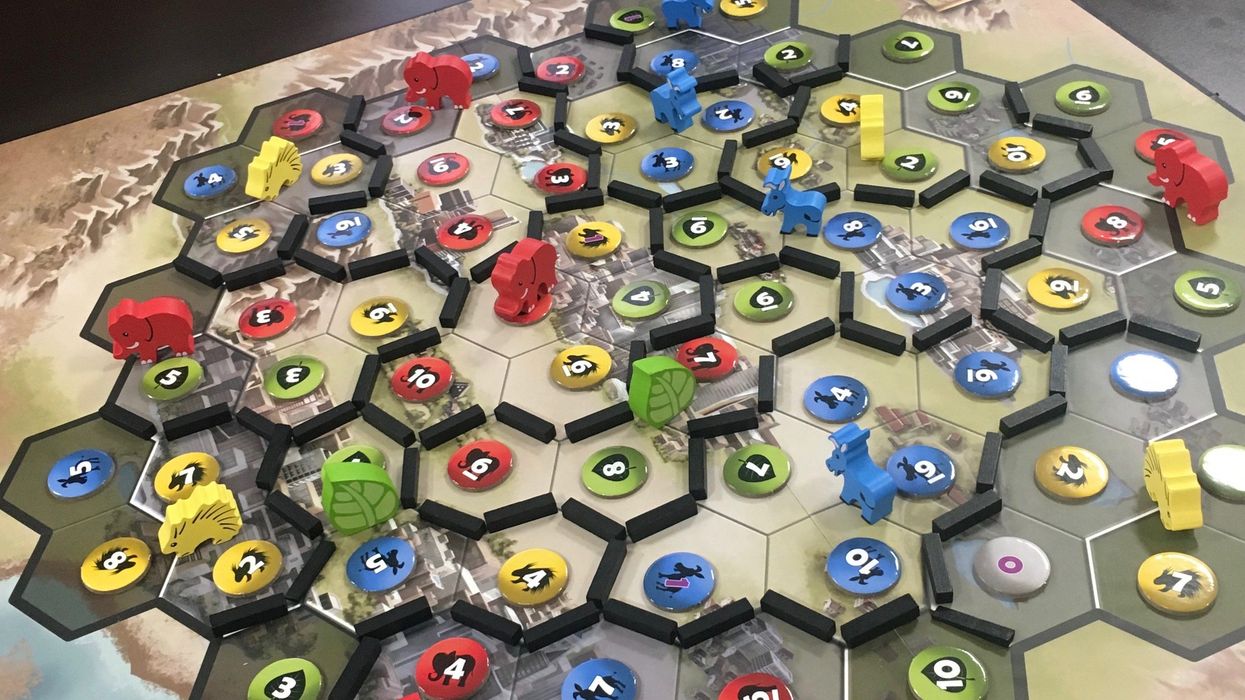

Gerrymandering for partisan advantage has been a game only politicians could play. The Supreme Court is poised to decide if those contests can continue under the currently loose rules. But whatever the outcome, mapmaking like a professional will become a pastime the whole family can enjoy.
That's because of Mapmaker: The Gerrymandering Game, produced by three board game enthusiasts from a politically engaged family in Texas. It's been issued ($40 on Calenders.com or Amazon) just in time for a landmark ruling, expected this week, on whether there's a constitutional limit to the cartographic contortions both parties employ to capture as many congressional seats as possible.
While players of the game handle their balsa wood pieces for half an hour at a time, the justices are handling something much less tangible – but with consequences that could last decades.
The court has been examining two U.S. House maps. The one for North Carolina was drawn to give the Republicans a 10-3 lock on the delegation even though the state's congressional vote has been almost dead even all decade. The one for Maryland was drawn successfully to benefit the Democrats 7-1 even though the party routinely gets only three of every five congressional votes statewide.
If the court decides the minority party members in each state have a constitutional right to a fairer shot at more representation, the justices will be compelled to determine what standard should govern the partisan limit to mapmaking.
The rulings will affect two other states, Ohio and Michigan, where federal courts have ruled the House maps are unconstitutionally partisan gerrymanders benefiting Republicans. Several state legislative maps, starting with the one drawn by Republicans in Wisconsin, also hang in the balance. And so will the ground rules for the nationwide round of redistricting all states will begin after the 2020 census decides how many House seats will be assigned to each state.
The intense and highly consequential legal battle, of course, is nothing like the bouts of levity and interpersonal gamesmanship that crop up when playing the board game contrived by young adults Joshua, Louis and Rebecca Lafair.
The goal when playing the siblings' Mapmaker is, predictably, to win by drawing more districts in your favor than your opponents can contrive. Not only does the game call attention to the pervasive personality shortcomings of those who carve up political power for a living – the scheming, strategizing and underhanded deal cutting – but it also shows how easy it is to fall into such a competitive mental frenzy.
The game is set up with a solitaire option, in which the singleton is rewarded for carving up the map of a fictional state as equitably as possible. Playing the game this way can be a rewarding way to cultivate the better angels of one's inherent political nature.
But add one, two or three more players to the mix, and the stakes suddenly get much higher. Once red elephants, blue donkeys, yellow porcupines and green leaves are on the board, any other motive than victory readily evaporates. Consideration for the opposing political parties falls to the wayside as players use black borders to wall off their districts.
In the end, Mapmaker is just a board game, but it reflects real-life issues of political power across the United States.
And that was part of what attracted the Lafairs, who live in a part of liberal redoubt Austin captured at the fringes of the 10th district of Texas. The 5,00-square-mile territory, the shape of a bone-in leg of ham, stretches across 170 miles of conservative rural farmland toward the suburbs of Houston. The district was drawn by Republicans to be a safe bet for Republicans, by making sure their voters in the middle far outnumbered the Democrats on the urban edges. (It's now held by Michael McCaul, the senior Republican on the Foreign Affairs Committee.)
Combining their political engagement and love for board games, the Lafairs crafted Mapmaker over the course of two years. It officially launched in March as the Supreme Court listened to arguments for the redistricting cases in Maryland and North Carolina.
To actually get the game off the ground, the Lafairs used a Kickstarter campaign. In 28 days, almost 1,500 people pitched in to help raise a total of more than $67,000. Among the donors was former California Gov. Arnold Schwarzenegger, a Republican who gave $3,000 to send finished copies of the game to all nine Supreme Court justices, 32 governors and 37 state legislatures with power over redistricting.












The President Invited Iran to Bomb My Home