

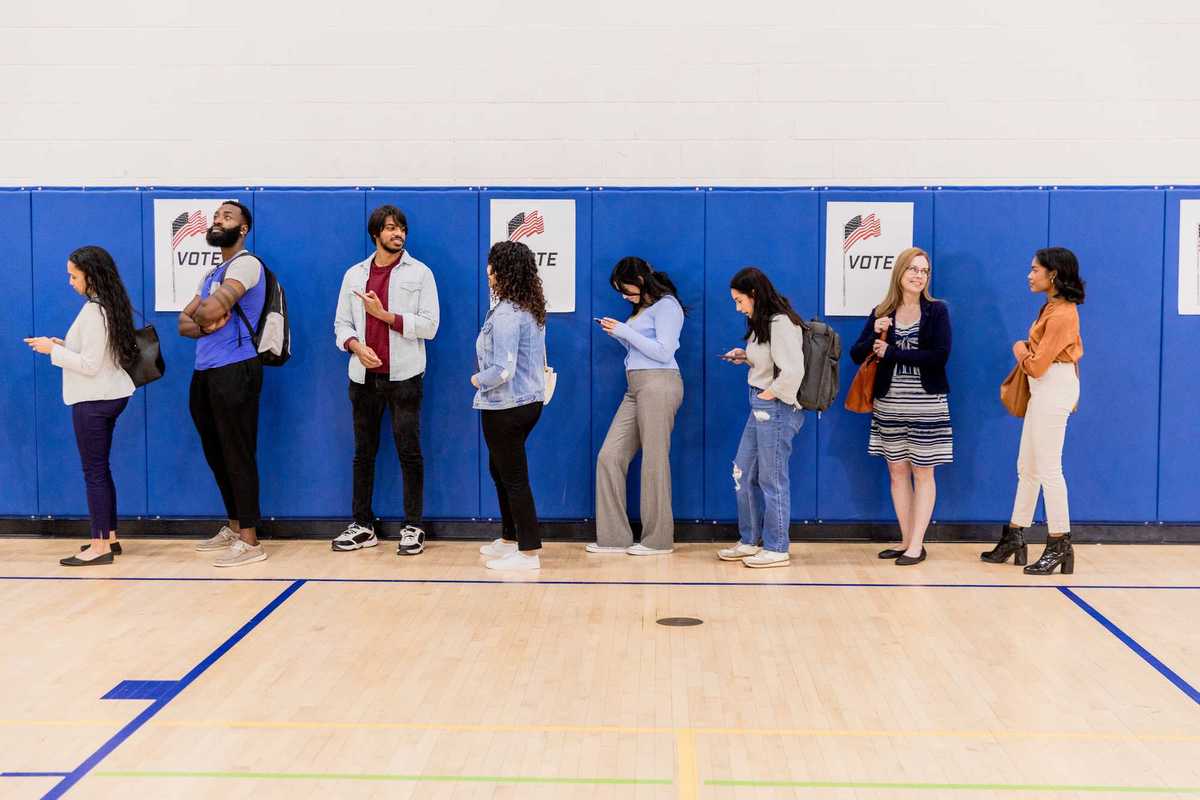


Legislators in 19 states are considering changes to state courts that would diminish the role or independence of the judiciary by giving political players more control over judicial selection, judicial decision-making or judicial administration. The roster of such bills was compiled by the progressive Brennan Center for Justice at New York University Law School, which opposes all such efforts.
Site Navigation
Search
Latest Stories
Join a growing community committed to civic renewal.
Subscribe to The Fulcrum and be part of the conversation.
Top Stories


Latest news


Read More

Universal basic income would cost trillions. Wage insurance, a bigger child tax credit, and a tax break for work could help workers left behind by AI at a fraction of the price.
Andriy Onufriyenko / Getty Images
AI’s Costs: The Human Element & the Response
Oct 23, 2026
The age of AI will be a revolutionary age. In medicine, engineering, and more, there is the possibility of great benefit to humanity. Consider some Wall Street Journal headlines: “The Quest to Use AI to Help Find New Drugs,” and “Fusion Startup Gets an AI Boost.” Already, AI is a substantial portion of GDP growth.
Yet a rising tide will not lift the boats with holes in their hulls, as Jack Kemp once said. Artificial intelligence is challenging our leaders to think about those possibly left behind. Within the AI community itself, Anthropic CEO Dario Amodei expresses concern that we could see 5-10% GDP growth with 10% unemployment.
We cannot allow this concern about AI’s human costs to go totally unaddressed. “Pull yourself up by only your own bootstraps” is not an appropriate response when there is so much disruption throughout the entire economy—when the owners of capital will thrive as workers and would-be workers struggle. Ideas from both political parties are necessary.
A universal basic income is one possibility being pushed, but the cost may be prohibitive. A decent-sized UBI of $12,000 a year would cost trillions annually. A more realistic approach is needed.
There are two alternate proposals that have not passed Congress in the past, but they could be brought back up for consideration. First is the expansion of a concept called “wage insurance.” The second is an expanded child tax credit. I will contribute a third idea too.
Wage insurance was part of the Trade Adjustment Act’s safety net. A worker 50 or older who lost a job due to foreign trade qualified if the worker found another job paying less (but no more than $50,000). The benefit was half the difference in pay between the old and new jobs, up to $10,000 over two years.
The Obama administration proposed eliminating the trade-impacted requirement. Anyone over age 50 would qualify for wage insurance so long as they were in their previous job for at least three years. The cost was estimated at $3 billion a year. Unlike a universal basic income, Congress could find the savings to offset this spending.
Wage insurance directly addresses the immediate costs of an AI economy. The worker whose career is disrupted by what was only, until recently, science fiction finds a benefit other than only unemployment insurance. The worker may very well never have the old income level again and is approaching retirement. Help for such a person in the throes of capitalism’s “creative destruction” makes sense. We are addressing those in the spaces between what was and what is becoming.
I mentioned an expanded child tax credit as well. Former Sen. Mitt Romney proposed a kind of refundable and advanceable child tax credit—meaning paid even to those who do not owe taxes, and paid monthly before even filing a tax return—of $4,200 per child under age six and $3,000 for other children. This contrasts with the $2,200 per child, with less refundability, under President Donald Trump’s “one big beautiful bill.”
Sen. Romney proposed paying for the cost partly through tax reforms that largely, but not entirely, shift the tax code’s other credits and deductions in a more progressive direction. The “mostly” is why anti-poverty advocates seemed to give the bill two cheers instead of three. Overall, the proposal would net reduce childhood poverty but would cause some families lifted out of poverty to slip right back in.
Still, the Romney proposal could be a countervailing force against AI’s corrosive effects. Even more so if the bill’s pay-for is tipped in an even more progressive direction. We would have a kind of modest universal basic income for families with children. We would be addressing those of greatest need in the economy.
The third suggestion is this: Provide a tax break for work equivalent to the size of what we give to capital. The lower income tax rate for dividend income costs the federal government a little over $40 billion a year. Putting similarly-sized tax relief into workers’ pockets would produce an average tax savings of about $235 per worker.
An extra $235, or for a two-earner family, $470, is not a universal basic income, but it is affordable. The more progressive could very well connect the revenue that can be raised by eliminating the dividend preference to offsetting the cost of lowering the 10% bottom income tax rate, or some other way to put the money in pockets. A more ideologically conservative approach would seek the curtailment or elimination of tax breaks and government programs.
What is important is recognizing that the owners of capital will be great beneficiaries of the AI age. As a matter of public policy, we should look out for labor too. Patch the boat’s holes and let the tide rise. The human cost of not doing anything needs to be addressed along with the fiscal cost of doing something.
Scott Miller is a graduate of Widener School of Law, a former chief of staff in Congress, and the author of 'Christianity & Your Neighbor's Liberty.
Keep ReadingShow less
Recommended







A Social Security inspector general found $1 billion in improper SSI payments tied to earnings alerts left unresolved for two years. Here’s what went wrong.
JJ Gouin/Getty Images
$1 Billion, 733 Days: Inside Social Security’s Improper-Payment Backlog
Oct 23, 2026
Social Security's inspector general opened its books this week and found a number that should stop any controller cold: roughly $1 billion in improper Supplemental Security Income payments, made to 333,800 recipients, sitting on top of a backlog the agency has known about for years. The cause was not a hacker, not a sophisticated fraud ring, and not a policy loophole. It was an earnings alert nobody closed out.
Here is how the mechanism actually works, and why it matters more than the headline figure. When a recipient's reported earnings change, the Social Security Administration's system generates an alert flagging that the payment amount may need adjustment. An employee is supposed to resolve that alert, verify the wage documentation, and correct the payment before the gap compounds. The inspector general's office pulled a sample of 100 such cases. Only 20 had been resolved. Sixty-three had gone untouched entirely, left pending for an average of 733 days, just over two years. Seventeen more were marked "cleared" without the wage documentation ever being fully verified, meaning the case was closed on paper while the underlying question remained open.
Multiply that failure rate across the full caseload and the agency's own auditors landed on 417,291 recipients with alerts still pending, and roughly $1 billion in resulting overpayments — $344 million of it still recoverable, and $664 million gone for good under the administrative finality rules that bar the agency from clawing back money once too much time has passed. That second figure is the one a controller would flag first. It is not merely money the government failed to collect. It is money the government forfeited its own legal right to ever collect, because the paperwork sat too long.
Put the number in context. The SSI program pays out $5.8 billion a month to roughly 7 million recipients, many of them elderly, disabled, or with no other income. A $1 billion improper-payment figure is a rounding error against annual outlays in the hundreds of billions, and that is precisely the trap: individually forgivable, structurally significant, and consequent, cycle after cycle, on the same unresolved bottleneck. Michelle Anderson, the assistant inspector general for audit who signed the report, put it plainly: the agency "has the opportunity to strengthen its controls to ensure employees timely and accurately resolve earnings alerts." That is auditor-speak for "someone stopped doing their job, and nobody noticed for two years."
This is where the story becomes bipartisan rather than partisan, and that is worth saying explicitly. Nobody designed a policy to let $664 million walk out the door permanently. No administration, no party, no piece of legislation set out to create a 733-day queue. This is what happens when a caseload grows faster than the staff assigned to work it, and when a backlog becomes background noise rather than a crisis, because it never generates a single dramatic headline of its own. It simply accretes, report after report, until an inspector general adds it up and the total is substantial enough to notice.
The agency's own response is instructive, and to its credit, unresisting. SSA agreed to implement all three of the inspector general's recommendations: review and correct the 63 unresolved alerts, review and correct the 17 incomplete verifications, and identify what is actually driving the pattern so it stops recurring. That last item is the one that determines whether this report changes anything. Reviewing the specific 63 cases is a one-time fix. Diagnosing why alerts sit for two years at a time is the only step with any chance of preventing the next inspector general's report from finding the same thing with a different case number attached.
There is a broader lesson here for how Washington measures accountability. A single agency losing $664 million to its own processing delays will not move a federal budget measured in trillions. But add up every program running the same kind of quietly aging backlog — disability claims, unemployment insurance overpayments, veterans' benefits recalculations — and the aggregate is not a rounding error anymore. It is a pattern of institutions that are diligent about writing rules and much less diligent about enforcing them against their own inertia. A pragmatic fix is not more legislation. It is adequate staffing against the alert queue that already exists, tracked with the same rigor a private-sector controller would apply to any accounts receivable aging past ninety days.
Congress does not need a new program to address this. It needs an oversight hearing that asks SSA a narrower and more useful question than "how much fraud is there": how many earnings alerts are open right now, how old is the oldest one, and what is the staffing plan to close the gap before the next $1 billion accrues. That is a question with an answer a controller could evaluate in an afternoon. Whether anyone in Washington asks it before the next inspector general's report comes due is the real test of whether this one changes anything.
Jose E. Navarro, MBA, is a financial controller and founder of The Navarro Report, a public finance and government accountability publication based in San Diego, California.
Human-Directed AI Journalism: This article was researched and drafted with AI assistance under the direction, review, and editorial control of the author.
Keep ReadingShow less

America’s polarization has closed us off to each other’s humanity. The Golden Rule and the churches may be the way back to common ground.
Getty Images, PeopleImages
Land of the Free, Home of the Brave? How Trump Is Destroying America's Soul
Oct 22, 2026
The recent actions by both some Jewish leaders and pro-Palestinian activists against NY mayor Zohran Mamdani are an example of just how far our nation has come from our ideals under the presidency of Donald Trump.
Even with Mamdani's consistent pro-Palestinian statements, he was called a "coward" and a "sellout" because he stood with the Jewish community in remembering the October 7 Hamas attack. Jewish leaders condemned him for his criticism of Israel and Palestinian sympathies expressed in the same breath as remembrance of the attack. But Mamdani understands the connection between the treatment by Israel of Palestinians and Palestinian treatment of Israel.
The United States under Trump has become driven by hatred and distrust. There has of course always been much hatred and distrust in our country, as there is everywhere in the world.
But under Trump, those feelings have been heightened to the point that we have become so polarized that the two sides—any two sides, not just MAGA and liberals—cannot talk to each other. There is no commonality remaining and there is little hope of finding common ground, so closed off is one side to the other's humanity and its core desire for the same things that we all desire—respect and the ability to live our lives in peace.
We have no freedom if we are caught in this vortex of hate and distrust. There is no bravery if we don't have the courage to listen to the other side's valid sorrows and understand where they are coming from.
In this, as in so many other ways, we are far from the ideals of our founding principles as stated in the Declaration of Independence—equality and the right to pursue life, liberty, and happiness. Or as the Pledge of Allegiance puts it, "Liberty and justice for all."
Let's look at the struggle between Israel and the Palestinians as an object lesson. Both sides have the same dream: to live in a country that validates and protects their existence and their ability to pursue life after decades or centuries of being subject to the control of others, of being persecuted, of having to live their lives in fear.
And so both have tried to create a space—a state—where they can be free to live their lives as human beings. But to do that, they have not just been willing, but felt it necessary to subjugate another people just as they have been subjugated. It's in many ways the same story as the English Puritans who founded the Massachusetts Bay colony. They came to America to escape persecution. But once they got here and founded their own state, they persecuted all other Christians, let alone other religions, who did not agree with them.
So our current dynamic is not a new page in the story of human societies. Nor is it the worst example of how a majority treats a minority. But it is an example of how our founding principles remain, in so many ways, far from achievement even as we as a nation have made substantial progress towards implementing those principles.
Nor is this just a failure to live up to the founding principles of our country. Every religion has at the core of its teaching a version of the Golden Rule: "Do unto others as you would have them do unto you."
Yet this principle remains far from the hearts and actions of man; historically, even from that of many religious establishments. To live that rule requires great humility, a characteristic not very prevalent among humans; instead, we are ruled by ego, insecurity, anger, fear, self-righteousness, and a host of other negative emotions.
These are all examples of human nurture, as opposed to human nature. These negative emotions are all a result of how man is raised, the experiences he has—especially as a young child—and the culture in which he lives. These emotions reflect man as he develops, not man as he is born. He is born a child of the Universe (or the child of God, if you prefer) full of light and love, positive energy and joy, equanimity. See my book, Discover Your Power.
But those seeds are not watered by his life experiences, which are predominantly negative, and so his ego grows to be a dominating force, bowling over any effort by his true self to do what is right. You've all seen the cartoons of a person with an angel sitting on one shoulder whispering good thoughts in his ear, and the devil sitting on the other shoulder, whispering negative thoughts in the other ear—it is always the devil that wins out.
How do we as a nation, let alone the world, move towards a world filled with more equality and more understanding? During the civil rights movement, in addition to the civil disobedience of Blacks led by Martin Luther King, Jr., White churches and their leaders were important in making clear that this was not just a Black v White movement, it was a movement by those who fought for equality and respect against those who had no interest in those values, except for themselves.
Today, to move our country forward, the churches must step forward again and be part of a movement (see American Solidarity) to have people come to embrace the principles of equality and respect, to embrace the Golden Rule, treating others the way they want to be treated. To bring about MLK's dream, that one day, "all of God’s children — black men and white men, Jews and Gentiles, Protestants and Catholics — will be able to join hands and sing in the words of the old Negro spiritual: 'Free at last! Free at last! Thank God Almighty, we are free at last!'"
Ronald L. Hirsch is a teacher, legal aid lawyer, survey researcher, nonprofit executive, consultant, composer, author, and volunteer. He is a graduate of Brown University and the University of Chicago Law School and the author of We Still Hold These Truths. Read more of his writing at www.PreservingAmericanValues.com
Keep ReadingShow less

Hand holding cutout of figures holding hands
Image produced on Canva
Leaders Igniting Transformation Helps Milwaukee Youth Find Their Voice
Oct 22, 2026
MILWAUKEE, WI– At Kozy Community Center, giant post-it notes with questions about school resource officers and student safety covered the walls of a meeting room. The meeting was hosted by Leaders Igniting Transformation, a nonprofit focused on empowering young Black and Brown people in Wisconsin.
Over the course of the afternoon, students shared about what helped them feel safe in their communities, and learned about Act 12, the legislation responsible for the reinstatement of school resource officers in Milwaukee Public Schools (MPS). They brainstormed answers to questions about how officers should be used in schools.
“We provide support to young people to mobilize around issues that they care about,” Kahina Cargile, co-executive director of LIT, said.
LIT, which was founded in 2017, has chapters at the high school and college level, as well as a civics department that brings in people locally from the city of Milwaukee. They offer a fellowship for high school and college students.
The state of Wisconsin does not require civics instruction in its schools, and Cargile said LIT is filling a gap. This year, more than four hundred high school and college students have taken part in LIT through school chapters, fellowships, and citywide meetings,
“We're constantly focused on civic education. We're bringing experts in to explain bills, explain policies,” Cargile said.
During the summer, LIT hosts Black Hogwarts, a paid summer leadership institute aimed at helping students develop the skills they need to organize.
The civic education LIT provides to young people through Black Hogwarts and as fellows helps them develop stronger reading and writing abilities.
“They're building public speaking skills. They're building writing skills, along with learning how to make real change in their communities,” Cargile said.
At the high school level, LIT’s current initiative is focused on making sure that the memorandum of understanding between MPS and the Milwaukee Police department allows high school students to feel safe in the building with police officers. The memorandum has been in effect since early 2025.
Adija A., a high school fellow with LIT, was attending the event with her cousin. Adija said LIT was the first space she had where she could talk about issues that mattered to her.
“I have these people that care as much as I do, and we can actually discuss and try to figure out what we can do about it to stand up for ourselves,” she said.
Adija said she is concerned about school resource officers in her school.
“A lot of times, they abuse their power,” Adija said. “I want to know how I can know these rights and use them effectively and also have other people know that they have these rights within the school system, so that they don't let the school system abuse them.”
LIT offers opportunities for the local community to participate in the process year-round, like the meeting held at the Kozy Community Center.
Connor Grossnickle, development coordinator for LIT, said that he was drawn to LIT by its flexibility and willingness to meet the community’s needs.
“We're trying to make these spaces available to people who wouldn't have that space otherwise,” Grossnickle said. Barriers to civic engagement, like a need for childcare or a meal, are reduced through the spaces LIT provides.
Another goal for LIT is to reach Wisconsin voters about the upcoming midterms elections. The ballot for November features three referendums.
Cargile said LIT is educating Black and Brown voters about the impacts of the referendums through canvassing. From March through December this year, LIT’s nonpartisan canvassers knocked on 50,003 doors and had 1,786 conversations with voters in Milwaukee’s majority-Black and Latino 8th, 12th and 15th aldermanic districts.
“We believe if those demographics are equipped, they have the information, they have the confidence to go vote, that they can really make a change in the city,” Cargile said.
Adija said LIT has taught her that her voice and rights as a young person matter.
“It’s gonna help you be able to make change because at the end of the day, whether you're involved in these things or not, they are going to affect you,” she said.
Abbey Osborn is a fall Fulcrum Fellow. A student at CUNY Newmark Graduate School of Journalism, Abbey focuses on local democracy, public institutions, and youth civic engagement. She brings experience in community reporting and a commitment to amplifying voices often overlooked in political coverage.
Keep ReadingShow less
Load More