



Bryce Bennett is the executive director of Vote Early Day, a national nonpartisan civic holiday dedicated to empowering Americans to vote early.
It’s Vote Early Day! Today, thousands of nonprofits, businesses, campus groups, election leaders, and other voting enthusiasts are hosting celebrations encouraging Americans to vote early in every corner of the country.
But why vote early?
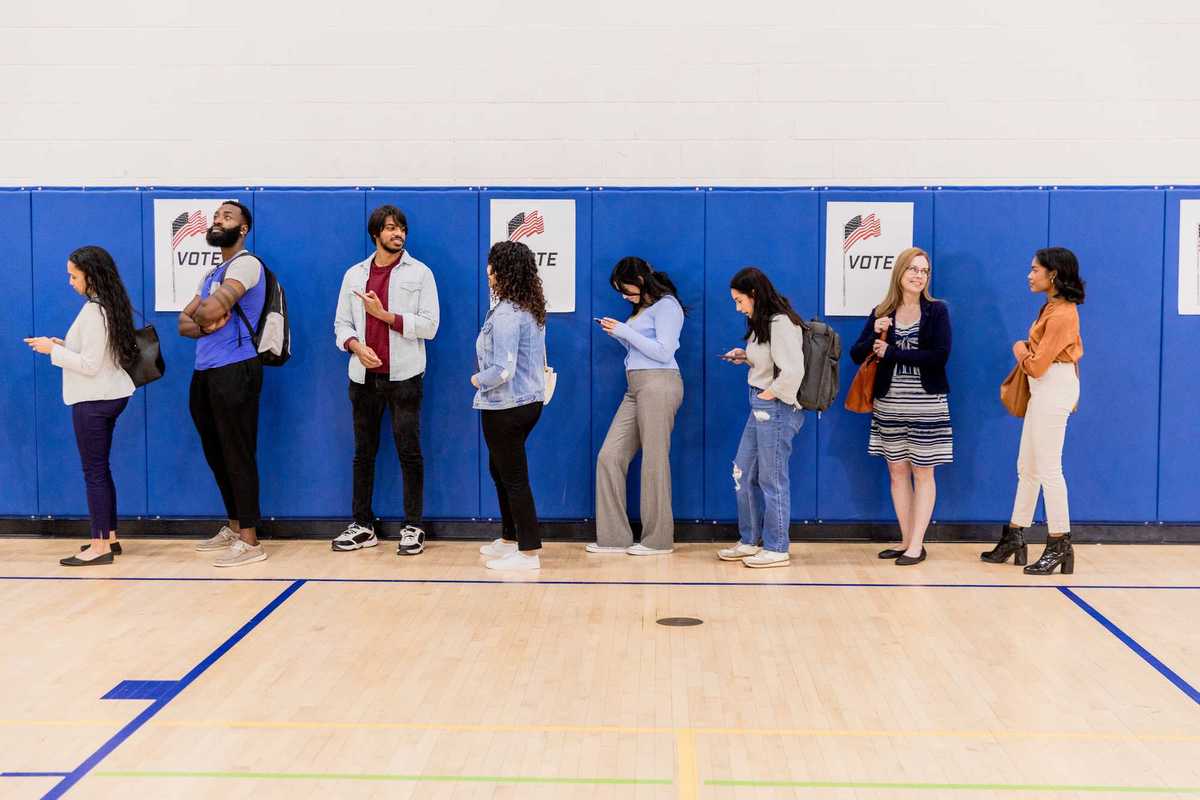
In the final hours of voting, Americans can face unanticipated barriers that may keep them from casting their ballot. Challenges include long lines, hectic schedules, illness, last-minute childcare or work issues, traffic jams, changing election laws, voter disinformation, and myriad other obstacles. We’ve all encountered these issues and have seen even the best-laid plans fall apart when problems arise.
When you vote early by mail or in person, nothing can stop you from having your say. When people vote ahead of Election Day, they have the convenience of finding a date and time that works for their schedule. The lines may be substantially shorter, so you can get in, get out, and get on with your day. And if you run into an issue like not having the proper ID or showing up to the wrong polling place, you have plenty of time to correct the problem and cast your ballot.
Launched in 2020, Vote Early Day is a nonpartisan holiday dedicated to ensuring all Americans have the tools and information they need to vote early. Built in the same model as other civic holidays like National Voter Registration Day, it culminates in a tentpole moment: a shared day to celebrate our democracy by helping others participate in it.
The success of this holiday is built on the idea that empowering voters is a task no single group can or should do alone. Through a broad, diverse set of partners, Vote Early Day can meet people where they are with the information they need to vote in advance of Election Day. Every business, educator, nonprofit, faith community, student group, media company, athlete, celebrity, and more plays a critical role. Each group has the unique ability to build a celebration that meets the needs of their communities, customers, or constituents.
With politics seen as hostile and toxically partisan by so many people our team encounters, Vote Early Day events mark a fun and joyful opportunity to lower the barrier to entry into our democracy. Through the work of organizations celebrating the holiday, partners not only amplify the benefits of voting early, but also empower people to take advantage of their options to make their voices heard.
With more than half of states seeing changes to their election laws since the 2020 election, Vote Early Day provides an important opportunity to overcome confusion and delays at the polls. By celebrating Vote Early Day, we can share nonpartisan, up-to-date voter information that stops political disinformation in its tracks. When people vote early, they have the time and opportunities to navigate anything that comes their way.
On Vote Early Day 2022, we saw over 3,000,000 votes cast - the highest number of early ballots cast in October, according to the U.S. Elections Project. The total number of Americans voting early in person or by mail grew by 5,766,671 votes in 2022 versus the last midterm election in 2018, marking a 4.6% increase!
While many are already looking forward to the crucial races in the year ahead, national and local partners will not allow a year with hundreds of state elections and thousands of critical local elections to be set aside as an “off year.”
Together, we met the moment and helped millions of Americans gain the knowledge and tools to vote early. Partners built impactful celebrations that pulled voters off the sidelines and made a real difference, but the work is far from over.
In 2023, we must keep up the momentum to ensure that the voices of every American voter are heard. Today, Vote Early Day partners will step up to achieve that goal and empower Americans once again.














image of U.S. President Donald Trump is displayed on a digital billboard in Times Square in New York on April 8, 2026.
Trump is stuck between two realities. Neither serves the American people
Normally, I worry that events may overtake a column. But not so with the Iran war.
I don’t worry about running afoul of a headline or Truth Social post from the president because what is said about the situation is no longer very relevant to the reality.
On April 8, Nick Catoggio, my Dispatch colleague, dubbed an earlier stoppage with Iran “Schrödinger’s ceasefire.” This was a reference to the famous thought experiment by the physicist Erwin Schrödinger, who was trying to explain the weirdness of “superpositionality” in quantum physics. A cat in a box is both dead and alive at the same time until you open the box. Schrödinger meant to illustrate the absurdity of the idea that particles aren’t any one thing, but a “cloud of probabilities.”
The Trump administration is stuck in a word cloud of probabilities of his own making. The war is over. The war is on. The war isn’t a war. We have a deal, but we don’t have a deal, but we’re about to have a deal. We destroyed Iran’s military. No, we left it intact. We want regime change. No we don’t. We already accomplished it. We “obliterated” Iran’s nuclear program a year ago. We had to go to war in February to prevent nuclear war. The Strait of Hormuz is open, closed, or something in-between. No deal without “unconditional surrender.” Let’s make a deal!
This everything-all-at-once vibe can be disorienting, particularly since most Americans didn’t have a war with Iran on their bingo cards until the shooting had already started. President Trump didn’t prepare the country or consult with Congress beforehand because he thought it would all be a smashing success in a matter of weeks.
The miscalculation that started it all: killing Iran’s Supreme Leader, Ayatollah Ali Khamenei, and much of Iran’s senior leadership, on the first day of the war. To “the great proud people of Iran, I say tonight that the hour of your freedom is at hand,” Trump announced on Feb. 28. “When we are finished, take over your government. It will be yours to take. This will be probably your only chance for generations.”
I support regime change in Iran and shed no tears for Khamenei or his goons. But when you start a war by killing the regime’s top leaders, it’s not unreasonable for the remaining ones to conclude that you really intend regime change.
Khamenei was a murderous fanatic, but he was a fairly cautious one. He liked to threaten closing the Strait of Hormuz or attacking our regional allies, but he was reluctant to actually do it, fearing it would invite a regime change war. The mullahs and IRGC goons believed, not unreasonably, that if they lost their grip on power, they’d be lynched by the Iranian people they’ve brutalized for decades.
By starting with a regime change war, Trump removed any reason for the regime not to go for broke. When you have nothing to lose — particularly when you are a millenarian religious fanatic — a Persian Alamo strategy makes a lot of sense.
So Iran closed the Strait of Hormuz and attacked its neighbors.
But it turns out this wasn’t the Alamo. In the contest of wills, Trump blinked. The Iranian regime’s tolerance for punishment proved — so far — to be greater than Trump’s and that of our gulf allies. Militarily we could finish the job, but that would require ground troops and much greater economic turmoil. In a conflict Trump launched unilaterally without the prior support of Congress, NATO or the American people, Trump doesn’t have the political capital for that.
But that’s only half the problem. Trump wants the war over, but he doesn’t want to pay — militarily, economically, politically — what that would cost. So he wants to make a deal that ends it. But there is no deal available that wouldn’t come at an equally undesirable cost. Any deal that looks like what President Obama struck with the Iranians would be too embarrassing to bear. But the Iranians are convinced that they can get just such a deal, and they’re willing to drag things out as long as it takes.
The result: Trump’s in a box of his own making. He thinks he can talk his way out by simply asserting a reality that doesn’t exist. When the financial markets get nervous, he announces a breakthrough that is, at best, a possibility. When the Iranians agree to a deal that looks similar to one Obama might negotiate, Trump goes back to his threats.
It can’t go on forever. But I’m sure it’ll last until long after this column is forgotten.
Jonah Goldberg is editor-in-chief of The Dispatch and the host of The Remnant podcast. His Twitter handle is @JonahDispatch.