


Skip to content
Search

Latest Stories

Follow Us:
Top Stories

Ballot drive from the right expands for battleground states to underscore citizen-only voting

Ballot drive from the right expands for battleground states to underscore citizen-only voting

Citizen Voters Inc. wants to add the phrase "only a citizen" to Colorado's state constitution.

Hustvedt / Wikimedia Commons

Conservative groups have launched an effort to amend the Colorado constitution to specify that only U.S. citizens may vote in the state.

It's the latest front in a campaign designed to galvanize anti-immigrant sentiment in the electorates of more than a dozen states, many of them likely presidential battlegrounds next year.

It's also a solution in search of a problem. American citizenship is already a requirement for voting under federal law and in virtually every state election. (A handful of places permit non-citizens to vote in local contests.) The Colorado Constitution, for example, says "every citizen" may vote who meets qualifications and is registered.

Citizen Voters Inc., a national nonprofit working to spearhead and help finance 2020 ballot measures across the country, is gathering signatures on a petition that would put a proposed constitutional amendment on the Colorado ballot next fall -- changing those two words to "only a citizen."

The group's chairman and treasurer is John Loudon, a former Republican state senator in Missouri. His wife, Gina, who frequently appears on conservative radio and TV, is spokeswoman. Both are ardent promoters of President Trump, were active in his winning campaign and belong to his Mar-a-Lago Club.


If supporters gather 125,000 valid signatures by November, the ballot initiative would succeed a year later if backed by 55 percent statewide. A well-funded effort to secure those votes could help Trump contest Colorado, which has given its nine electoral votes to the Democratic nominee the past three elections.

But the group's biggest target is Florida. It spent $4.7 million to get 1.3 million signatures on a petition for a similar initiative next fall, when the 29 electoral votes of the nation's most populous purple state will be up for grabs. (That measure is still subject to automatic judicial review before getting a spot on the ballot.)

The spending was reported by the Washington Post, but the source of the money is unknown because Citizen Voters Inc. is the sort of "dark money" nonprofit not required to disclose contributors.

Tim Mooney, a veteran Republican strategist working on the Florida campaign, told the Post the group is planning similar efforts in the potential presidential battlegrounds of Georgia, Iowa, Maine, Michigan, North Carolina, Nevada and Ohio – plus reliably red Alabama, Kentucky, Missouri, Nebraska and West Virginia.

George Athanasopoulos, who took 40 percent as the 2016 Republican challenger to Democratic Rep. Ed Perlmutter in the Denver suburbs, is leading the Colorado petition drive and told the Colorado Springs Gazette: "It's a national effort that will obviously have additional benefits. It will help drive turnout; it will help elect candidates; it may be the decisive issue in many elections across the country this year."

He added: "If Republicans are smart, they will grab this issue and run with it. This polls like no other issue does."



Read More

A Democracy Cannot Run on an AI Model

Clerk Matthew Sandbar, 34, demonstrates part of the ballot-sorting process to members of the media attending a walkthrough of the Philadelphia Ballot Processing Center used to process the ballots of the 2022 US midterm elections, in Philadelphia on October 27, 2022.

Photo by Ryan Collerd / AFP via Getty Images

A Democracy Cannot Run on an AI Model

Tallying the results of Washington, DC’s first ranked-choice election in June took about 10 days—longer than many voters are used to. In an age when artificial intelligence can generate an answer in seconds, waiting days for election results can feel old-fashioned, inefficient, even suspicious. And it is about to matter far more widely. This November, 17 states, cities, and counties will use ranked-choice voting, including Maine and Alaska statewide, in races that could help decide control of Congress. More voters than ever will watch results take days to resolve, and more will be asked to trust a count they cannot see.

But that slowness may be one of its most democratic features.

Keep ReadingShow less
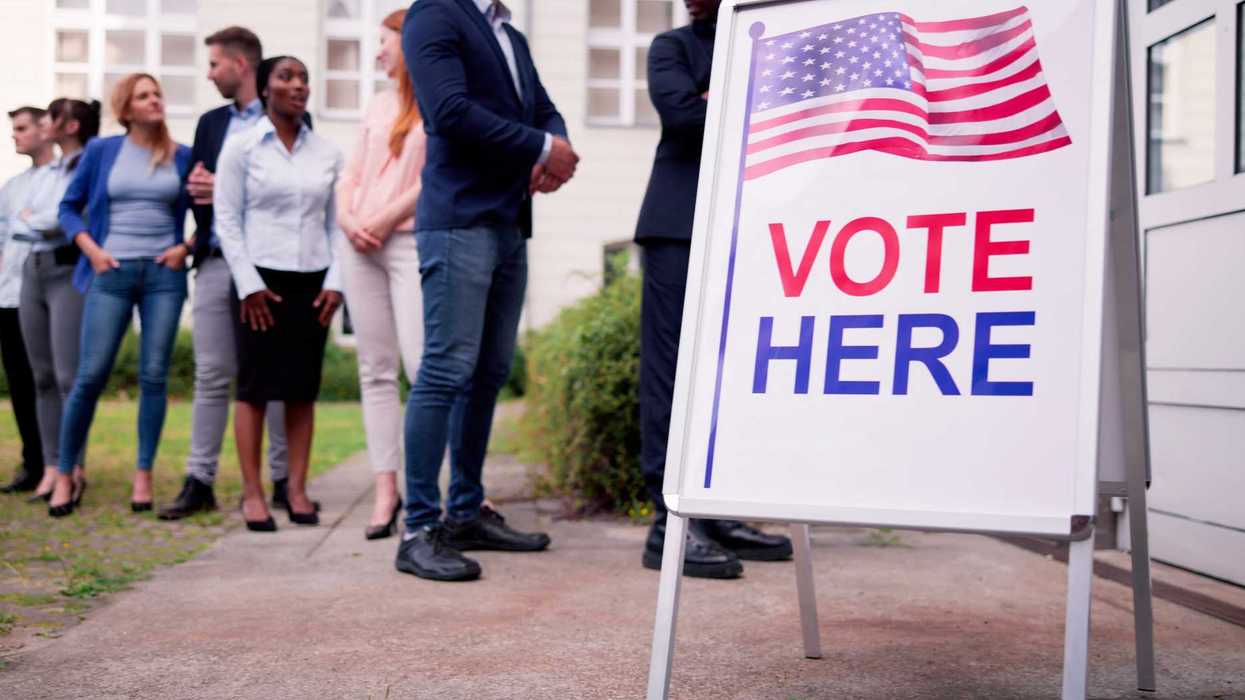
People waiting in a line outside as the sun sets.

Voters wait in line outside the Metropolitan Multi-Service Center to cast their ballots in Houston, Tuesday, Nov. 4, 2025. A recent state investigation confirmed that some registered voters flagged as potential noncitizens by a federal system had already provided proof of citizenship.

Brett Coomer/Houston Chronicle via Getty Images

Texas Confirms Some Flagged As Potential Noncitizens on Voter Rolls Had Provided DPS Proof of Citizenship

Election officials across the state should immediately reinstate some voters who were incorrectly flagged as potential noncitizens through a federal program, the Texas Secretary of State’s Office told county officials Wednesday.

Christina Adkins, the state elections director, told county officials the state had reviewed Texas Department of Public Safety records confirming the citizenship of some of the 2,724 registered voters who were flagged as potential noncitizens, according to an audio recording of her comments obtained by Votebeat and The Texas Tribune, as well as election officials who heard them. The voters were flagged after the state checked its voter roll through a federal program called Systematic Alien Verification for Entitlements, or SAVE, used to verify the citizenship of people registered to vote.

Keep ReadingShow less
People walking down the steps of the U.S. capitol.

House Minority Leader Hakeem Jeffries (D-NY) (C), Democratic Conference Chair Rep. Pete Aguilar (D-CA) (R), and House Minority Whip Katherine Clark (D-MA) (L) and other House Democrats arrive for a news conference on the House steps on November 12, 2025 in Washington, DC.

Andrew Harnik/Getty Images

DNC's Proposed RCV Ban Sparks Debate Over 2028 Presidential Primaries

Democratic National Committee insiders are poised to ban the use of ranked choice voting (RCV) in selecting their presidential nominee in 2028 – overriding presidential primary laws in Maine and Washington, D.C, and squashing great interest in this use of RCV among state legislators and the many state parties who run their own primaries.

Presidential primaries are among the most compelling use cases for RCV. They draw crowded fields of candidates that voters get to know and are eager to rank rather than be limited to one. Parties must unite their big tent of voters, and RCV rewards unifying candidates. The sequential nature of primaries is a problematic fit with early voting – in 2020, for example, more than three million Democratic voters cast a ballot for a candidate who had withdrawn before that vote was counted.

Keep ReadingShow less
​U.S. President Donald Trump sitting in the Oval Office.

U.S. President Donald Trump speaks during an announcement on American nuclear innovation in the Oval Office at the White House on July 24, 2026 in Washington, DC.

Eric Lee/Getty Images

Trump’s Elections Speech Was Not the Opening Shot; It was the Latest Salvo

President Donald Trump’s recent address repeating his claim that he won the 2020 election was widely portrayed as a dramatic escalation of his attacks on our election system. It wasn’t.

It is nothing new!

Keep ReadingShow less