



Skip to content
Search

Latest Stories

Follow Us:
Top Stories

Florida voter site goes dark. Routine maintenance or suppression?

Florida voter site goes dark. Routine maintenance or suppression?

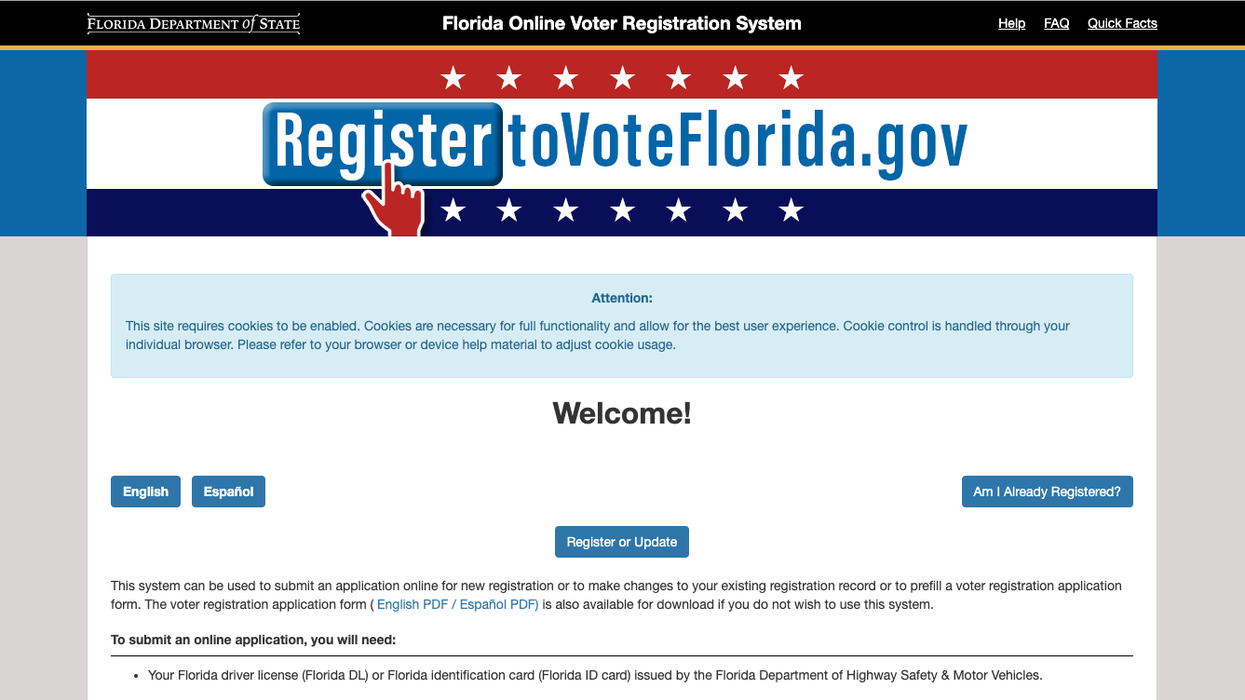
Florida's voter registration site went down over the weekend, angering Democrats prepping for a statewide voter registration drive.

Florida's voter registration website went down over the weekend, angering Democrats who accused the state's Republican governor of voter suppression just days ahead of a national voter registration drive.

The website went down Friday night for "routine maintenance," the site said, and was online again Sunday.

Democrats said they beieved Gov. Ron DeSantis orchestrated the shutdown to interrupt plans to register voters over the weekend and ahead of Tuesday's National Voter Registration Day, the single largest campaign to register voters.


"Shuttering the online voter registration site for 'maintenance' as we kick off our largest voter registration week is the latest act of voter suppression from a governor who has doubled down on voter suppression tactics during his short tenure," said Terrie Rizzo, chairwoman of the state Democratic Party.

A spokeswoman for the department that oversees Florida's elections said the scheduled maintenance was announced in advance, and was designed to provide increased security and ensure an expected surge in traffic during the registration drive.


Read More

A person signing a piece of paper with other people around them.

Javon Jackson, center, was able to register to vote following passage of a 2019 Nevada law that restored voting rights to formerly incarcerated individuals.

The Nation Is Missing Millions of Voters Due to Lack of Rights for Former Felons

If you gathered every American with a prison record into one contiguous territory and admitted it to the union, you would create the 12th-largest state. It would be home to at least 7 million to 8 million people and hold a dozen votes in the Electoral College.

In a close presidential race, this hypothetical state of the formerly incarcerated could decide who wins the White House.

Keep ReadingShow less
People standing at voting booths.

The proposed SAVE Act and MEGA Act would require proof of citizenship to register to vote, risking the disenfranchisement of millions of eligible Americans.

Getty Images, EvgeniyShkolenko

The SAVE Act is a Solution in Search of A Problem

The federal government seems to be barreling toward a federal election power grab. Trump's State of the Union address called for the Senate to push through the SAVE Act, which has already passed the House, in the name of so-called "election integrity." And the SAVE Act isn’t the only such bill. Like the SAVE Act, the Make Elections Great Again (MEGA) Act—introduced in the House—would require voters to provide a document outlined in the Act that allegedly proves their U.S. citizenship. We’ve been down this road before in Texas, and spoiler alert: it was unworkable.

Both the SAVE and MEGA Acts would disenfranchise millions of eligible U.S. citizens without making our federal elections more secure. They seek to roll out a faulty federal voter registration system, despite the existing separate registration and voting process for state and local elections. And these Acts target a minuscule “problem”—but would unleash mass voter purges and confusion.

Keep ReadingShow less
Stickers with the words "I Voted Today."

Virginia is on its way to be the 19th jurisdiction to adopt the National Popular Vote Interstate Compact, bringing the U.S. closer to electing presidents by the national popular vote.

Getty Images, EyeWolf

Virginia On The Path to Join the National Popular Vote Interstate Compact

NPVIC is an agreement among U.S. states and the District of Columbia to award all their electoral votes to the presidential ticket that wins the overall popular vote in all 50 states and the District of Columbia. It is considered a pragmatic, voluntary state-based initiative because it aims to ensure the winner of the national popular vote wins the presidency without requiring a constitutional amendment, operating instead within the existing Electoral College framework by utilizing states' constitutional authority to appoint electors. If enough states join the NPVIC to reach a total of 270 electoral votes, the United States will effectively shift from a winner-take-all (WTA) regime to a national popular vote system for electing the President.

With Virginia's adoption, the National Popular Vote Interstate Compact will be adopted by eighteen states and the District of Columbia, collectively holding 222 electoral votes. The compact requires 270 electoral votes (a majority of the 538 total) to take effect. It currently needs forty-eight more electoral votes to become active.

Keep ReadingShow less
With the focus on the voting posters, the people in the background of the photo sign up to vote.

Should the U.S. nationalize elections? A constitutional analysis of federalism, the Elections Clause, and the risks of centralized control over voting systems.

Getty Images, SDI Productions

Why Nationalizing Elections Threatens America’s Federalist Design

The Federalism Question: Why Nationalizing Elections Deserves Skepticism

The renewed push to nationalize American elections, presented as a necessary reform to ensure uniformity and fairness, deserves the same skepticism our founders directed toward concentrated federal power. The proposal, though well-intentioned, misunderstands both the constitutional architecture of our republic and the practical wisdom in decentralized governance.

The Constitutional Framework Matters

The Constitution grants states explicit authority over the "Times, Places and Manner" of holding elections, with Congress retaining only the power to "make or alter such Regulations." This was not an oversight by the framers; it was intentional design. The Tenth Amendment reinforces this principle: powers not delegated to the federal government remain with the states and the people. Advocates for nationalization often cite the Elections Clause as justification, but constitutional permission is not constitutional wisdom.

Keep ReadingShow less