
Skip to content
Search

Latest Stories

Follow Us:
Top Stories

Put the racing sausages on ice, Wisconsin GOP demands

Racing Sausages

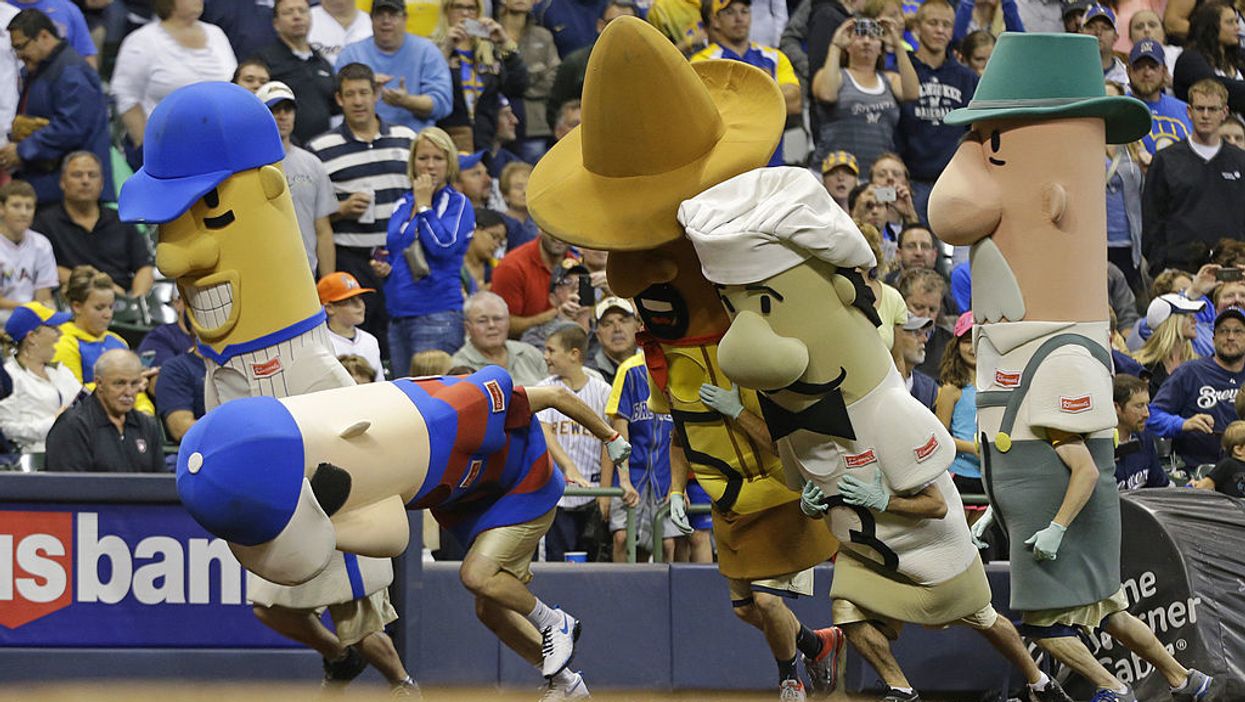
The Wisconsin Republican Party is warning that having the Milwaukee Brewers' famous racing sausages in Miller Park while people are voting would violate state election law.

Jeffrey Phelps/Getty Images

The Republican Party is telling the Wisconsin Election Commission and the Milwaukee Brewers that election law would be violated by the mere presence of the baseball team's popular racing sausages when people vote in the stadium.

And, no, it wasn't a joke meant to inject a little levity into the intense debate about election integrity and voter fraud.


The legalistic letter was sent Tuesday by the state GOP chairman, Andrew Hitt. He sent a similar warning to the Milwaukee Bucks about Bango, the NBA franchise's mascot.

Littered with references to specific provisions of state law and precedent-setting court cases, the letters seek to find out what is being planned for Miller Park and Fiserv Forum when they are used as voting sites from Oct. 20 to Nov. 1.

"We want to ensure that no one engages in electioneering or other improper activities at those sites," the letter states. (You see, there are real people inside those goofy and outsized costumes.)

Hitt said he became concerned because a registration drive at Miller Park last week, on National Voter Registration Day, "prominently featured the Brewers Racing Sausages."

To be precise, they are actually the Johnsonville Famous Racing Sausages. Which is trademarked, by the way. And for those who don't know, five oversized costumed characters — representing bratwurst, hot dog, polish, Italian and chorizo — race around the stadium before the bottom of the sixth inning at the Brewers' home games.

While baseball's efforts to promote civil engagement are "commendable," Hitt wrote, having the sausages on hand while voters are marking their ballots would violate the Wisconsin law banning "any activity which is intended to influence voting at an election."

The prohibition, the GOP argues, does not just cover the promotion of candidates. It also guards against any encouragement of the very act of voting.

Neither team has announced plans to put Bango and the racing sausages to work enticing people to get out and vote in one of the year's most important tossup states

But the state GOP asked to be notified if any celebrities are going to be at the arena or ballpark when they are being used as polling places.

Who knows: Maybe they want to make sure to bring condiments.

Read More

U.S. Capitol.
As government shutdowns drag on, a novel idea emerges: use arbitration to break congressional gridlock and fix America’s broken budget process.
Getty Images, Douglas Rissing

Congress's productive 2025 (And don't let anyone tell you otherwise)

The media loves to tell you your government isn't working, even when it is. Don't let anyone tell you 2025 was an unproductive year for Congress. [Edit: To clarify, I don't mean the government is working for you.]

1,976 pages of new law

At 1,976 pages of new law enacted since President Trump took office, including an increase of the national debt limit by $4 trillion, any journalist telling you not much happened in Congress this year is sleeping on the job.

Keep ReadingShow less
Someone using an AI chatbot on their phone.

AI-powered wellness tools promise care at work, but raise serious questions about consent, surveillance, and employee autonomy.

Getty Images, d3sign

Why Workplace Wellbeing AI Needs a New Ethics of Consent

Across the U.S. and globally, employers—including corporations, healthcare systems, universities, and nonprofits—are increasing investment in worker well-being. The global corporate wellness market reached $53.5 billion in sales in 2024, with North America leading adoption. Corporate wellness programs now use AI to monitor stress, track burnout risk, or recommend personalized interventions.

Vendors offering AI-enabled well-being platforms, chatbots, and stress-tracking tools are rapidly expanding. Chatbots such as Woebot and Wysa are increasingly integrated into workplace wellness programs.

Keep ReadingShow less
Women holding signs to defend diversity at Havard

Harvard students joined in a rally protesting the Supreme Courts ruling against affirmative action in 2023.

Craig F. Walker/The Boston Globe via Getty Images

Diversity Has Become a Dirty Word. It Doesn’t Have to Be.

I have an identical twin sister. Although our faces can unlock each other’s iPhones, even the two of us are not exactly the same. If identical twins can differ, wouldn’t most people be different too? Why is diversity considered a bad word?

Like me, my twin sister is in computing, yet we are unique in many ways. She works in industry, while I am in academia. She’s allergic to guinea pigs, while I had pet guinea pigs (yep, that’s how she found out). Even our voices aren’t the same. As a kid, I was definitely the chattier one, while she loved taking walks together in silence (which, of course, drove me crazy).

Keep ReadingShow less
The Domestic Sting: Why the Tariff Bill is Arriving at the American Door
photo of dollar coins and banknotes
Photo by Mathieu Turle on Unsplash

The Domestic Sting: Why the Tariff Bill is Arriving at the American Door

America's tariff experiment, now nearly a year old, is proving more painful than its architects anticipated. What began as a bold stroke to shield domestic industries and force concessions from trading partners has instead delivered a slow-burning rise in prices, complicating the Federal Reserve's battle against inflation. As the policy grinds on, economists warn that the real damage lies ahead, with consumers and businesses absorbing costs that erode purchasing power and economic momentum. This is not the quick victory promised but a protracted burden that risks entrenching higher prices just as the economy seeks stability.

The tariffs, rolled out in phases since early March 2025, have jacked up the average import duty from 2 percent to around 17 percent. Imported goods prices have climbed 4 percent since then, outpacing the 2 percent rise in domestic equivalents. Items like coffee, which the United States cannot produce at scale, have seen the sharpest hikes, alongside products from heavily penalized countries such as China. Retailers and importers, far from passing all costs abroad as hoped, have shouldered much of the load initially, limiting immediate sticker shock. Yet daily pricing data from major chains reveal a creeping pass-through: imported goods up 5 percent overall, domestic up 2.5 percent. Cautious sellers absorb some hit to avoid losing market share, but this restraint is fading as tariffs are embedded in supply chains.

Keep ReadingShow less