


The Fulcrum is committed to nurturing the next generation of journalists. To learn about the many NextGen initiatives we are leading, click HERE.
We asked Jessica Meza , a Journalism & Advertising and Public Relations student at the University of Nebraska-Lincoln, to share her thoughts on what democracy means to her and her perspective on its current health.
Here's her insight on the topic
We, the people, are the first words of the Constitution and the basis of American democracy. The United States of America was founded on this principle by a group of people who were tired of the tyranny of a king. People who wanted representation in a government that would serve them. Today, we find ourselves in a similar situation to that of our founding fathers 249 years ago.
The story of America inspires many to dream, defy, and strive for freedom. I am the product of the hope for the American dream. Like many children of immigrants, I grew up hearing the story of the American dream. Hearing the struggle to put me in the place I am in today. People leave their countries, families, and cultures. All to raise their children in a country of opportunity and freedom. With the hope of providing a better future for generations to come.
Today, that is not the reality for many. Not even native born Americans. But what happened to “liberty and justice for all?” Every day from kindergarten through 12th grade, I would recite the Pledge of Allegiance every morning. I believed in these words and believe that they can be true one day.
At 9 years old, I first formally learned about immigration. I understood the basic concept, and I knew my parents weren’t born in the U.S. But they were always Americans to me. My class learned about the immigrant journey to Ellis Island. About the struggle of leaving your home behind. Also, the treatment of immigrants in the U.S. is due to their status.
As a child, this was when I learned that people didn’t like immigrants. That’s when the rude bus drivers, dirty looks, and frustrated store clerks started to make sense to me. To this day, I still will never understand the treatment of immigrants. They have always been people looking for a better life for me.
As a Latina, I don't believe that democracy has served me in my immigrant community of taxpayers, hard workers, and families. They are not heard, not because of language barriers but due to ignorance and hate. People are being ripped apart from their families for trying to better their lives.
Concentration-like camps are being set up in Florida for immigrants. Politicians are selling merchandise for 'Alligator Alcatraz.' Political activist Laura Loomer tweeted that now the alligators have 65 million meals. 65 million is the number of Hispanics and Latinos in the U.S. There is no due process, no respect.
As a woman, I don’t believe that democracy has served me with the overturning of Roe v. Wade. Women are afraid of losing their bodily autonomy. That in the event they are dying, their child will receive priority over them, even if they want a fighting chance. In the first year of the Dobbs decision, Texas's maternal mortality rate rose 56% after banning abortions after 6 weeks.
In Georgia, Adriana Smith was declared brain dead and was kept on life support for about 5 months to sustain her 8-week-old fetus. She was put on life support to support the fetus until it could be delivered. The family wasn’t given a choice in this decision, and Smith’s body was used as an incubator. The wishes of the family were ignored to support a law that prioritizes unborn fetuses over women's lives.
Rep. Kat Cammack's life-saving treatment to expel her pregnancy was delayed in Florida in 2024. Strict laws have made medical professionals fearful of providing medical treatment, fearing arrest. Doctors have to choose their licenses over saving women's lives with treatments that are easily available. Congress has hijacked women's bodily autonomy.
Married women now fear losing their ability to vote with the SAVE Act. The act would prohibit you from voting if the name on your ID did not match the one on your birth certificate. 69 million women's right to vote is being infringed on. The ideals that pushed women to take their husbands' last names have now risked their ability to vote. These measures taken to prevent voter fraud are creating barriers for women.
This past election, I had the opportunity to vote for the first time in a presidential election. I proudly can say I got to vote for a woman. I can proudly say I voted for someone I thought could lead our nation in the right direction.
The night of the election, I covered a watch party, and I saw so many hopeful women. I got to talk to women who have been waiting ages for a change. I saw young girls who were hopeful for their future. I wonder if those women today still have hope for change.
As an American, democracy is not serving us anymore. Our democracy is in danger, and we are heading towards an authoritarian government.
The people rule a democracy. Right now, we have rich, old, out-of-touch representatives who don't represent any of our interests—Republican, Democrat, Independent, or non-partisan. We are divided by political affiliations when we are all suffering under this new administration.
We have lost our sense of community. Start talking to your neighbors; they are also people being impacted. Begin having difficult conversations with each other. It'll be mild discomfort, but you'll gain a better understanding of your neighbor. The price of community is inconvenience, but the cost of having no community is suffering in silence.
Democracy can serve us again. There is still hope to better our country. To ensure that we are fighting for liberty and justice for all. Because the Constitution begins with 'We,' not 'them.'






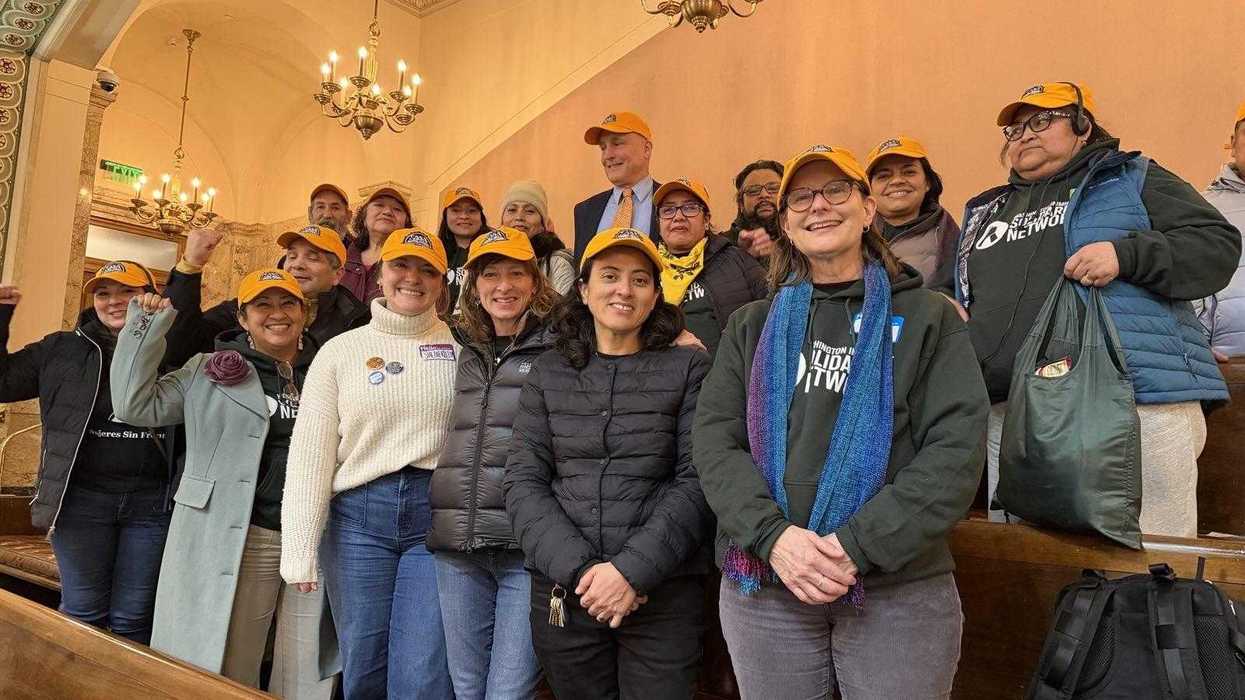
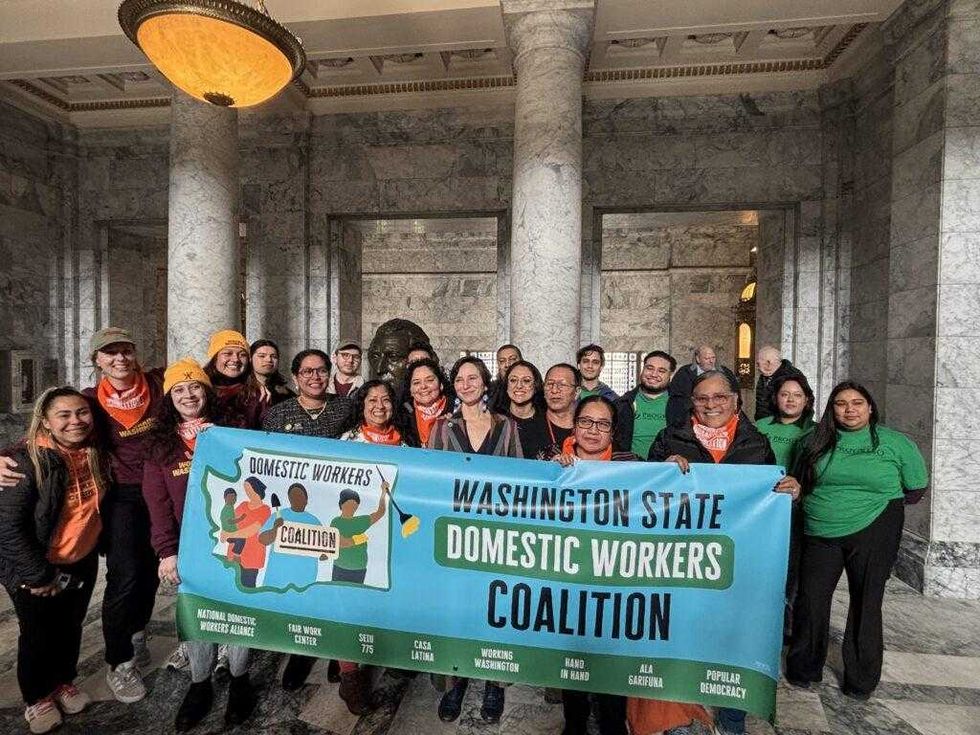 State Sen. Rebecca Saldaña, center, stands with members of the Washington State Domestic Workers Coalition at the state Capitol on Feb. 28, 2026. The Domestic Workers Bill of Rights passed in the House that day, before being signed into law in March. (Photo courtesy of Casa Latina)

The President Invited Iran to Bomb My Home