

Skip to content
Search

Latest Stories

Follow Us:
Top Stories

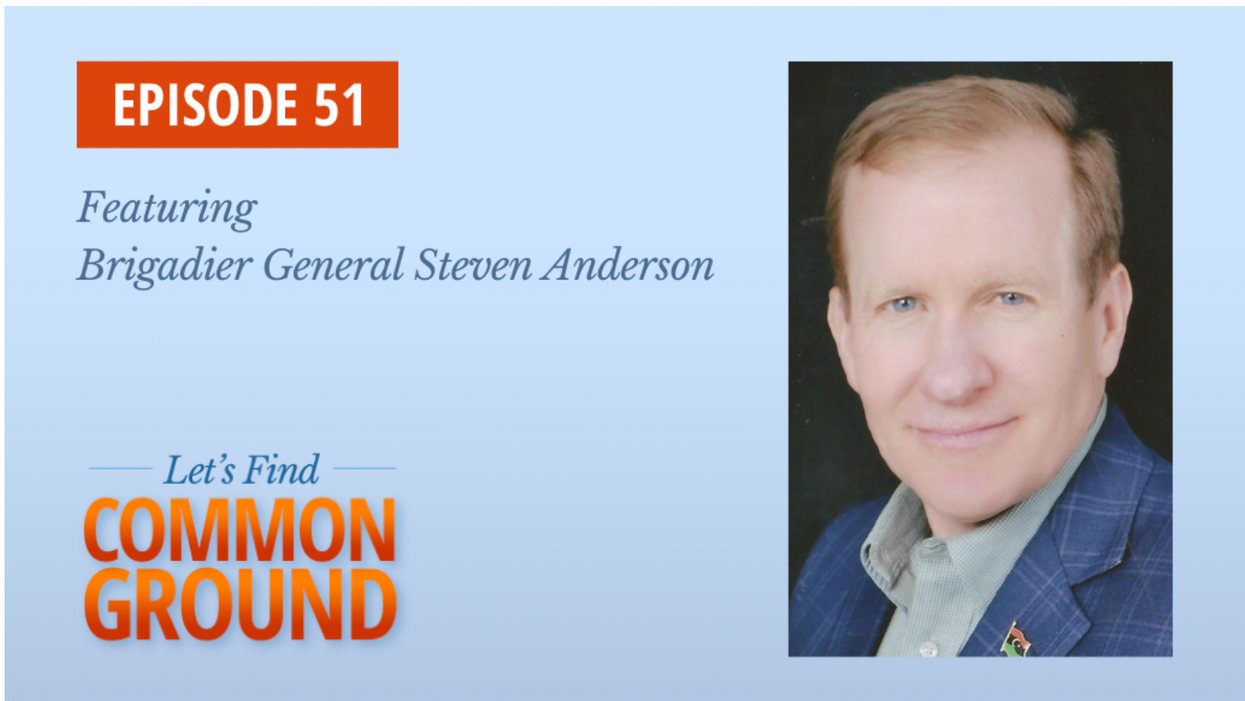
Podcast: Can our military help protect the future of American democracy?

Podcast: Can our military help protect the future of American democracy?

The riot at the U.S. Capitol on January 6th, 2020, and the deep partisan divide since then over what happened on that chaotic day and who should be held responsible, added to deep concerns about the future of American democracy.

After decades of service in the U.S. military, retired Brigadier General Steven Anderson decided to speak out about the threat of future insurrections and the possibility that a coup might succeed next time. “There is a significant threat being posed to our nation and our democracy,” he says.


While some of those arrested and charged in the attack were veterans or even active members of the military, General Anderson says America’s armed forces can play a constructive role in the future. In this episode of “Let’s Find Common Ground,” he says the Pentagon should order a civics review for all members—uniformed and civilian—on the U.S. Constitution and electoral integrity. We also discuss how the military can foster diversity and common ground.

Listen now


Read More

Virginia Gov. Abigail Spanberger delivers the Democratic response to U.S. President Donald Trump's State of the Union address on February 24, 2026 in Williamsburg, Virginia.

Virginia Gov. Abigail Spanberger delivers the Democratic response to U.S. President Donald Trump's State of the Union address on February 24, 2026 in Williamsburg, Virginia.

Getty Images, Mike Kropf

Three Questions Linger After State of the Union Speech

Anyone tuning into the State of the Union expecting responsible governance was sorely disappointed. What they got instead was pure Trumpian spectacle.

All the familiar elements were there: extended applause lines, culture-war provocation, even self-congratulation, praising the U.S. hockey team and folding its victory into a broader narrative of national resurgence. The whole thing was show business, crafted for reaction rather than reflection, for clips rather than consensus.

Keep ReadingShow less
When Secrecy Becomes Structural

U.S. President Donald Trump at the White House February 20, 2026 in Washington, DC.

(Photo by Kevin Dietsch/Getty Images)

When Secrecy Becomes Structural

Secrecy is like a shroud of fog. By limiting what people can see and check for themselves, the public gets either a glimpse (or nothing at all), depending on what gatekeepers decide to share. And just as fog comes in layers, so does withholding: one missing document, one delayed detail, one “not available” that becomes routine.

Most adults understand there are things that shouldn’t be shown. Lawyers can’t reveal case details to people who aren’t involved. Police don’t release information during an active investigation. Doctors shouldn’t discuss your medical history at home. The reason is simple: actual harm can follow when sensitive information is revealed too early or to those who shouldn’t be told.

Keep ReadingShow less
The spectacle of Operation Epic Fury
A general view of Tehran with smoke visible in the distance after explosions were reported in the city, on March 02, 2026 in Tehran, Iran.
(Photo by Contributor/Getty Images)

The spectacle of Operation Epic Fury

The U.S. and Israel’s joint military campaign against Iran, which rolled out under the name Operation Epic Fury, is a phrase that sounds more like a summer action film than a real‑world conflict in which people are dying. The operation involves massive strikes across Iran, with U.S. Central Command reporting that more than 1,700 targets have been hit in the first 72 hours. President Donald Trump described it as a “massive and ongoing operation” aimed at dismantling Iran’s military capabilities.

This framing matters. When leaders adopt language that emphasizes spectacle, they risk shifting public perception away from the gravity of war. The death of Iran’s supreme leader following the bombardment, for example, was a world‑altering event, yet it unfolded under a banner that evokes adrenaline rather than anguish.

Keep ReadingShow less
How Race and Species are Leveraged Against Each Other

Texas Rep. Al Green held a sign reading "Black People Aren't Apes," protesting a racist video Trump had previously shared on Truth Social. Green was escorted out of the House chamber just minutes into President Donald Trump's State of the Union address.

How Race and Species are Leveraged Against Each Other

This was nothing new.

Before President Donald Trump released a video on his Truth Social account earlier this month that depicted Michelle and Barack Obama as apes, many were already well aware of his compulsive use of AI-generated deepfake content to disparage the former president. Many were also well aware of his tendency to employ dehumanizing rhetoric to describe people of color.

Keep ReadingShow less