




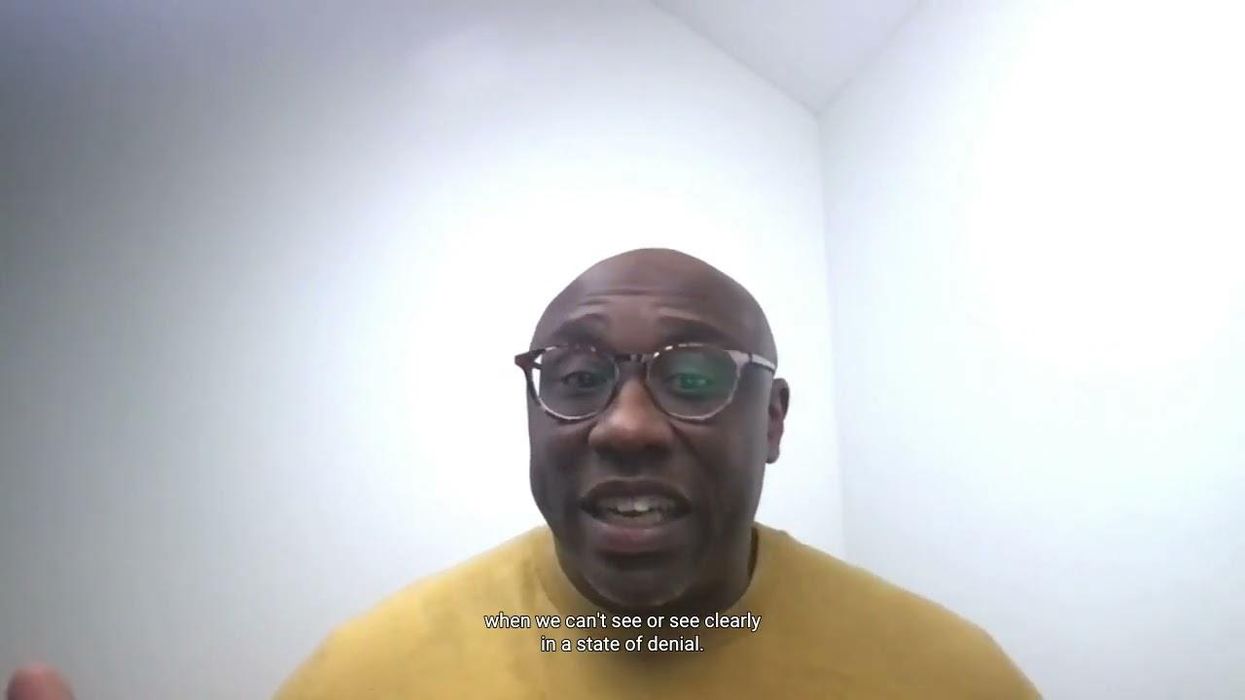
In recognition of Black History Month, Rev. Dr. F. Willis Johnson, Jr., Vice President of Partnerships and Programming with the Bridge Alliance, shares his thoughts on racial justice, the existence of color lines in America, and the work that remains for us all to cross these lines to help achieve an inclusive democracy.
Video: an open letter to the bridging field
The Fulcrum An Open Letter to the Bridging Field

By F. Willis JohnsonFeb 25, 2022
F. Willis Johnson
Rev. Dr. F. Willis Johnson, Jr., serves as vice president of partnerships and programming with the Bridge Alliance.
A third-generation educator, Rev. Dr. F. Willis Johnson is a spiritual entrepreneur, Senior Minister of Living Tree Church and adjunct faculty at Methodist Theological School of Ohio. Johnson formerly served as senior minister of Wellspring Church in Ferguson, Missouri, a predominately African-American intergenerational urban parachute church plant.
Rev. Dr. Johnson is respected for his leadership and strategies around social and racial justice issues. Recognized as a scholar-practitioner, Johnson authored Holding Up Your Corner: Talking About Race in Your Community, and is a sought after thought-leader who empowers individuals and communities towards prophetic response—healing, justice and reconciliation. With some 19 years of professional ministry experience in Indiana, North Carolina, and Missouri, Johnson’s skills extend far beyond the pulpit. Trained in education and nonprofit management, he has served in volunteer and paid leadership positions for multiple nonprofit organizations. He counsels bishops, General Board agencies, annual conferences, and local churches across the country. Johnson in 2017 was the Vosburgh Visiting Professor of Ministry and Social Engagement at Drew University’s Theological School.














Democratic U.S. Senate candidate Graham Platner speaks to voters at a town hall at the Elks Lodge 188 on June 7, 2026, in Portland, Maine.
McConnell and Platner both feel entitled
The two men could not be more different. One, a Republican, octogenarian, seven-term Southern senator, the other a progressive, millennial Maine oysterman who’s never spent a day in elected office.
But Mitch McConnell, the senior senator from Kentucky who’s been MIA for the past few weeks and Graham Platner, the Maine Senate candidate who’s facing calls to drop out of his race against Sen. Susan Collins, apparently do have something in common: an outsized sense of entitlement.
McConnell, who is 84 and not running for reelection, has been hospitalized for three weeks, and yet we still don’t fully know what he was admitted for or what his condition is. Per CNN, “his office has not disclosed a medical reason for the hospitalization or provided specifics on his health status beyond saying last week that he ‘continues to improve’ and ‘is working closely with his staff on Kentucky and Senate matters.’ ”
While several legislators have said they’ve talked to him and insist he sounds strong, others have said they are completely in the dark. One MAGA influencer, Laura Loomer, posted ”High level source close to the White House tells me ‘Mitch McConnell is officially brain dead. He’s not coming back.’ ”
Meanwhile, up in Maine, Platner has been artfully dodging calls from his own party to drop out of his race after several allegations of misconduct from women, including a sexual assault allegation from a former girlfriend, came to light. While Platner, who has managed to survive a Nazi-tattoo scandal, a sexting scandal, and several old tweets scandals, denies the allegations, he has not quit.
High-profile Democrats including Sens. Bernie Sanders and Chuck Schumer, the latter of whom had unsuccessfully hand-selected Maine Gov. Janet Mills to face Collins instead of Platner, have urged Platner to drop out, while other Dems have accused him of trying to influence the picking of his replacement.
Maine Democratic Party Executive Director Devon Murphy-Anderson released a statement Tuesday, which said in part:
“Unfortunately, Graham Platner’s team has repeatedly reached out to us in an attempt to put their thumb on the scale of what this process looks like. We have repeatedly reiterated to Graham Platner’s team that they have no role in determining our next Democratic nominee for the U.S. Senate nor in determining what this process looks like.”
Both incidents show a deep lack of accountability to voters, who in one case deserve to know whether their senator is capable of performing his duties, and in another deserve a candidate who isn’t being accused of crimes, bigotry and deception.
The offensive and odious entitlement of both McConnell and Platner stands out not because it is particularly unique among today’s political class. Tom Kean, the New Jersey GOP congressman, missed more than 100 votes, only sharing after a three-month mystery absence that he was dealing with depression.
Former President Joe Biden’s Defense Secretary Lloyd Austin failed to disclose a hospitalization for prostate cancer surgery, flouting the established rules for Cabinet members and senior U.S. officials.
From Biden’s insistence on running for reelection despite his obvious cognitive and political weaknesses to Trump’s brazen flouting of laws and norms, few politicians seem to appreciate that their public service job comes with responsibilities to constituents, including transparency and honesty.
But both parties increasingly justify the chicanery, because the stakes of winning elections and keeping power are simply too high. But that’s no excuse. If we’ve learned anything over the past decade, it’s that character and accountability do, in fact, matter. And when we, the voters, stop caring about it, well, so do they.
S.E. Cupp is the host of "S.E. Cupp Unfiltered" on CNN.