



Skip to content
Search

Latest Stories

Follow Us:
Top Stories

Video: SNF Agora Symposium on Civic Health Highlights

SNF Agora Symposium on Civic Health Highlights
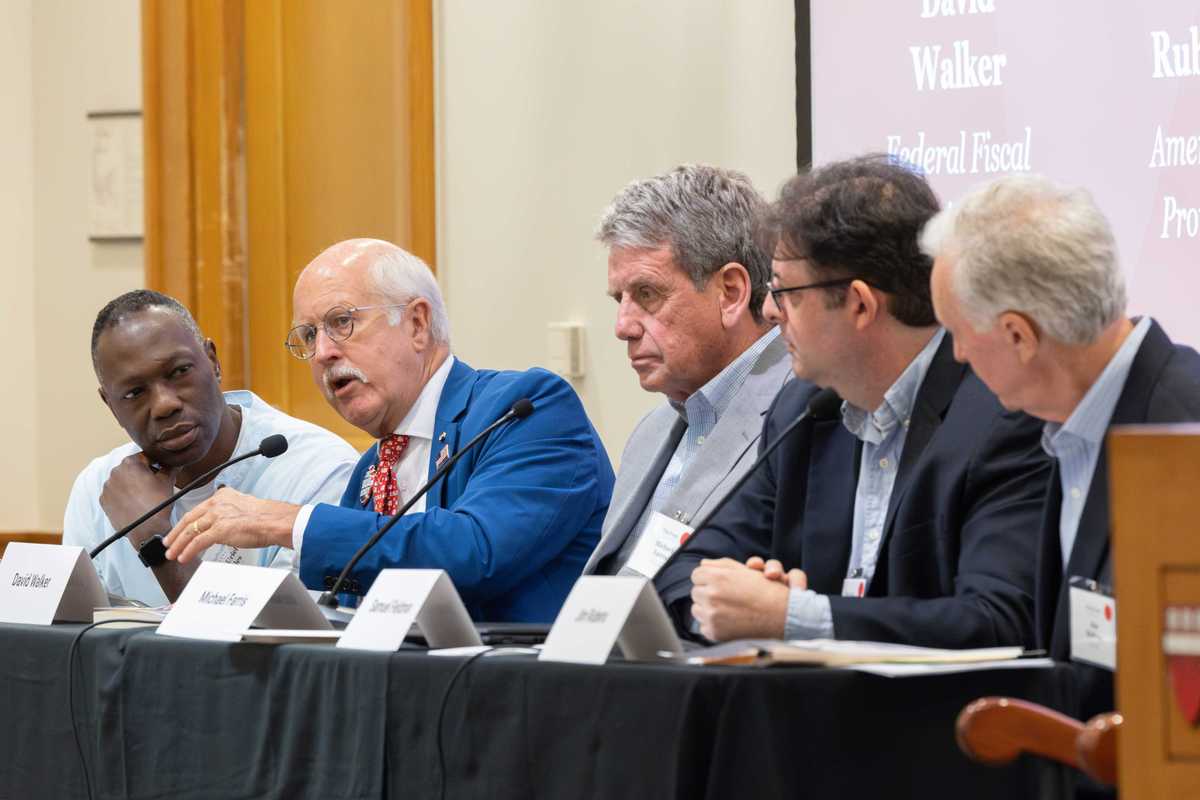
For democracies around the globe, COVID-19 has brought into stark relief the ways that citizens’ health and very lives can depend on how their government functions. But the reverse is also true: the health of democracy – and its ability to safeguard our health – depends on how we as citizens participate. SNF Agora's symposium brought together scholars, innovators, and health officials who, in their own work, are showing how health and democracy are linked in unexpected ways, and who are developing tools that can help us change the trajectory of health in our own communities. Through the discussions, participants saw how they can use their voice in civic and democratic processes to improve the well-being of global democracy, and the planet itself.


Read More

John Adams

When institutions fail, what must citizens do to preserve a republic? Drawing on John Adams, this essay examines disciplined refusal and civic responsibility.

en.m.wikipedia.org

John Adams on Virtue: After the Line Is Crossed

This is the third Fulcrum essay in my three-part series, John Adams on Virtue, examining what sustains a republic when leaders abandon restraint, and citizens must decide what can still be preserved.

Part I, John Adams Warned Us: A Republic Without Virtue Can Not Survive, explored what citizens owe a republic beyond loyalty or partisanship. Part II, John Adams and the Line a Republic Should Not Cross, examined the lines a republic must never cross in its treatment of its own people. Part III turns to the hardest question: what citizens must do when those lines are crossed, and formal safeguards begin to fail. Their goal cannot be the restoration of a past normal, but the preservation of the capacity to rebuild a political order after sustained institutional damage.

Keep ReadingShow less
Marco Rubio: 2028 Presidential Contender?

U.S. Secretary of State Marco Rubio arrives to testify during a Senate Foreign Relations Committee hearing in the Dirksen Senate Office Building on Capitol Hill on January 28, 2026 in Washington, DC. This is the first time Rubio has testified before Congress since the Trump administration attacked Venezuela and seized President Nicolas Maduro, bringing him to the United States to stand trial.

(Photo by Chip Somodevilla/Getty Images)

Marco Rubio: 2028 Presidential Contender?

Marco Rubio’s Senate testimony this week showcased a disciplined, media‑savvy operator — but does that make him a viable 2028 presidential contender? The short answer: maybe, if Republicans prioritize steadiness and foreign‑policy credibility; unlikely, if the party seeks a fresh face untainted by the Trump administration’s controversies.

"There is no war against Venezuela, and we did not occupy a country. There are no U.S. troops on the ground," Rubio said, portraying the mission as a narrowly focused law‑enforcement operation, not a military intervention.

Keep ReadingShow less
The map of the U.S. broken into pieces.

In Donald Trump's interview with Reuters on Jan. 24, he portrayed himself as an "I don't care" president, an attitude that is not compatible with leadership in a constitutional democracy.

Getty Images

Donald Trump’s “I Don’t Care” Philosophy Undermines Democracy

On January 14, President Trump sat down for a thirty-minute interview with Reuters, the latest in a series of interviews with major news outlets. The interview covered a wide range of subjects, from Ukraine and Iran to inflation at home and dissent within his own party.

As is often the case with the president, he didn’t hold back. He offered many opinions without substantiating any of them and, talking about the 2026 congressional elections, said, “When you think of it, we shouldn’t even have an election.”

Keep ReadingShow less
The Deadly Shooting in Minneapolis and How It Impacts the Rights of All Americans

A portrait of Renee Good is placed at a memorial near the site where she was killed a week ago, on January 14, 2026 in Minneapolis, Minnesota. Good was fatally shot by an immigration enforcement agent during an incident in south Minneapolis on January 7.

(Photo by Stephen Maturen/Getty Images)

The Deadly Shooting in Minneapolis and How It Impacts the Rights of All Americans

Thomas Paine famously wrote, "These are the times that try men's souls," when writing about the American Revolution. One could say that every week of Donald Trump's second administration has been such a time for much of the country.

One of the most important questions of the moment is: Was the ICE agent who shot Renee Good guilty of excessive use of force or murder, or was he acting in self-defense because Good was attempting to run him over, as claimed by the Trump administration? Local police and other Minneapolis authorities dispute the government's version of the events.

Keep ReadingShow less