
Skip to content
Search

Latest Stories

Follow Us:
Top Stories

Kansas GOP splits over new law making it easier to vote

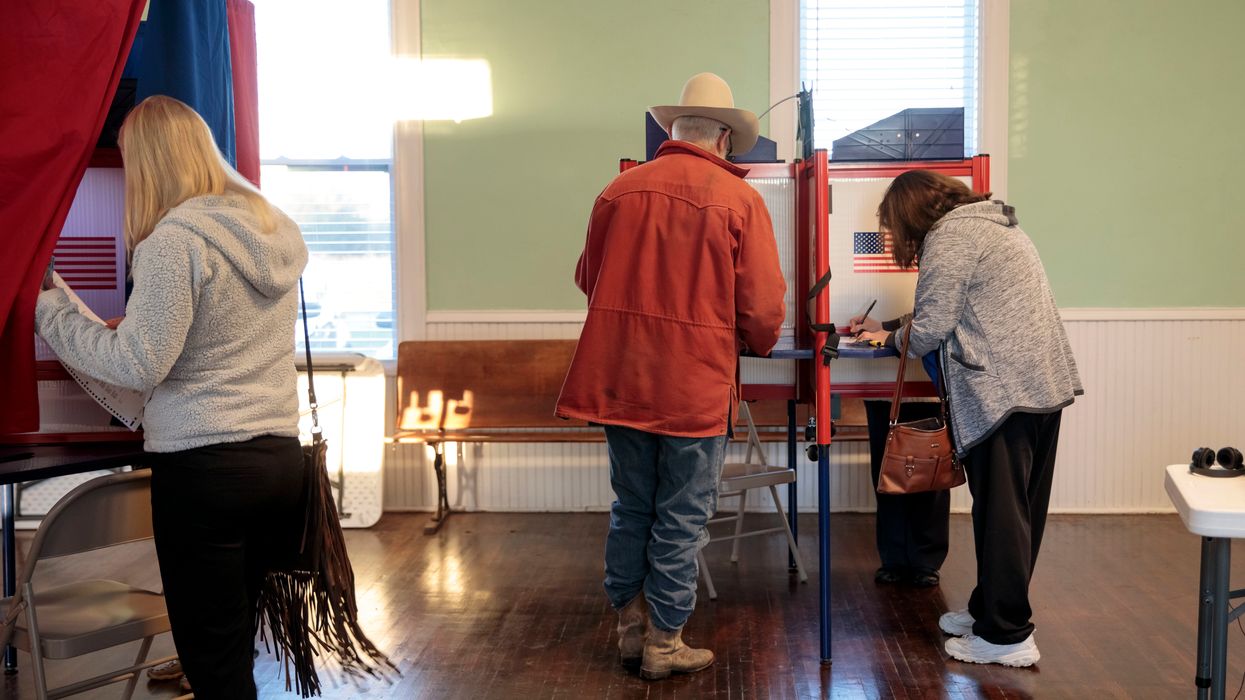
Voters cast ballots in Kansas

Voting in 2018 in Peoria, an hour southwest of Kansas City. A new law is supposed to give Kansans more flexibility to choose where to cast ballots in their county.

Whitney Curtis/Getty Images

Efforts to expand access to the ballot box in Kansas in time for the presidential election face further delays because of an intensifying dispute among the Republicans in charge in Topeka.

Ten months ago the Legislature enacted a law giving voters a broader choice of polling places. But Secretary of State Scott Schwab, who took office last year, has delayed instituting the change because he says it raises security concerns — and that at least a year more is needed to ensure electronic voter lists and computer systems are ready.

Even some of his fellow Republicans at the statehouse say Schwab is creating flimsy excuses masking his disinterest in making it more convenient to vote in a year when Kansas' traditionally deep red hue is going to be tested, especially in an open-seat Senate contest.

The tussle also revives the image of Kansas as a voting rights minefield that was set when conservative Republican Kris Kobach was secretary of state and pushed for some of the country's strictest voter ID laws, including a proof-of-citizenship requirement for new voters now on hold in the courts. Koback is now running for the Senate.


Kansas' law would allow voters to cast ballots at any of the dozens of voting centers set up by their home counties rather than at their precinct-specific polling locations. Proponents say this gives voters more flexibility and will boost turnout. Currently, 16 states have laws that permit counties to run voting centers, according to the National Conference of State Legislatures.

While it will take time to implement this new system, Democratic and Republican lawmakers alike agree that at the very least Sedgwick County, which includes the state's largest city, Wichita, can handle the change. Sedgwick already has multiple voting sites linked and the voting equipment, in place since 2017, allows for polling place flexibility.

At the end of January, a bipartisan group of 26 legislators introduced a bill that would allow Sedgwick County voters to use any polling place for the 2020 primary and general elections. However, last week, two scheduled hearings for this bill were canceled.

Read More

Let's End Felony Disenfranchisement. Virginia May Lead the Way

Virginia Governor-elect Abigail Spanberger promises major reforms to the state’s felony disenfranchisement system.

Getty Images, beast01

Let's End Felony Disenfranchisement. Virginia May Lead the Way

When Virginia’s Governor-Elect, Abigail Spanberger, takes office next month, she will have the chance to make good on her promise to do something about her state’s outdated system of felony disenfranchisement. Virginia is one of just three states where only the governor has the power to restore voting rights to felons who have completed their prison terms.

It is the only state that also permanently strips a person’s rights to be a public notary or run for public office for a felony conviction unless the governor restores them.

Keep ReadingShow less
​Marjorie Taylor Greene.

Marjorie Taylor Greene’s resignation highlights the Primary Problem—tiny slivers of voters deciding elections. Here’s why primary reform and open primaries matter.

Getty Images, Anna Moneymaker

Marjorie Taylor Greene Resigns: The Primary Problem Exposes America’s Broken Election System

The Primary Problem strikes again. In announcing her intention to resign from Congress in January, Rep. Marjorie Taylor Greene (R-GA) became the latest politician to quit rather than face a primary challenge from her own party.

It’s ironic that Rep. Greene has become a victim of what we at Unite America call the "Primary Problem," given that we often point to her as an example of the kind of elected official our broken primary system produces. As we wrote about her and Rep. Alexandria Ocasio-Cortez, “only a tiny sliver of voters cast meaningful votes that elected AOC and MTG to Congress – 7% and 20%, respectively.”

Keep ReadingShow less
Jolt Initiative Hits Back at Texas Attorney General Ken Paxton in Fight Over Voter Registration

Texas Attorney General Ken Paxton, who is running for U.S. Senate, speaks at an event in Lubbock on Oct 7, 2025. Paxton is seeking to shut down Jolt Initiative, a civic engagement group for Latinos, alleging that it's involved in illegal voter registration efforts. The group is fighting back.

Trace Thomas for The Texas Tribune

Jolt Initiative Hits Back at Texas Attorney General Ken Paxton in Fight Over Voter Registration

Jolt Initiative, a nonprofit that aims to increase civic participation among Latinos, is suing Texas Attorney General Ken Paxton to block his efforts to shut the organization down.

Paxton announced Monday that he was seeking to revoke the nonprofit’s charter, alleging that it had orchestrated “a systematic, unlawful voter registration scheme.”

Keep ReadingShow less
MAGA Gerrymandering, Pardons, Executive Actions Signal Heightened 2026 Voting Rights Threats

A deep dive into ongoing threats to U.S. democracy—from MAGA election interference and state voting restrictions to filibuster risks—as America approaches 2026 and 2028.

Getty Images, SDI Productions

MAGA Gerrymandering, Pardons, Executive Actions Signal Heightened 2026 Voting Rights Threats

Tuesday, November 4, demonstrated again that Americans want democracy and US elections are conducted credibly. Voter turnout was strong; there were few administrative glitches, but voters’ choices were honored.

The relatively smooth elections across the country nonetheless took place despite electiondenial and anti-voting efforts continuing through election day. These efforts will likely intensify as we move toward the 2026 midterms and 2028 presidential election. The MAGA drive for unprecedented mid-decade, extreme political gerrymandering of congressional districts to guarantee their control of the House of Representatives is a conspicuous thrust of their campaign to remain in power at all costs.

Keep ReadingShow less