
Skip to content
Search

Latest Stories

Follow Us:
Top Stories

Video: Ukraine, NATO, and Putin

Ukraine, NATO, And Putin Fulcrum Video

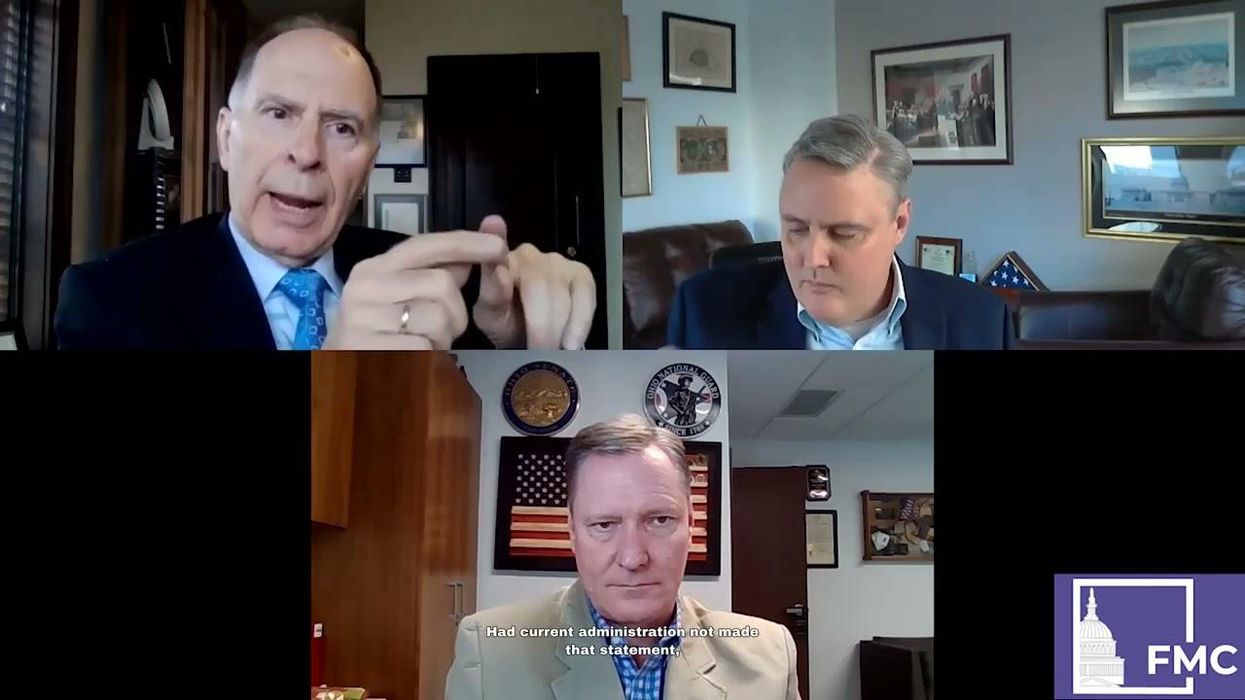
From social media to cable news, all the American public sees from our leaders are partisan attacks and hyperbolic rhetoric, but that's not the way it has to be. To prove it, Former Members of Congress (FMC) and the Fulcrum have joined forces to bring you Congress at a Crossroads.

The monthly video series brings together former members of both parties to discuss the structural issues in today's Congress, as well as the hottest political issues. They won't always agree, but they will always treat each other with respect and civility. This month, our host, FMC CEO Pete Weichlein sat down with Former Reps. Bill Enyart (D-IL) and Steve Stivers (R-OH) to discuss the current situation in Ukraine, and what it means for the rest of the world.


Read More

Who Should Lead Venezuela? Trump Says U.S. Will “Run the Country,” but Succession Questions Intensify

U.S. President Donald Trump at Trump’s Mar-a-Lago club on December 28, 2025 in Palm Beach, Florida.

AI generated image with Photo by Joe Raedle/Getty Images

Who Should Lead Venezuela? Trump Says U.S. Will “Run the Country,” but Succession Questions Intensify

CARACAS, Venezuela — Hours after U.S. forces captured Venezuelan President Nicolás Maduro in a large‑scale military operation, President Donald Trump said the United States would “run the country” until a “safe, proper, and judicious transition” can take place. The comments immediately triggered a global debate over who should govern Venezuela during the power vacuum left by Maduro’s removal.

Trump said Venezuelan Vice President Delcy Rodríguez had been sworn in as interim president.The president said that “we’ve spoken to her [Rodriguez] numerous times, and she understands, she understands.” However, Rodríguez, speaking live on television Saturday, condemned the U.S. attack and demanded "the immediate release of President Nicolas Maduro and his wife Cilia Flores. The only president of Venezuela, President Nicolas Maduro."

Keep ReadingShow less
After the Ceasefire, the Violence Continues – and Cries for New Words

An Israeli army vehicle moves on the Israeli side, near the border with the Gaza Strip on November 18, 2025 in Southern Israel, Israel.

(Photo by Amir Levy/Getty Images)

After the Ceasefire, the Violence Continues – and Cries for New Words

Since October 10, 2025, the day when the US-brokered ceasefire between Israel and Hamas was announced, Israel has killed at least 401 civilians, including at least 148 children. This has led Palestinian scholar Saree Makdisi to decry a “continuing genocide, albeit one that has shifted gears and has—for now—moved into the slow lane. Rather than hundreds at a time, it is killing by twos and threes” or by twenties and thirties as on November 19 and November 23 – “an obscenity that has coalesced into a new normal.” The Guardian columnist Nesrine Malik describes the post-ceasefire period as nothing more than a “reducefire,” quoting the warning issued by Amnesty International’s secretary general Agnès Callamard that the ”world must not be fooled” into believing that Israel’s genocide is over.

A visual analysis of satellite images conducted by the BBC has established that since the declared ceasefire, “the destruction of buildings in Gaza by the Israeli military has been continuing on a huge scale,” entire neighborhoods “levelled” through “demolitions,” including large swaths of farmland and orchards. The Guardian reported already in March of 2024, that satellite imagery proved the “destruction of about 38-48% of tree cover and farmland” and 23% of Gaza’s greenhouses “completely destroyed.” Writing about the “colossal violence” Israel has wrought on Gaza, Palestinian legal scholar Rabea Eghbariah lists “several variations” on the term “genocide” which researchers found the need to introduce, such as “urbicide” (the systematic destruction of cities), “domicide” (systematic destruction of housing), “sociocide,” “politicide,” and “memoricide.” Others have added the concepts “ecocide,” “scholasticide” (the systematic destruction of Gaza’s schools, universities, libraries), and “medicide” (the deliberate attacks on all aspects of Gaza’s healthcare with the intent to “wipe out” all medical care). It is only the combination of all these “-cides,” all amounting to massive war crimes, that adequately manages to describe the Palestinian condition. Constantine Zurayk introduced the term “Nakba” (“catastrophe” in Arabic) in 1948 to name the unparalleled “magnitude and ramifications of the Zionist conquest of Palestine” and its historical “rupture.” When Eghbariah argues for “Nakba” as a “new legal concept,” he underlines, however, that to understand its magnitude, one needs to go back to the 1917 Balfour Declaration, in which the British colonial power promised “a national home for the Jewish people” in Palestine, even though just 6 % of its population were Jewish. From Nakba as the “constitutive violence of 1948,” we need today to conceptualize “Nakba as a structure,” an “overarching frame.”

Keep ReadingShow less
Ukraine, Russia, and the Dangerous Metaphor of Holding the Cards
a hand holding a deck of cards in front of a christmas tree
Photo by Luca Volpe on Unsplash

Ukraine, Russia, and the Dangerous Metaphor of Holding the Cards

Donald Trump has repeatedly used the phrase “holding the cards” during his tenure as President to signal that he, or sometimes an opponent, has the upper hand. The metaphor projects bravado, leverage, and the inevitability of success or failure, depending on who claims control.

Unfortunately, Trump’s repeated invocation of “holding the cards” embodies a worldview where leverage, bluff, and dominance matter more than duty, morality, or responsibility. In contrast, leadership grounded in duty emphasizes ethical obligations to allies, citizens, and democratic principles—elements strikingly absent from this metaphor.

Keep ReadingShow less