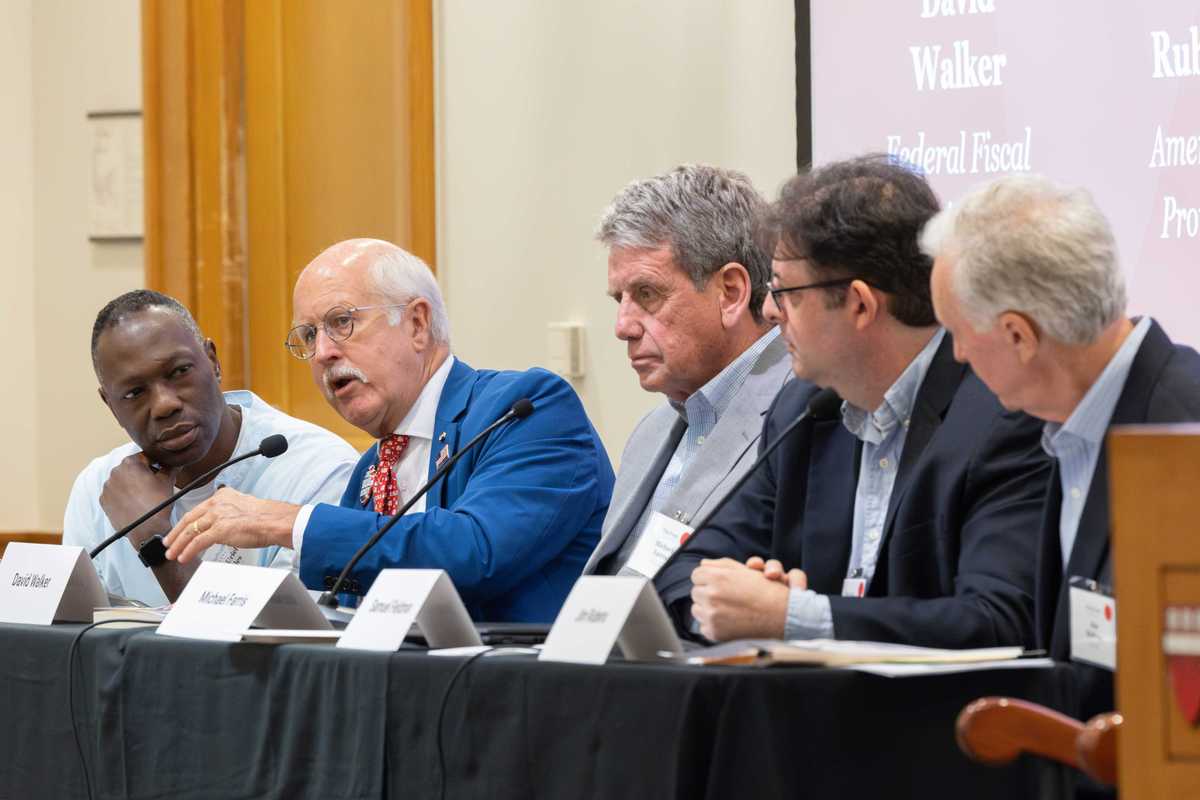

What is the value of dialogue in a polarized world? In episode four of Collage, Dr. F. Willis Johnson and guest Dr. Kenann F. McKenzie, Director Generous Listening and Dialogue Center (GLADC), reflect on that question as well as curating of space and innovative practices where dialogue becomes a way of redress to the inequitable dimensions that tarnish the work of bridging and deliberative discourse.
Site Navigation
Search
Latest Stories
Start your day right!
Get latest updates and insights delivered to your inbox.
Top Stories
Latest news
Read More
Governors Cox and Shapiro Urge Nation to “Lower the Temperature” Amid Rising Political Violence
Dec 13, 2025
In the days following the murder of conservative activist Charlie Kirk, I wrote Governor Cox’s Prayer Wasn’t Just Misguided—It Was Dangerous, an article sharply criticizing Utah Gov. Spencer Cox for his initial public response. Rather than centering his remarks on the victim, the community’s grief, or the broader national crisis of political violence, Cox told reporters that he had prayed the shooter would be from “another state” or “another country.” That comment, I argued at the time, was more than a moment of emotional imprecision—it reflected a deeper and more troubling instinct in American politics to externalize blame. By suggesting that the perpetrator might ideally be an outsider, Cox reinforced long‑standing xenophobic narratives that cast immigrants and non‑locals as the primary sources of danger, despite extensive evidence that political violence in the United States is overwhelmingly homegrown.
Recently, Cox joined Pennsylvania Governor, Democrat Josh Shapiro, issuing a rare bipartisan warning about the escalating threat of political violence in the United States, calling on national leaders and citizens alike to “tone it down” during a joint interview at the Washington National Cathedral.
- YouTube www.youtube.com
The conversation, conducted by CNN’s Dana Bash, brought together two leaders whose states have been shaken by high‑profile acts of political extremism. “Political violence traumatized our states,” Bash said in the introduction to the segment, framing the urgency of their message.
Shapiro, who has faced multiple politically motivated attacks—including an assassination attempt involving a firebombing at the Pennsylvania governor’s mansion—said the country is at a breaking point. “We cannot keep going down this road where disagreement becomes dehumanization,” he told CNN. “Leaders have a responsibility to turn down the rhetoric before someone else gets hurt.”
Cox echoed the sentiment. “We’ve seen firsthand what happens when people stop seeing each other as Americans,” he said. “This is not about left or right. It’s about whether we can continue to live together in a functioning democracy”.
Both governors emphasized that political leaders—including President Donald Trump—must help reduce tensions. Shapiro was direct: “Everyone, including the president, has a role to play in lowering the temperature”.
Cox, who has championed a national depolarization initiative called Disagree Better, argued that Americans must relearn how to debate without hatred. “We’re not going to agree on everything,” he said. “But we can disagree in ways that don’t lead to violence”.
Despite their shared message, the two occasionally diverged on policy issues such as social media regulation and economic priorities. Still, their joint appearance was a deliberate show of unity. “We don’t have to think the same to stand together against violence,” Shapiro said.
Their bipartisan appeal comes as political tensions continue to rise nationwide, with both governors warning that without collective action, the country risks “normalizing the unacceptable.”
Hugo Balta is the executive editor of the Fulcrum and the publisher of the Latino News Network.
Keep Reading
Show less
Recommended

New research shows Americans overwhelmingly support collaboration across differences and look to charitable foundations and nonprofits to model unity and real problem-solving.
Getty Images, FilippoBacci
As Americans Look for Unity, The Charitable Sector Provides a Model
Dec 12, 2025
As the United States confronts the limits of its own divisions, it can feel as though blame has replaced problem-solving in nearly every area of public life. That perception has led to public trust in just about every major institution—from government to media, religious institutions, and nonprofits—reaching historic lows.
But Americans are tired of division—and new research confirms that. A national survey by the Council on Foundations and Hattaway Communications found that nearly nine in ten Americans (89%) support working across differences, and 80% believe charitable foundations should play an important role in modeling that collaboration. The vast majority—across political lines—remain optimistic about the future, and fewer than one in four believe the country is “hopelessly divided." And despite narratives to the contrary, they believe charitable foundations and nonprofits should play a leading role in modeling how to bring people together.
In a moment when polarization dominates headlines, these findings tell a clear story: Americans still believe in the power of working together. The large majority of survey respondents agreed with the statement: “To make a difference in the world, you need to be able to work with people you disagree with.” The survey shows they believe that every sector has a role to play—starting with government, but extending to businesses, faith groups, and philanthropy. And they look to charitable foundations and nonprofits as examples of how collaboration can actually work.
Our survey found that Americans overwhelmingly believe collaboration across differences is how real problems get solved—citing working together on hard issues, creating stronger communities, and finding more effective solutions as the top reasons for doing so. This isn’t a niche or ideological position—it’s a widely shared conviction about how progress happens in America. And it is precisely the work that philanthropy does: bringing people with different experiences and perspectives around the same table to make tangible progress.
The hope people expressed in these findings already has a home in the charitable sector. The work of foundations and the nonprofits they work with shows us regularly that our diversity of identities, priorities, and worldviews isn’t an obstacle to overcome but a resource to draw from when the nation feels most fractured. Whether it’s the local church feeding neighbors during an economic downturn, or the local YMCA providing emergency childcare for first responders during the pandemic, foundations and nonprofits are a steadying force that show up brightest in our darkest times, creating progress by tapping into the strengths in our differences.
Rooted in Purpose
Across the country, charitable foundations are providing the resources and support necessary to not only help local nonprofits support the job creation, small-business recovery, and affordable housing communities rely on–but also provide a critical model for supporting the dialogue, participation, and collaboration that healthy societies depend on.
Consider Lilly Endowment’s $22.4 million grant to support Weave, a program of the Aspen Institute founded by former editor and columnist David Brooks. Weave was created to address one of America’s deepest challenges: a breakdown of trust and belonging. By connecting 75 community-based organizations and thousands of local leaders, Weave helps towns across the country rediscover what it means to live and work together. Its “weavers” aren’t political figures—they’re the neighbors, teachers, faith leaders, and small business owners building stronger communities one relationship at a time. As Lilly Endowment Chairman and CEO N. Clay Robbins put it, “Time and time again, we have seen that neighbors working together to address an important local need can heal fractures and correct misunderstandings in a community.”
The same spirit is visible in Park City, Utah, where the Park City Community Foundation’s Early Childhood Alliance helped unite city officials, county leaders, and nonprofits to confront one of the most pressing challenges for working families: the rising cost of childcare. In a community known for its high cost of living, families were struggling to balance car payments, mortgages, and childcare fees that rivaled rent. In response, the foundation partnered with the City of Park City, Summit County, and the nonprofit Upwards to launch a needs-based childcare scholarship program—ensuring that 100% of public funding for tuition assistance goes directly to families.
For many parents, the support was life changing. For local employers, it stabilized the workforce—city employees even receive childcare stipends as a benefit. What began as a local experiment has now generated a $4.5 million economic impact and drawn national attention as a model for other communities.
If this new data offers a glimpse of hope—countering the narrative of division with evidence that people still believe in unity—then these examples should give us optimism. They provide a model for what’s possible when communities choose connection over division. By supporting that critical work, charitable foundations and generous donors offer more than relief—they offer a model for how our nation can begin to move forward, one act of generosity at a time. During this season, let this remind us of something essential to our American spirit: generosity has always been one of our nation’s most powerful problem-solving tools.
Kathleen Enright is the president and CEO of the Council on Foundations. She has spent more than two decades working to make the philanthropic sector more vital, open, and effective. Widely respected as a mission-driven leader and coalition builder, she has led the Council since 2019, strengthening its vision, value to the field, and engagement with members nationwide.
Keep Reading
Show less

U.S. Vice President JD Vance delivers remarks to members of the US military on November 26, 2025 in Fort Campbell, Kentucky. The Vice President visited Fort Campbell to serve a Thanksgiving meal to service members ahead of the holiday.
Getty Images, Brett Carlsen
Vice President J.D. Vance’s Tiebreaking Senate Votes, 2025
Dec 12, 2025
On issues including tariffs, taxes, public media like PBS and NPR, and Pete Hegseth’s confirmation as Secretary of Defense, Vice President J.D. Vance broke seven tied Senate votes this year.
Here’s a breakdown of Vance’s seven tiebreaking votes.
But first, a quick comparison
How do Vance’s seven tiebreaking votes in a year stack up to his recent predecessors?
Vance’s immediate predecessor, Kamala Harris, broke seven tied votes in 2023, 11 in 2022, and 15 in 2021 – the most ever in a single year. (However, she broke none in 2024.)
Vance’s precursor as Donald Trump’s vice president, Mike Pence, broke six tied votes in 2017 and seven in 2018. (Though none in 2019 or 2020.)
Confirming Pete Hegseth as Defense Secretary
The vote
Military veteran and Fox News television host Pete Hegseth was a controversial nominee due to allegations of spousal abuse, sexual assault, and alcohol abuse. (Hegesth admitted to infidelity but denies the claims of abuse and assault.)
Three Republican senators voted against him: Sens. Susan Collins (R-ME), Mitch McConnell (R-KY), and Lisa Murkowski (R-AK). No Senate Democrat voted in favor.
On January 24, Vance cast the tiebreaking vote.
Interestingly, this marked only the second time that a Cabinet nominee was confirmed by a tiebreaking Senate vote – with the other time also under Trump. In 2017, Pence cast the tiebreaking vote for Betsy DeVos as Secretary of Education.
What Vance said
Vance argued Hegseth would shake up a military system that had produced failed wars like Afghanistan and Iraq. For the former, the Taliban reclaimed control in 2021. For the latter, no promised weapons of mass destruction were found.
"I think Pete is a disrupter, and a lot of people don't like that disruption," Vance said in his first interview as vice president, with Margaret Brennan on CBS News’s Face the Nation. "If you think about all of those bipartisan, massive votes, we have to ask ourselves, what did they get us? They got us a country where we fought many wars over the last 40 years, but haven't won a war about as long as I've been alive."
What Republican opponents said
Murkowski cited Hegseth’s limited and troubling leadership experience.
“His leadership of two veteran organizations was marked with accusations of financial mismanagement and problems with the workplace culture he fostered,” Murkowski said in a January statement.
She also voiced concerns about his views on women in the military, particularly his hesitancy towards women serving in combat roles.
“Women have served our nation with distinction, overcoming immense obstacles to excel in combat and leadership roles,” Murkowski added. “They deserve to know that their leader honors and values their commitment to our nation.”
McConnell, meanwhile, was unimpressed by Hegseth’s answers during his confirmation hearings.
“Mr. Hegseth provided no substantial observations on how to defend Taiwan or the Philippines against a Chinese attack, or even whether he believes the United States should do so,” McConnell said in a January statement. “Absent, too, was any substantive discussion of countering our adversaries’ alignment with deeper alliance relationships.”
Upholding Trump’s national emergency on trade
The vote
On April 2, President Trump issued an executive order declaring the U.S. trade deficit a national emergency, implementing tariffs on a host of nations, including many international allies.
Sen. Ron Wyden (D-OR) introduced legislation to overturn this national emergency. Three Senate Republicans crossed party lines: Sens. Collins, Murkowski, and Rand Paul (R-KY). No Senate Democrat crossed party lines.
On April 30, Vance cast the tiebreaking vote to table the bill.
What Vance said
Vance argued that tariffs level the playing field against nations that have been undercutting American employees with low wages and working conditions.
“You hear people saying, ‘Well, how dare Donald Trump impose tariffs on foreign countries,’” Vance said at a March speech in Michigan. “And the answer is that unless you're willing to use American power to fight back against what those countries have been doing for a generation, you are never going to rebuild American manufacturing and you're never going to support the American worker.”
“When foreign countries make it impossible to ship American cars into their countries, why have we had leadership that refuses to fight back?” Vance continued. “When we have foreign countries that use slave labor that undercuts the wages of American workers, why have we had American leadership that has refused to fight back?”
What Republican opponents said
Sen. Paul countered that such important policies should be determined by an institution like Congress, rather than an individual.
Especially if that individual is someone like Trump, who’s frequently changed tariff rates on other countries for such minor reasons as he didn’t like how Brazil was treating his friend or he didn’t like a commercial Ontario (Canada) aired during the World Series.
“No country, no business, no family can plan a budget when the import tax rates and the cost of every commodity are determined by the whims of one man,” Paul said in a Senate floor speech. “There are now tariffs on steel, tariffs on aluminum, tariffs on lumber – and they change from day to day. But not one of these tariffs was voted on by the people’s elected representatives in Congress. These tariffs are simply announced by presidential proclamation.”
What happens now
Interestingly, the Senate would have voted to overturn Trump’s national emergency back in April, but two senators who likely would have voted that way were absent. Sen. McConnell was sick, while Sen. Sheldon Whitehouse (D-RI) was traveling from South Korea.
More than six months later, on Nov. 3, with Sens. McConnell and Whitehouse now present and voting in favor, the Senate actually did vote to overturn the national emergency. However, House odds of passage are low – in April, Speaker Mike Johnson didn’t even allow a vote on the measure at all.
One Big Beautiful Bill Act
The One Big Beautiful Bill Act is the biggest legislation Republicans have enacted this Congress: a combination of tax breaks, new spending on immigration and border enforcement, and deregulations, particularly in the energy sector.
Three Senate Republicans voted against: Collins, Rand Paul, and Sen. Thom Tillis (R-NC). No Senate Democrats voted in favor.
On July 1, Vance cast the tiebreaking vote for it.
Earlier that day, Vance also cast two tiebreaking votes in favor of two amendments to the bill introduced by Sen. Lindsey Graham (R-SC). The Senate votes were the exact same as for the “main” bill, with those same three Senate Republicans voting against.
What Vance said
Vance argued the legislation would supercharge the American economy and put more money in the pockets of working people.
“Here's what the One Big Beautiful Bill means for you in very concrete terms. Number one, we're going to see take-home pay go up in the United States of America. In this district, probably 7,000, $8,000 per family over the next three to four years,” Vance said at a July speech in Ohio.
“If you build or expand a great American factory, the federal government is going to reward you instead of penalize you, for a change. I think that's the biggest provision in the One Big Beautiful Bill,” Vance continued. “Invest in American workers, invest in American companies.”
What Republican opponents said
After Sen. Tillis announced he would oppose the bill, the internal Republican backlash was so severe that he announced mere days later that he wouldn’t seek reelection in 2026.
Medicaid cuts were his litmus test.
“I told the president, I really do believe it could be his Obamacare,” Tillis said in his first interview after the vote, with Jake Tapper on CNN’s The Lead.
“Because of the promise that [Obama] made, which was not true: ‘If you like your doctor, you can keep your doctor,’” Tapper clarified.
“And now it’s like: ‘If you like Medicaid and you’re eligible, you can keep it,’ Tillis answered. “That’s fundamentally untrue, because the funding mechanisms are probably going to take people who are eligible for it off of it over time. Or it’s going to create an enormous unfunded mandate on the states, in a timeframe that they can’t absorb.”
What happened next
Two days later, on July 3, the House passed the larger overall legislation by 218-214. Two House Republicans voted against: Reps. Brian Fitzpatrick (R-PA1) and Thomas Massie (R-KY4). No House Democrat voted in favor.
President Trump signed it into law on July 4, timed to Independence Day.
Rescissions Act
In March, Trump requested Congress rescind money for 22 government programs equaling $9.4 billion. These proposed cuts would primarily target international assistance like USAID and public media like the Corporation for Public Broadcasting, which funds local NPR (National Public Radio) and PBS (the Public Broadcasting Service) stations.
On July 15, two procedural votes were held on whether to advance to a roll call on the actual bill itself – essentially a “vote on whether to hold a vote.”
For both procedural votes, three Senate Republicans voted against: Sens. Collins, McConnell, and Murkowski. No Senate Democrats voted in favor.
Vance cast the tiebreaker for both.
What Trump said
The Trump-Vance administration argued that the conditions prompting the initial creation of public media 58 years ago no longer hold, in an era of mass websites, podcasts, apps, and cable television.
“Unlike in 1967, when the CPB was established, today the media landscape is filled with abundant, diverse, and innovative news options,” Trump said in a May executive order banning executive departments and agencies from funding CPB. “Government funding of news media in this environment is not only outdated and unnecessary, but corrosive to the appearance of journalistic independence.”
What Republican opponents said
Collins countered that PBS and NPR stations are a vital lifeline for local communities.
“In Maine, this funding supports everything from emergency communications in rural areas, to coverage of high school basketball championships, and a locally-produced high school quiz show,” Collins said in a Senate Appropriations Committee hearing. “Nationally-produced television programs such as Antiques Roadshow and Daniel Tiger’s Neighborhood are also enjoyed by many throughout our country.”
“I understand, however, the concern about subsidizing the national radio news programming that for years has had a discernibly partisan bent,” Collins acknowledged. “There are, however, more targeted approaches to addressing that bias at NPR than rescinding all of the funding.”
Later votes
The actual Rescissions Act itself was ultimately enacted later that week.
On July 17, the Senate passed the “actual” bill by 51-48. Two Senate Republicans voted against: Collins and Murkowski. No Democrats voted in favor. (Interestingly, McConnell voted in favor of the actual recissions, despite earlier voting against the bill’s procedural votes.)
The next day, on July 18, the House passed it by 216-213. Two House Republicans voted against: Reps. Brian Fitzpatrick (R-PA1) and Mike Turner (R-OH10). No House Democrat voted in favor.
President Trump signed it into law on July 24.
In August, the Corporation for Public Broadcasting (CPB) – which has funded U.S. public media, including PBS and NPR since 1967 – announced it would shut down in January 2026. However, PBS or NPR themselves will almost certainly continue to exist, due to a combination of listener or viewer donations, corporate or nonprofit contributions, and U.S. states' funding.Jesse Rifkin is a freelance journalist with The Fulcrum. Don’t miss his report, Congress Bill Spotlight, on The Fulcrum. Rifkin’s writings about politics and Congress have been published in the Washington Post, Politico, Roll Call, Los Angeles Times, CNN Opinion, GovTrack, and USA Today.
SUGGESTIONS:
Congress Bill Spotlight: $2.50 for America’s 250th Act
Congress Bill Spotlight: The Charlie Kirk Act
Keep Reading
Show less
My First Adult Experience with Getting ‘High on Life’
Dec 12, 2025
Efforts to protect children around the world from malnutrition and preventable disease are saving nearly 10 million young lives a year compared to the early 1980s. (Good luck finding that in the news.) When volunteers in the anti-poverty lobby RESULTS began their advocacy in 1984, the UN Children’s Fund (UNICEF) reported that 40,000 children were dying each day from things like measles or diarrheal dehydration coupled with malnutrition. This year, the United Nations Inter-Agency Group for Child Mortality Estimation reported 13,125 daily deaths, a 66 percent drop. (A drop that Messrs. Trump, Musk, and Rubio seem determined to reverse.)
Much of this progress was fueled by what I call transformational advocacy, where you work to change an issue, and you are changed in the process. But transformational advocacy requires risk, moving out of your comfort zone and into unfamiliar territory guided by training, support, and empathy for children and families you’ll never meet. Because this advocacy began in the early 1980s, RESULTS is losing many of the people who helped launch it—advocates whose shoulders today’s successes stand on.
One such advocate was Nancy Taylor of Chicago, who passed away recently.
"I was born to an Irish, Catholic, Democratic family," Nancy told me in 1993 when I was working on the first edition of Reclaiming Our Democracy. "We considered all three conditions to be genetically coded. In Chicago, all politics were local and of the ward healer variety...'you campaign for our candidates, and we'll get your kid a summer job'….It wasn't pretty or inspiring, but it was the way things seemed to work. I carried this cynical view of politics and individual participation to college, where I met a truly inspiring American history teacher.”
There it is, the cynicism we all share, and the inspiration too many of us miss out on later.
But after college, that inspiration “faded into a dim memory,” Nancy recalled, “Resignation dulled my senses about the power of possibility.”
I met Nancy in 1983 when I arrived in Chicago on a Greyhound Bus on one of my 21-city trips to start RESULTS chapters.
She described RESULTS’ action steps as “challenging but stunning in their simplicity.” You learned an issue, practiced talking about solutions, and then acted—contacting a legislator or editorial writer to push for change.
“But when it came time to take action,” she said, “the panic began.”
There’s no breakthrough without fear. Panic or not, Nancy decided to pitch an editorial to the Chicago Tribune on this newly discovered opportunity to save millions of children’s lives through what UNICEF Executive Director Jim Grant called a “child survival revolution” that included oral rehydration therapy and vaccinations.
"I can't remember what pushed me past my fear and helped me dial the telephone," Nancy recalled, "but I found myself talking to an editorial writer at the Tribune, who encouraged me to submit an op-ed. He explained that this would be the best way to get something printed. Now the heat was really on…I took the plunge and wrote with as much clarity and passion as I could muster.”
To be sure, none of this happens without training, the support of your local chapter, and the pull of a larger vision.
"After mailing the op-ed,” Nancy continued, “I experienced another bout of panic, but calmed myself thinking that it would probably never be printed, and I could maintain my anonymity. When nothing had appeared in the paper within two weeks, my panic subsided, and my life returned to its normal, safe rhythm.
"My calm was shattered early one morning, however, when my husband thrust the editorial page in my face. There it was—my words and my name. As I read what seemed like foreign phrases, I felt a head rush, like an unfiltered cigarette and a stiff martini being ingested simultaneously. I had my first adult experience with getting 'high on life.'
"….People I hadn't heard from in years called me to say they had read the op-ed and wanted to know what I was up to…..
“I told them that individuals aren't powerless if you can convert your good ideas into positive actions. The most valuable thing for me about this experience,” Nancy concluded, “was that I felt alive and full of energy. The creative juices were flowing…I felt more alive than I had since I was five years old and thought I could sing and dance. And the best part of this high was that it wasn't at anyone's expense, it harmed no one, and it might do some good."
Indeed, it did. Nancy and throngs of activists spanning more than four decades have done a world of good, using their voices to help save some 10 million young lives a year. With that first campaign in 1984, activists like Nancy Taylor showed thousands who would follow that you can safely move through your fear, a lesson the world needs now more than ever.
Sam Daley-Harris is the author of “Reclaiming Our Democracy: Every Citizen’s Guide to Transformational Advocacy” and the founder of RESULTS and Civic Courage. This is part of a series focused on better understanding transformational advocacy: citizens awakening to their power.
Keep Reading
Show less
Load More