




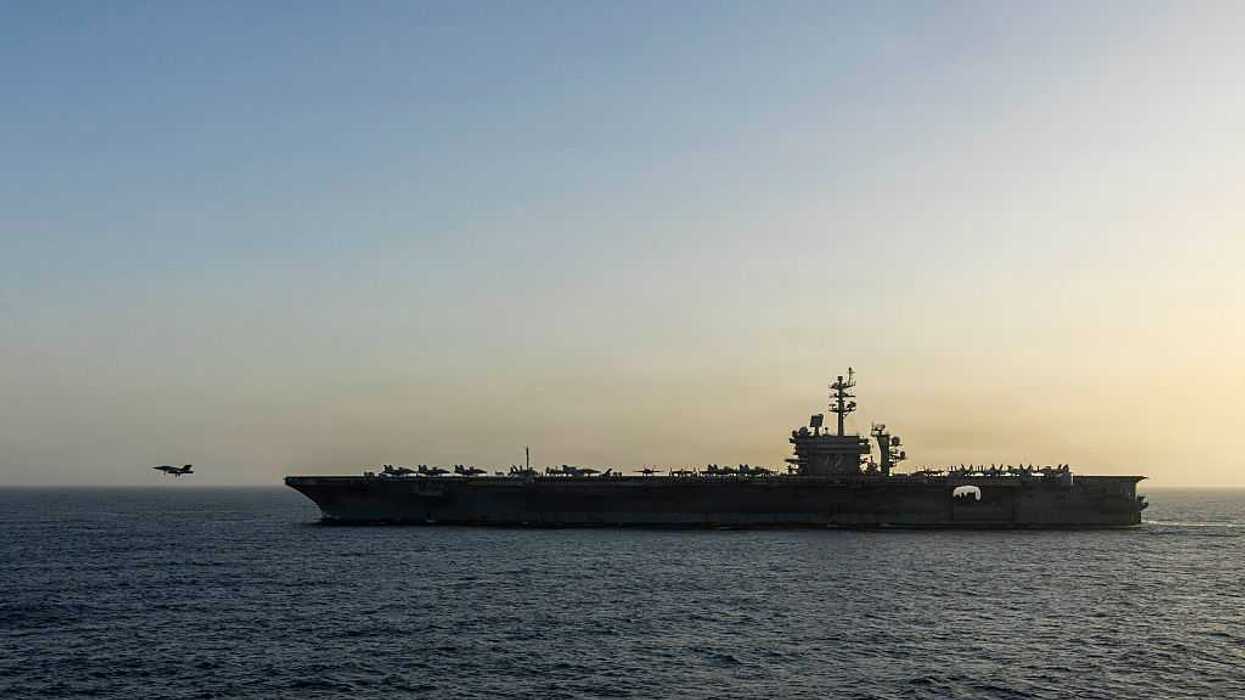

The crew of the USS Abraham Lincoln has been at sea for over 265 days, and over 200 days without a port call. The aircraft carrier left San Diego on November 21, 202 for a routine Pacific deployment, only to be redirected to the Middle East instead for a war Congress never declared and voted not to authorize. Carriers are supposed to pull in every 30 to 45 days for resupply, maintenance, and something resembling a break; the Lincoln has gone nearly five times that long without one–a modern record for a warship.
Consider what that actually means for a human being. You’re living at work, on a ship, with your coworkers, away from your family and friends, and now the ship is starting to fall apart: the water fountains are broken, the water is contaminated, sometimes water needs to be rationed so showers and laundry are secured, the showers are moldy, the toilets are clogged, and the food is rationed, rotten, and can be, as Congressman Mike Levin described, as meager as a half a cup of rice and two tortillas. These are horrible working conditions. Whether or not you believe sailors signed up for this when they joined the military, you must admit, it’s a brutal job.
I’ve deployed to the South China Sea and the Persian Gulf as a Navy helicopter pilot. I know what months at sea do to a person, even when the ship has hot chow and working plumbing. It is unclear what their mission is and how they hope to achieve it, and now negotiations have stalled, and finding a diplomatic solution seems like a fantasy under this administration. Conditions have gotten so bad that the members of the crew are increasingly suicidal.
Some of them have managed to report back to their families. About 200 family members showed up to a town hall in San Diego this month to give acting Navy Secretary Hung Cao a message: that the Pentagon has broken their trust. Back in April, Secretary Hegseth called similar reporting “fake news.” Now, Navy Times and Stars and Stripes have both reported multiple attempted man overboard incidents aboard the Lincoln. One wife told reporters her husband texted her that he “hopes he doesn't wake up tomorrow.” The Navy's official response is that it hasn't “identified an increase in reported suicidal ideation or suicide attempts,” and that sailors have “continuous access to clean water, functional AC and healthy meal options.” The magnitude of the difference between official information from the Pentagon and firsthand reports from the crew should be troubling. The Department is either being intentionally deceptive or is just that out-of-touch.
Some critics may hear these reports and argue that troops had it way worse in Vietnam. Or in Iraq. But those were wars. If this administration continues to ballerina around calling this conflict a war in order to circumvent the Constitution, then they don’t get to use “war” to justify why our service members are being forced to ration food. Even if this were called a war, the forever wars in Iraq and Afghanistan already taught this country, at enormous cost, what repeated extended deployments do to a force. Veterans came home broken at a rate this country still hasn't fully grasped. How many missions can we accomplish if we keep forgetting to take care of our personnel along the way?
Meanwhile, for all his chest-beating, Secretary Hegseth sure likes to take his eye off the ball of war. He wants to make sure sailors have enough testosterone, but can’t ensure they have enough food. Since the Lincoln left San Diego, Hegseth has found time to pick fights with the Ivy League over military fellowships, threaten to sever the Pentagon's relationship with the Boy Scouts over wokeness, and, in an unprecedented move, personally blocked the promotions of more than a dozen senior officers (a disproportionate number of them Black or women). That's where his energy has gone, while sailors half a world away are jumping off his ships to escape.
Hegseth says he makes these decisions in the name of lethality. He believes the warrior ethos will save the military. But you don't get lethality out of a crew running on a rationed dinner for months on end. And the warrior ethos shouldn’t have to include bravely facing water contamination on your own ship. Even warfighters need basic care. The Department of Defense needs a leader who is up to the job of providing that care. Perhaps Secretary Hegseth could start by prioritizing the needs of the active-duty service members deployed to the Middle East over his beef with the Boy Scouts.
There are strategic reasons for us to take care of these sailors: their operational capacity depends on it, and not doing so could have negative consequences on retention and recruitment, which adds up to readiness, which is essential to national security. But there’s another reason: compassion. Leadership should mean looking out for your people. As my old Command Master Chief used to say, “it’s about heads in beds, too.” It’s time Secretary Hegseth realized that’s part of his job, fixed the plumbing, and got these sailors home to their families. And if he isn’t up to the task, then it’s high time he stepped aside.
I believe we can achieve lethality without sacrificing humanity. If we can’t, then let’s decide it’s not worth it.
Julie Roland was a Naval Officer for ten years, deploying to both the South China Sea and the Persian Gulf as a helicopter pilot before separating in June 2025 as a Lieutenant Commander. She has a law degree from the University of San Diego, a Master of Laws from Columbia University, and is a member of the Truman National Security Project.














The President Invited Iran to Bomb My Home