



“We love our country. Save our democracy. No kings,” says Davina Martínez, holding a protest sign with a raised brown fist and the handwritten word — “RESIST” — in bold red and black ink.
Standing amid rowdy chants and cheers, echoing against the sand-colored walls of a historic Tucson courthouse, Martínez is one of tens of thousands of people— citizens and non-citizens alike — who took to the streets across America on Saturday. They wanted their voices heard at the “No Kings” rallies against the actions and policies of President Donald Trump and his Republican administration.
“It’s not about our people, our education, our public health — We’re in danger with Trump,” Martínez says, as a woman passes carrying a sign with an American flag, a peace sign and a red heart that reads: “NO KINGS IN THE U.S.A.”
The fired-up rally crowd at downtown Tucson’s El Presidio Plaza includes religious leaders, pro-immigrant organizations, grassroots coalitions, labor unions, Democratic officials and families of all ages.
Demonstrators speak in Spanish and English in their borderlands community, where everyone understands when they hear “presente” that it’s a united show of support.
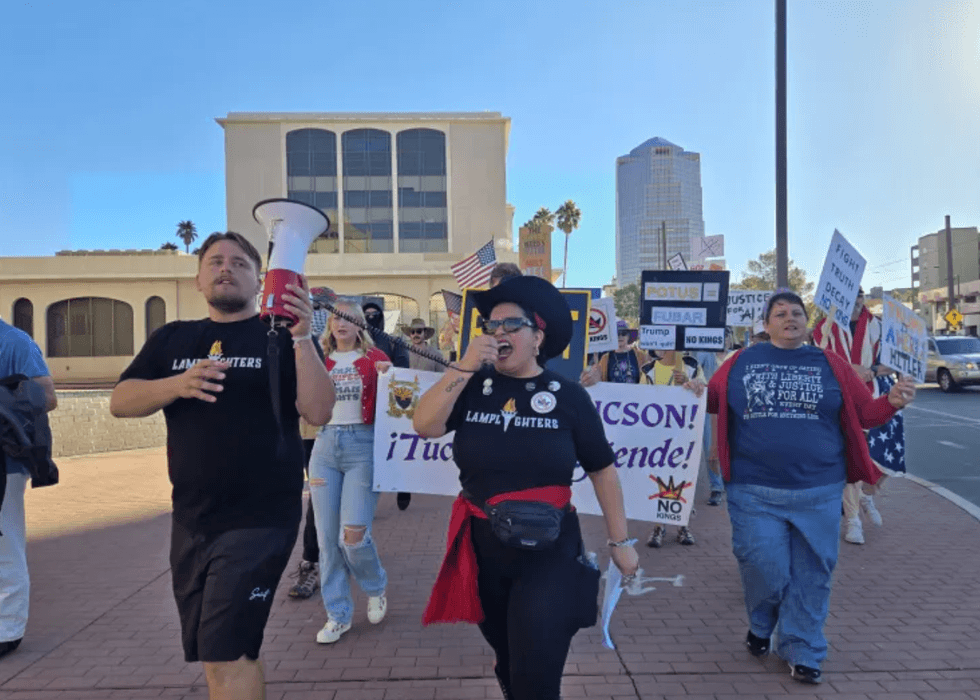 Members of the Tucson se Defiende Coalition say “presente” as they march through downtown Tucson to join supporters at the “No Kings” rally. Oct. 18, 2025. Credit: Dawn Page
Republicans have pushed back against the rallies calling the protests and protesters un-American.
Organizers say the rallies are a celebration of First Amendment rights to free speech and to assemble in solidarity. Protesters are pushing back against Trump administration policies, including aggressive immigration enforcement that has separated families, ignored due process rights to deport immigrants to foreign jails and ensnared U.S. citizens, as well as sent troops and masked agents into Democrat-leaning American cities.
The “No Kings” rally in Tucson stood out from the more than 2,700 planned demonstrations in cities and towns across the nation. In the Southwest state’s second largest municipality, many protesters denounced the Republican-controlled Congress for not swearing-in Congresswoman-elect Adelita Grijalva, leaving thousands of Southern Arizonans without representation in the legislative branch of their federal government.
Republican House Speaker Mike Johnson has refused to swear in Grijalva until the House is back in legislative session. Grijalva’s supporters have argued Johnson won’t swear her in because she pledged to be the deciding vote on a bill to release the Jeffrey Epstein files that may incriminate Trump.
Grijalva was elected nearly one month ago in a Sept. 23 special election, making history as the first Latina and Chicana to represent Arizona in Congress.
The race to represent Arizona’s Congressional District 7 — which encompasses a large swath of Southern Arizona and six counties — was spurred by the death in March of Raúl Grijalva, Adelita’s father. He represented the deep-blue district for more than 20 years. Democrats have threatened a lawsuit to force Johnson to uphold the rights of Southern Arizonans demanding representation.
Surrounded by local constituents, Congresswoman-elect Grijalva and Tucson Mayor Regina Romero are standing next to each other. Like Grijalva, Romero made history. Romero became Tucson’s first woman mayor, first Latina elected to the office and the only Latina mayor in the nation’s 50 largest cities when she won her first term in 2019.
Protesters recognize Grijalva and Romero for having long fought for each other, for Tucsonans, for the rights of immigrants, Latinos and the most vulnerable people in their communities. That matters to Tucsonans cheering as their elected Southern Arizona representatives encourage the crowd to fight for their country’s values of freedom, liberty, equality and justice.
“We’re defending democracy, fighting fascism and dictatorship, and oligarchy,” Romero says in an interview with Arizona Luminaria, before she speaks to the crowd, explaining why she joined the rally. “I want to make sure I let Tucsonans know that I stand in solidarity with them.”
The buzz around Grijalva’s delayed swearing-in ceremony resonates with demonstrators.
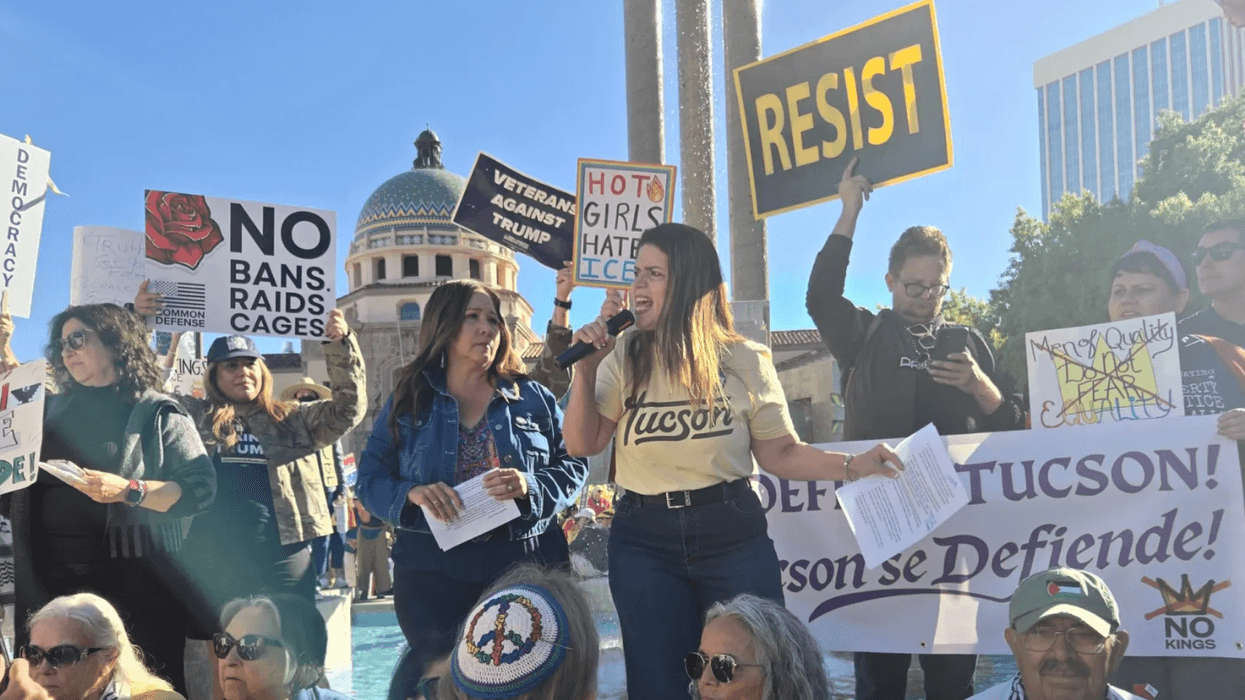
Their support turns into a rallying cry as Romero takes the stage. Chants of “Swear her in! Swear her in!” echo through the plaza as people call for an end to Trump-era politics. Grijalva throws a peace sign to the cheering crowd and places her hand over heart, standing in front of signs that say: “VETERANS AGAINST TRUMP” RESIST” “NO BANS. RAIDS. CAGES.”
“Yes, we want to swear in Adelita Grijalva because we voted for her fair and square,” Romero yells to the crowd. “We followed the rules. We want her in Congress.”
Invoking the legacy of late Congressman Raúl Grijalva, Romero raises her arm and shouts: “That is what he taught all of us — stand up in the face of power.”
As Grijalva takes the mic, chants of “Swear her in! Swear her in!” grow louder.
“I’m so grateful for your continued support,” Grijalva says. “We know how to fight back. Standing in union and solidarity is what we must do — for those who can’t be here, who are afraid of this administration. People are literally disappearing off our streets. We have to come together as a community and stand up for them.”
Grijalva speaks to the power of those able to show up.
“Thank you to each and every one of you for using your privilege to be here in unity. It’s an honor to be here with my community, my friends — and my mamá,” she says. “We love our community, and we want to make sure that generations from now, they can look back and know we stood up.”
Grijalva shares what many at the rally believe is at stake for their families, friends and their country.
“This administration wants to eliminate every one of us,” she says. “We are the 99%. We must remind them: We are here. We’re not going anywhere. And we’re going to make some changes in this next election.”
Grijalva also reflects on the legacy of her father: “My dad was unapologetically the most progressive member of Congress. He never stopped,” she says. “When he passed away, I had to make a decision — and that decision was easier because of the support of this community.”
Ending in a steady voice on the strength she draws from those who came before her, Grijalva recalls her grandfather’s words.
“So, when I get to Congress and they try to ignore me,” she says while the crowd boos, “as my Tata would say: No te dejes, mijita. I’m not going to. You elected an Adelita. Adelitas were women soldiers — guardians of the revolution. We are guerreras. And I will keep fighting until we get the representation this community deserves.”
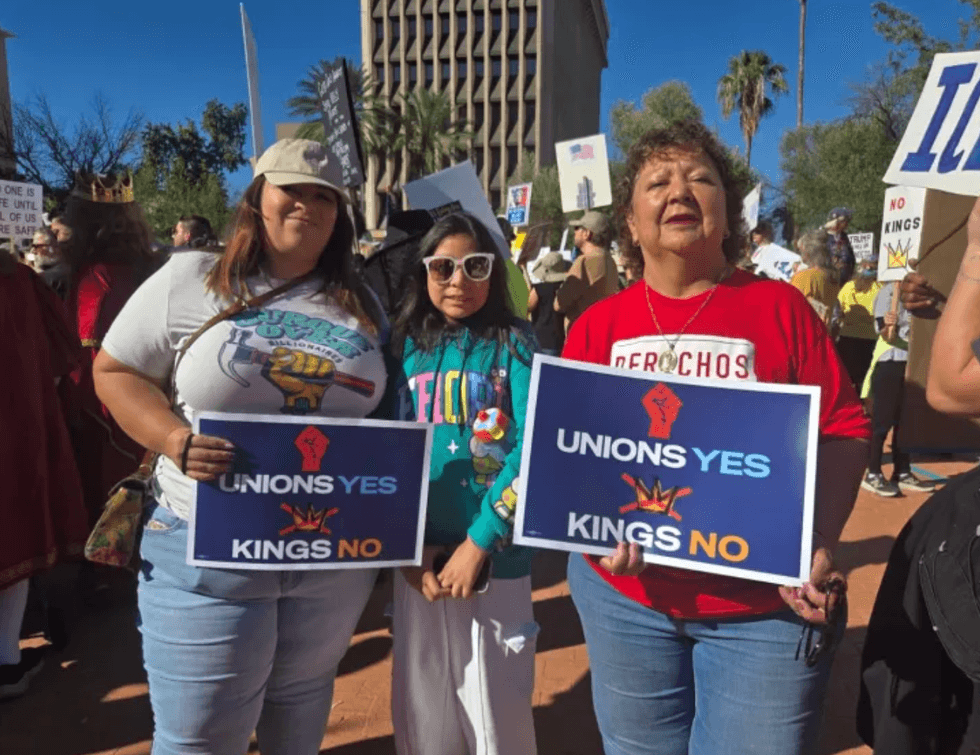 From left: Martha Reyes, Arizona Jobs with Justice organizer, and her daughter Jimena Reyes, alongside Cecilia Valdez, chair of the Pima Area Labor Federation, represent workers at the “No Kings” rally in downtown Tucson. Oct. 18, 2025. Credit: Dawn Page
Cecilia Valdez, Chair of the Pima Area Labor Federation — which represents affiliated unions across Pima County — also urges Congress to swear in Grijalva, emphasizing that more than 800,000 constituents are currently without representation.
“My message today is that we’re in a labor organizing crisis,” Valdez says. “We’re facing serious challenges because of the Trump administration, which eliminated nearly a million federal government jobs. That impacts all workers — especially union members.”
Valdez continues as the crowd breaks into chants of, “Hey hey, ho ho, Donald Trump has got to go!”
“The fact that Trump is taking from the poor to feed the rich is wrong,” she says “Our federal workers need to go back to work — they shouldn’t be getting fired. They deserve the jobs they have.”
Lidia Godínez and her 10-year-old daughter, Melina Godínez, came to support their community and their country, carrying signs that read: “LONG LIVE REBELLION” and “I CAN’T BELIEVE I HAVE TO EXPLAIN THIS TO ADULTS.”
“To fight for our rights and support our community,” Godínez says. “I have daughters and sons, and I want them to grow up in a world where their voices are heard. We need to keep rallying and protesting because this is what’s right — to show that we care and support each other.”
Melina’s handmade sign in red and blue paint on white posterboard is so big, she holds it just under her chin, over her long black hair and covering her body down to her knees. Her fingers curl alongside the all-caps word: “EXPLAIN.”
‘We are guerreras.’ Tucson ‘No Kings’ rally demands Congress swear in Adelita Grijalva, end to Trump era was first published on Arizona Luminaria and republished with permission.
Dawn Page is a freelance reporter.









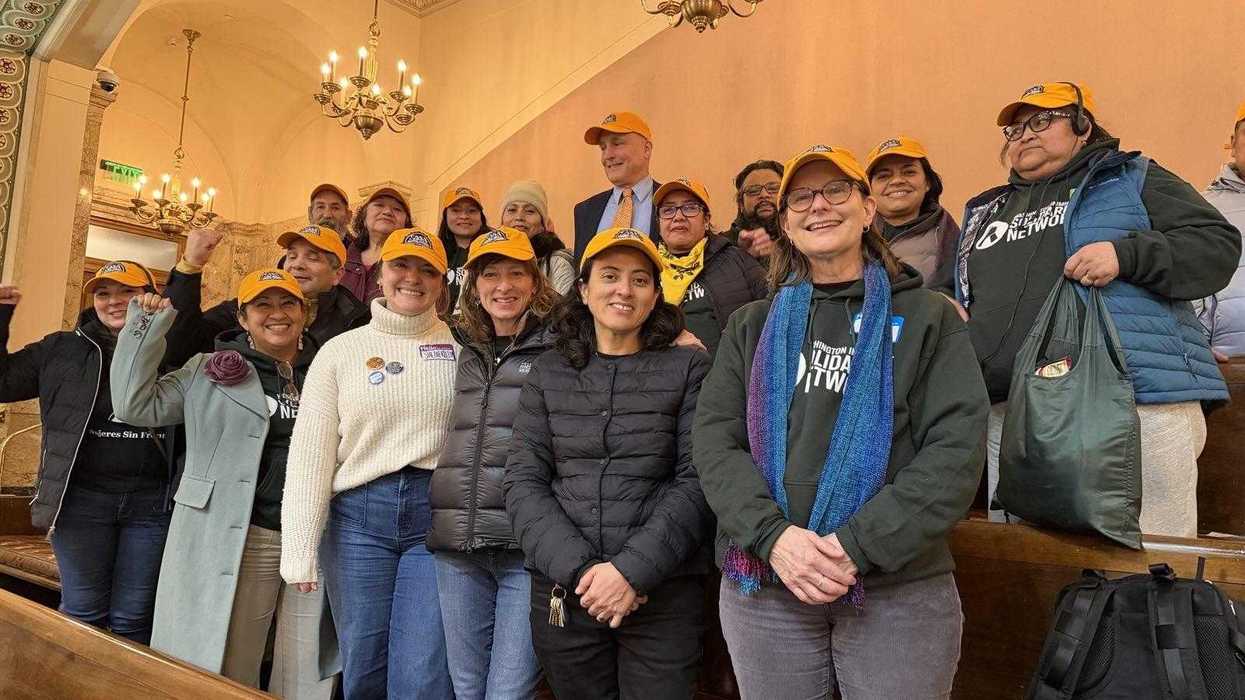
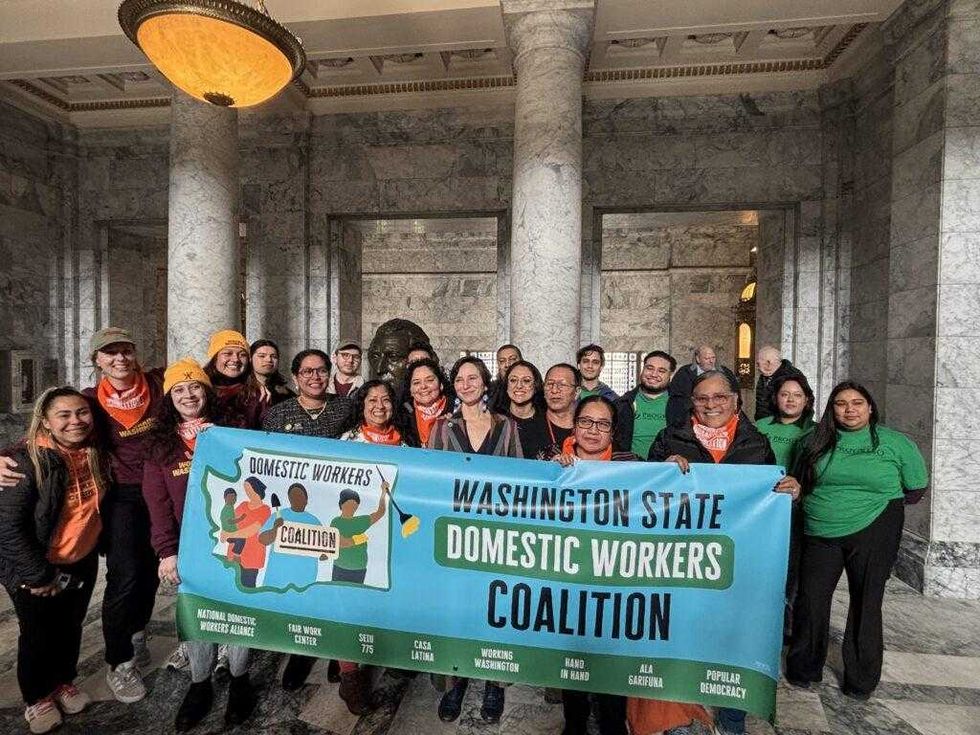 State Sen. Rebecca Saldaña, center, stands with members of the Washington State Domestic Workers Coalition at the state Capitol on Feb. 28, 2026. The Domestic Workers Bill of Rights passed in the House that day, before being signed into law in March. (Photo courtesy of Casa Latina)

The President Invited Iran to Bomb My Home