



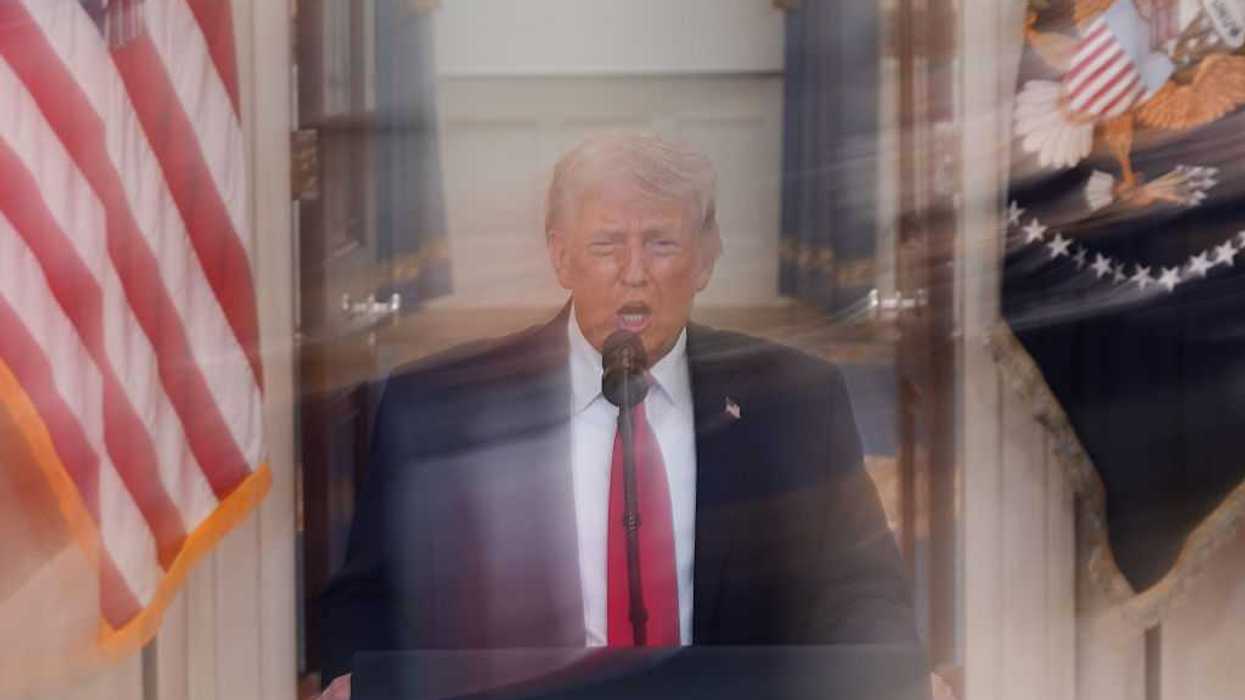
It is common in non-Trump circles to describe Trump as an inveterate, congenital liar. Throughout his campaigns and his presidency, his distorted perspective on facts—or outright lies—have been the underpinning of his combative arguments, And his forceful, passionate statements, whether distortions or lies, have become the truth for his followers. All real news and truth is regarded as "fake." Such is the power of "the big lie."
There is no need to site examples; they are legion. Most recently, though, this was observed when he fired the Director of the Bureau of Labor Statistics, claiming that the numbers were fudged. He felt he knew what the right numbers were.
The other day, the thought came to me that maybe Trump wasn't "lying." To lie implies that you know the truth and are purposely falsifying information. I have a feeling that Trump lives in an alternate reality where the truth is as he sees it. Whether it's the results of the 2020 election, the description of illegal immigrants, or the recent labor statistics, he knows/senses what to him is the truth; that is his reality. And since he is king/dictator, he is infallible and cannot be wrong. Anyone who says otherwise is, if under his control, fired, if not under his control, attacked.
I will use as an example of the ubiquitousness of this alternate reality Trump's Executive Order, "Restoring Truth and Sanity to American History." This is classic Trump—claiming to restore the truth when in fact he is the one who is destroying the truth. And In this instance, he is supported in his alternate reality by far-right scholars (see my post, "The Far-Right's Biggest Lie"). To make my point, I will go through the first paragraph of the Order sentence by sentence.
1. "Over the past decade, Americans have witnessed a concerted and widespread effort to rewrite our Nation’s history, replacing objective facts with a distorted narrative driven by ideology rather than truth."
True, but ... there has indeed been an effort to rewrite our history, but it is Trump and MAGA adherents who, driven by ideology rather than the truth, have been trying to rewrite our history—whether in school textbooks or at national parks—to eliminate the unpleasant facts of our history.
And what are the objective facts of our history? The objective fact is that racism is part of our history and our present. The horror of slavery is a fact. It is a fact that our country, through military and other purposeful actions, nearly wiped out the Native American indigenous people. It is a fact that until 1920 women did not have the right to vote and they still have not achieved equality with their male peers. These are the facts Trump wants to deny.
2. "This revisionist movement seeks to undermine the remarkable achievements of the United States by casting its founding principles and historical milestones in a negative light. Under this historical revision, our Nation’s unparalleled legacy of advancing liberty, individual rights, and human happiness is reconstructed as inherently racist, sexist, oppressive, or otherwise irredeemably flawed."
But in fact, liberal scholars or textbook authors have not cast the achievements of this country, its founding principles, or its efforts to advance liberty, human rights, and happiness in a negative light. To say that America had and has problems—short-comings—in realizing its principle, does not demean them or America.
Noting or addressing these short-comings is also not an implication that America is "irredeemably flawed." Rather they are the result of our nation being a representative democracy and of our being, after all, human beings, with imperfections and failings. Liberals realize that the aspirations of the Declaration of Independence pictured a state of existence that no country in the world has to this day achieved. To say that America has not achieved that state is thus not to say that the country is flawed.
3. "Rather than fostering unity and a deeper understanding of our shared past, the widespread effort to rewrite history deepens societal divides and fosters a sense of national shame, disregarding the progress America has made and the ideals that continue to inspire millions around the globe."
Without question, societal divides have recently deepened. But not because of liberal efforts to acknowledge and address our country's problems; they have been doing this for decades, Likewise, there is nothing new in the fact that there are many in our country who still harbor feelings of racism and misogyny and act on those feelings
What is new is that a President has for the first time since WWII supported that part of our citizenry that rejects the right of all Americans to be equal in the sight of the law, as required by the 14th Amendment. It is Donald Trump who has deepened the divide and fostered a feeling of national shame.
The extent of racism still present in our country may be a source of sadness for many for whom the words of the Declaration of Independence have an almost spiritual power and for whom the goal of all people being treated with humanity is heart-felt. But that sadness does not denigrate or dispute the substantial progress that America has made nor deter us in our faith that one day Martin Luther King's dream will become reality..
As to America's ideals inspiring millions around the globe, while I believe that has been true throughout our history, despite our short-comings, under the current Trump administration, that beacon of light has been diminished (see my article,"America Is Losing Its Light").
Whether Trump's statements are knowing lies or a reflection of his alternate reality, the impact is the same. He and his followers are leading our country away from its history, away from its historic values, toward a self-centered perspective that fosters inhumanity and the disavowal that we—regardless of color, race, ethnicity, or sex—are all God's children, His creation, and so were created equal.
Unfortunately, Democrats have not focused the public's attention on all the untruths—lies—that Trump and his MAGA allies have used in influencing the public to adopt a distorted understanding of our founding principles as well as facts, whether of the everyday sort or scientific. This the Party must begin doing and do so in an organized manner—I have suggested a weekly Trump scorecard press conference (see my post, "Returning the Country to the People Scorecard")—so that the public has the information they need.
It is the Democratic Party's essential task to lead the country back to the future, to connect each and every American with the truth of our founding principles, and to show how, by implementing those principles through government policy, all Americans will be lifted up, regardless whether White or persons of color; male or female; rich, middle class, or poor; or other defining characteristic. (See my post, "Where Is the Democratic Party's Clarion Voice?")
Ronald L. Hirsch is a teacher, legal aid lawyer, survey researcher, nonprofit executive, consultant, composer, author, and volunteer. He is a graduate of Brown University and the University of Chicago Law School and the author of We Still Hold These Truths. Read more of his writing at www.PreservingAmericanValues.com









The President Invited Iran to Bomb My Home