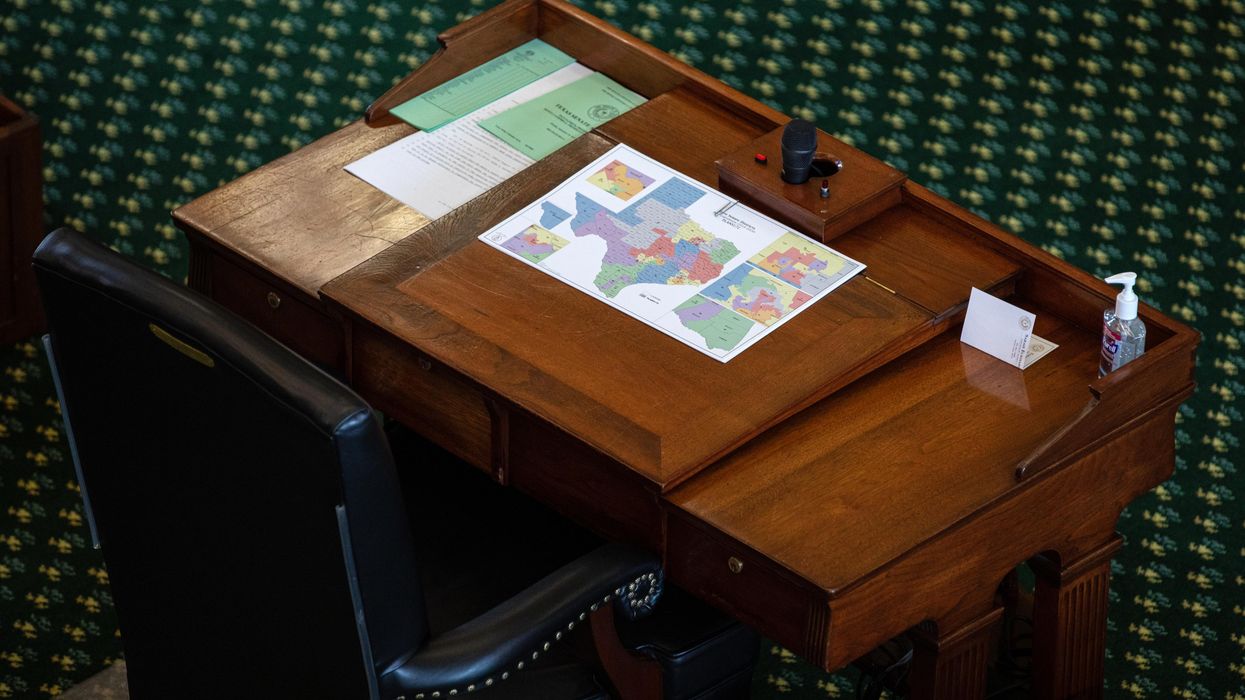

In the closing weeks of 2025, a majority of the U.S. Supreme Court moved our democracy in the wrong direction by clearing the way for a gerrymandered congressional map in Texas to be in place for the 2026 midterm elections in its Abbott v. LULAC decision. Aside from the fact that the new Texas map illegally discriminates to weaken the voting power of the state’s Black and Latino voters, the Supreme Court’s ruling is deeply problematic on a number of other levels.
Most disturbingly, the majority in this opinion takes an appalling new turn on the issue of partisan gerrymandering. To illustrate the Court’s backward slide, consider that in 2004 then-Justice Anthony Kennedy wrote as a concurrence to an opinion in a key redistricting case that, if a state declared it would redistrict with the goal of denying a certain group of voters “fair and effective representation” for partisan reasons, then the Court “would surely conclude the Constitution had been violated.”
Then, in 2019, Chief Justice John Roberts wrote a majority opinion in Rucho v. Common Cause that said “excessive partisanship in districting leads to results that reasonably seem unjust…such gerrymandering is ‘incompatible with democratic principles.’” Then he went ahead and denied relief from such partisan gerrymandering in federal court, falsely stating that federal courts were not capable of settling disputes over extreme partisan gerrymandering (despite a number of courts having done so).
This repudiation of partisan gerrymandering as unconstitutional and undemocratic has now completely disappeared in Abbott v. LULAC, with the majority opinion chiding the trial court panel of federal judges for not granting Texas redistricting a safe harbor because, according to Justice Samuel Alito, “the impetus for the adoption of the Texas map…was partisan advantage pure and simple.” By Justice Alito’s logic, the claim that Texas was a partisan gerrymander, rather than a racial one, makes its redistricting a thing to be lauded and approved!
The majority’s brief written order employs tortured logic to avoid the standard practice of deferring to findings of fact at the lower court level, dismissing the substantial evidentiary record showing that race was used impermissibly to draw the new Texas map. The Supreme Court says the lower court failed to grant state lawmakers a “presumption of good faith” in their gerrymandering project — good faith that they were gerrymandering for political gain rather than for racial reasons. In this case, the basis for that “presumption” is a claim contradicted by mountains of evidence.
The majority also claims the lower court decision to block the Texas map interferes with the midterms, even though the general election is about a year away, and primaries in Texas don’t take place until March. This reasoning thoroughly distorts a judicial concept known as the Purcell principle, which, in practice, means courts should refrain from handing down consequential election-related rulings “on the eve of an election.” The majority opinion would appear to say that an election is always “imminent” once the last one is over, thereby denying court review even of blatant racial gerrymanders such as Texas’s.
Anyone trying to make sense of the Supreme Court’s trajectory on redistricting issues has every right to be confused and frustrated. The situation could become even worse if the justices choose to undermine Section 2 of the Voting Rights Act, the one remaining portion of that law providing concrete tools for challenging racially discriminatory voting maps. This is the outcome many in the pro-democracy coalition are now worried about based on oral arguments during Louisiana v. Callais in October.
In the midst of these troubling developments, it is clear now more than ever that we need overarching solutions that take partisan bias out of the redistricting process and affirm the commonsense principle that voters should not be marginalized due to their race.
The U.S. Constitution gives Congress the authority to pass a federal law banning partisan gerrymandering and requiring every state to create independent redistricting commissions, but these ideas have yet to receive much bipartisan support. Perhaps that will change pending the fallout from the current gerrymandering arms race. Similarly, if Congress could resurrect a bipartisan consensus on the need to prevent states from passing racially discriminatory voting laws, we could see a re-authorization of the Voting Rights Act that would better withstand judicial scrutiny.
In lieu of a national solution, Campaign Legal Center is playing a strong leadership role in beating back the scourge of gerrymandering by helping to establish and defend independent redistricting commissions at the state level (Michigan) or through lawsuits filed in state court (Wisconsin, Utah). We entered the current fray by filing a lawsuit in September on behalf of Missouri voters, challenging a gerrymander so egregious that opponents have managed to collect nearly three times the signatures needed to put a measure nullifying it on the 2026 ballot.
This unprecedented mid-decade redistricting arms race has been one of the dominant political stories of 2025 and has included many twists and turns. One of the most recent to dominate the headlines saw Indiana state senators rejecting a proposed congressional gerrymander in the face of immense pressure by the Trump administration.
It is worth noting that the president who ignited this conflict has employed a similar playbook on issue after issue: Ignore established rules and norms meant to prevent the concentration of power. Exploit weaknesses in current laws to achieve political goals — in the case of gerrymandering, pressuring states to do so. Finally, rely on the courts, especially the Supreme Court, to favor arguments that prioritize executive power or, more broadly, the power of politicians over their constituents.
Campaign Legal Center’s efforts this year to fight this rising authoritarian threat have largely focused on the courts, either through lawsuits or legal briefs shining a bright light on issues that must be seriously considered during judicial deliberations. For example, in the hugely consequential case Trump v. Slaughter, the amicus brief I filed along with my CLC colleagues explains why leaders of federal agencies with the power to impact our elections must remain insulated from presidential influence.
It has been a challenging year — one that has seen an unconscionable assault on the pillars of our democracy. For those who are devoted to defending it, our task is to continue the fight, no matter the obstacles in our path.
Trevor Potter is founder and president of the Campaign Legal Center. Read more from The Fulcrum's Election Dissection blog or see our full list of contributors.