


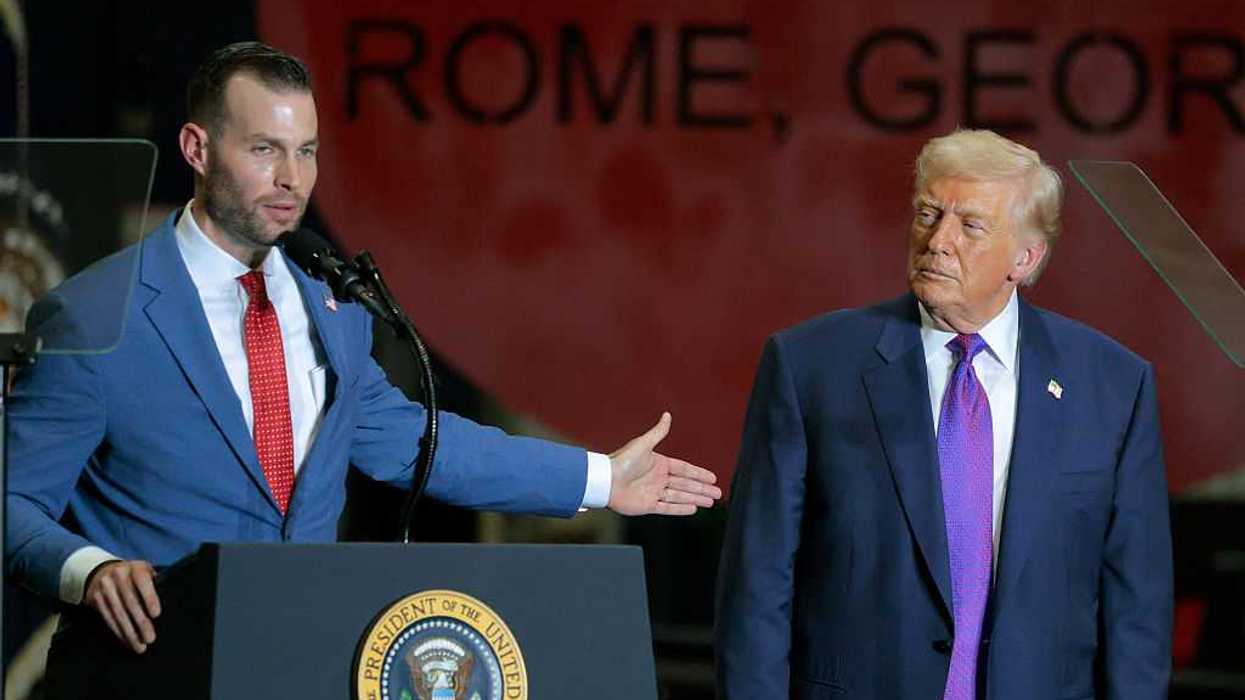
Following his endorsement of Clay Fuller for Majorie Taylor Greene’s former house seat, President Donald Trump spoke about the economy, allegations of voter fraud and his support for Fuller at the Coosa Steel Corporation in Rome on Thursday.
Fuller is one of 13 remaining Republicans vying for the 14th congressional district seat but is the only candidate to receive Trump’s influential endorsement. He said his experience was the reason Trump endorsed him.
“I think it was really important as they looked at my background,” Fuller said. “I moved my family up to DC to go and work for him in the first Trump administration from 2018-2019. I was willing to uproot my entire family from a community and schools that they loved, to go up there and support his America First agenda, especially in the national security realm. I think that really stood out.”
Fuller’s experience working for Trump was primarily in counterterrorism special operations oversight. After that, he returned to Georgia and was elected as the district attorney for the Lookout Mountain Judicial Circuit. According to Fuller, his experience prosecuting violent criminals influenced his campaign platform, including his tough-on-crime policy as well as his support for mass deportation and a secure border.
“I’ve been in the district attorney position for about two years, and so many of the problems that I was seeing, first off, [were] a number of fentanyl overdoses in our community, especially during the Biden administration,” Fuller said. “Over the course of the year that the president has taken over, we saw him actually securing the border, and it actually had an incredibly positive impact in saving lives in our community, driving fentanyl prices up because the supply was going down.”
Fuller said the endorsement from Trump meant the world to him.
“It was an honor of a lifetime to just get a call from the President of the United States and to hear him say that he’s supporting our campaign and believes in us and has chosen us,” Fuller said.
According to Fuller, younger voters — such as Berry students — may view him as an appealing candidate if they have had similar experiences living in northwest Georgia.
“[They may have] seen the things that I saw when I was growing up, that the economic opportunity wasn’t there for their small town; they saw businesses on their main street closing down, they saw friends and family that were caught up in the methamphetamine and fentanyl epidemic,” Fuller said. “For all of those issues that I think students would be concerned about, first off, that we’re sending a Christian conservative to Washington, D.C, but also that that experience is going to stand out [because] I’ve fought the toughest problems we have as a community and as a country.”
Shawn Harris is one of two Democrats running for Greene’s seat. He unsuccessfully ran against Greene in 2024 and is currently running against 13 Republicans, an independent and a Libertarian in the special election.
After hearing Trump’s endorsement of Fuller, Harris was shocked that all 13 Republicans stayed in the race instead of dropping out to avoid splitting the vote.
“The piece that kind of surprised me was after he was endorsed by Donald Trump, that really nobody dropped out of the race,” Harris said.
Harris said that he has a good chance of winning the district with a majority of the vote. In Harris’ view, Trump is visiting Rome because he is concerned about the Republican vote being split.
“The same reason why Donald Trump is physically coming here to northwest Georgia is because he’s been looking at the polls, and the polls are very clear that I’ve got a very good chance of winning this election on March 10,” Harris said.
Harris said his primary goal is to focus on the people of the 14th District. He does not want to be endorsed by politicians and instead wants to gain support from his constituents, regardless of their political affiliation.
“I’ve said to the people here in northwest Georgia that I don’t want to be endorsed by anybody at the national level,” Harris said. “The reason why is because when you get those endorsements, you’re basically selling your soul. My endorsement is the people of northwest Georgia, and their vote is what’s going to get me to D.C. I’m laser-focused on us back here at home versus having to answer questions, like Clay Fuller’s going to have to do, he’s going to have to answer questions to Donald Trump. I won’t.”
Trump and United States Treasurer Brandon Beach spoke in support of the administration’s tariff policy at the event. Trump said his economic policies will raise Georgia’s average income by $7,000 over the upcoming year. He also pointed to the uptick in business for companies like the Coosa Steel Corporation, saying that business owners like Andrew Seville, president of the Coosa Steel Corporation, knew the impact best.
“I said [to Seville], ‘How are you doing?’” Trump said. “He said, ‘President, if I didn’t have all these cameras running, I would grab you and start kissing you violently.’ And I said, ‘Why is that?’ He said, ‘Because of what you’ve done for us economically in this state, in this town, with the tariffs in particular.’”
According to Seville, the tire rack industry — a major part of the Coosa Steel Corporation’s production— began to decline in 2010, as the industry began to shift to Chinese production. He said that when Trump instituted his tariffs his second term as president, orders began flying in.
“They were coming nonstop,” Seville said. “In October 2025, we landed our [biggest] tire rack deal that we’ve had in ten years. This is going to keep our racks department busy for two shifts a day, six days a week, and we’re pumping them out as fast as we can go. Mr. President, what you’ve done for these guys, what you’ve done for the economy? What you’ve done for all of America? You did it. You’re making America great again.”
In his speech, Trump repeated his belief in unsubstantiated claims of voter fraud. He said that the Safeguard American Voter Eligibility (SAVE) Act, which would require to provide proof of citizenship like a birth certificate or unexpired passport when voting, would end voter fraud.
“When they look at the polls, 95% of the people want voter ID,” Trump said. “Then you have proof of citizenship. We want voter ID. We want proof of citizenship. For you to vote, let’s prove that you’re an American.”
A Gallup poll indicates that 83% of voters are in favor of voter identification, with a Pew Research Center study showing 84%.
On Fuller, Trump gave his full support, saying he was endorsing him very strongly.
“We want to vote for Clay,” Trump said. “He’s gonna take it home.”
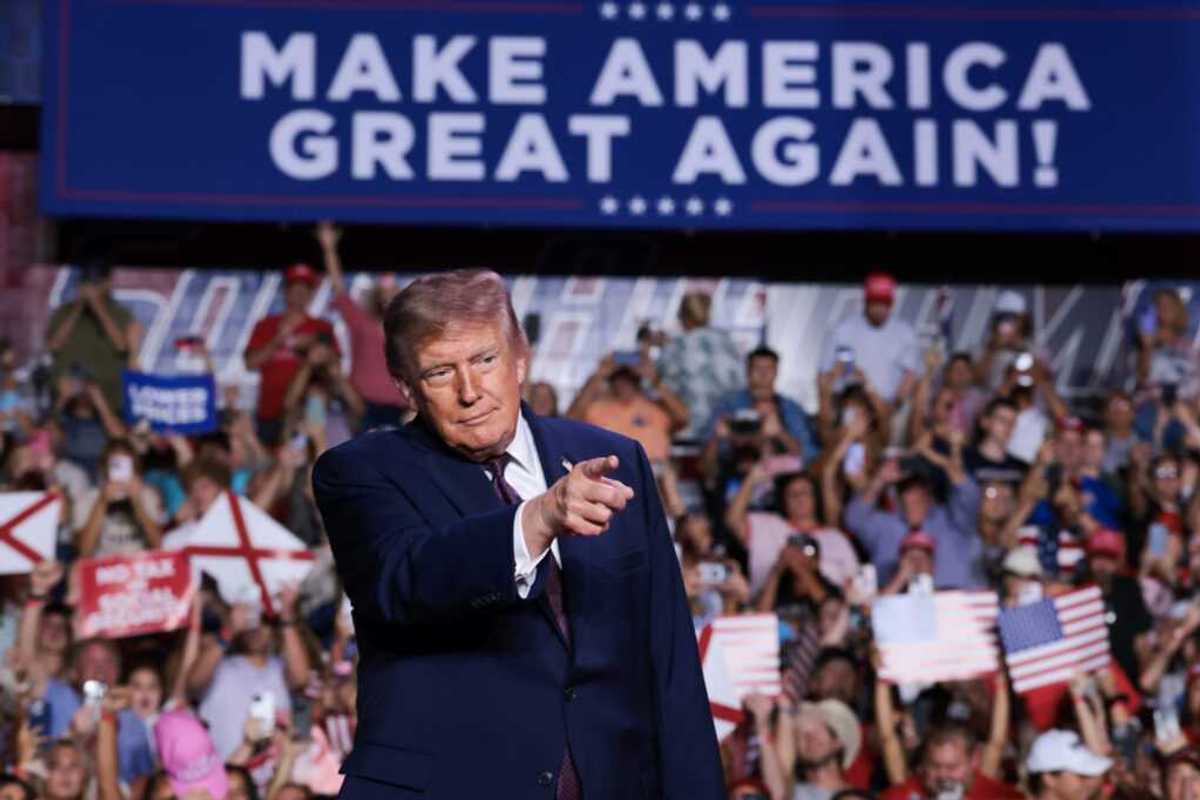
There was a large turnout at the event, with people lining up earlier than 7 a.m. The Coosa Steel Corporation building was not large enough to accommodate every attendee, so after the doors were closed, a group remained outside for the duration of the event. One group of Trump supporters, known as the “Front Row Joes,” was first in line at the event. They attend Trump rallies and events across the country, with some even standing outside the building during his 2024 business records falsification trial. Sharon Anderson of Tennessee is a member of this group and showed up for the Rome event.
“This is my 65th rally,” Anderson said. “We try to go to as many as we can. Every rally has Front Row Joes at it. We like to support [Trump]. He does what he says he’s going to do. He makes a promise and he keeps it, and that’s what people voted him in for.”
Sophomore Amanda Hartnett was one of many who weren’t able to see Trump speak. She waited in line for about four hours because it’s not often that the president visits a small city.
“I don’t know how often he visits here, but it was a really big deal for a lot of people,” Hartnett said. “There [were] a lot of Trump supporters, and we were in line for about four hours.”
Hartnett said that no one announced that the building was at full capacity, with many supporters sharing frustrated sentiments and yelling at Secret Service to let them into the building.
“Secret Service would not let us in,” Hartnett said. “People kept begging and saying things like, ‘Hey, just let Trump know we’re out here. He’ll let us in.’”
After being told that Trump would arrive shortly, people began to crowd the road to see him pass by in his presidential motorcade.
“There was a huge, huge crowd of people waiting for Trump to arrive,” Hartnett said. “When Trump’s car drove by, everybody was really loud.”
There was a group of protestors outside the event carrying signs and talking to people as they walked by. Maria, who asked to be identified only by her first name, stood with a sign that read “Pedophile supporter rally this way.”
“I’m out here for every child, every immigrant, every mother, anyone who has been a victim in any of this,” Maria said. “I’m here to be a voice and speak when some cannot speak for themselves. I am here for the children who are being detained, for the mothers who are being detained. Everyone is saying ‘Oh, they’re illegal immigrants,’ but no one is illegal on stolen land. I’m just trying to do my part, you know?”
After Trump spoke at Coosa Steel Corporation, Harris said that Trump may be losing his grip on the Republican Party if no candidates drop out. He believes that many Republicans may be considering voting for him.
“[The 13 Republicans] are still campaigning, so nobody’s listening to Trump,” Harris said. “That tells me that he’s losing grip on the Republican Party. At the same time, that’s why many Republicans are saying, ‘Hey, I want to give Shawn Harris a chance because I’m tired of the chaos.’”
According to Harris, if Trump’s endorsement had worked like he had planned, the Republican vote wouldn’t have been split among a few top Republican candidates. Harris said that Trump was quick to endorse a Republican candidate because control of the House is already on a knife’s edge.
“I will put the House one vote from being flipped, so it’ll just get even tighter,” Harris said. “That in itself means that the house would have to come to the table and compromise more, and I think compromise is a good thing.”
Election day for the special election is March 10, but early voting is underway. According to Fuller, he hopes that voters know that he will be a champion for northwest Georgia and for Rome.
“I’m gonna be someone who is fighting for their problems and fighting to solve the issues that we have in our community each and every day,” Fuller said. “I just say, if voters are looking for someone that’s going to be a warrior for them, a warrior for northwest Georgia, and who stands for faith, duty and America first, then I’m asking for their vote.”
President Trump speaks in Rome to endorse Clay Fuller, protestors demonstrate outside rally was first published on Viking Fusion and republished with permission.
Carson Bonner is the Campus Carrier editor-in-chief.
Sydney Martinez is the Campus Carrier news editor.








The President Invited Iran to Bomb My Home