


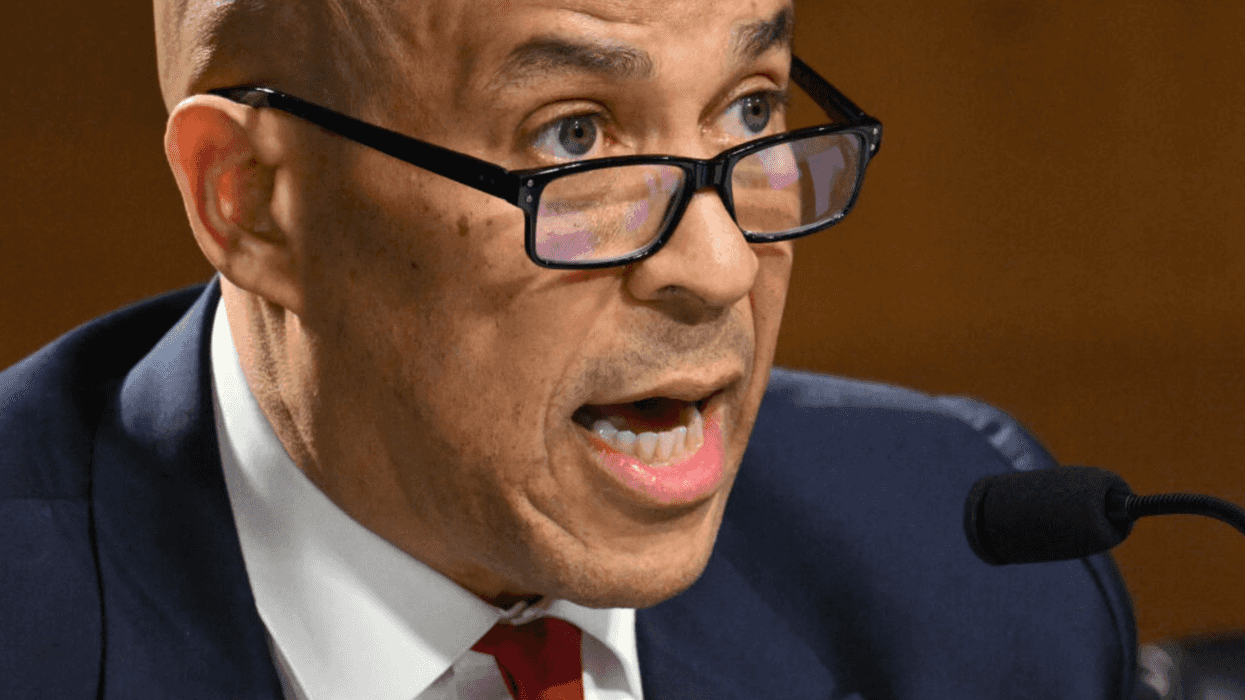

I wish “Meet the Press” host Kristen Welker had asked Sen. Cory Booker if he’s qualified to represent New Jersey given that nearly 9 out of 10 of his constituents are not Black.
I should probably back up.
Last month, the Supreme Court ruled in Callais vs. Louisiana that the state’s newest congressional map was an unconstitutional racial gerrymander.
Here’s a simplified recap. After the 2020 census, Louisiana drew a congressional map that included just one “majority-minority” district. Some Black voters sued, arguing that Section 2 of the 1965 Voting Rights Act required a second majority-minority district, because a third of Louisiana’s population is Black, and one district represented only a sixth of the state’s congressional representation. A federal judge agreed, ordering the state to redraw the map, or the court would do it for them. Louisiana tried again, producing a second majority-Black district.
This triggered a lawsuit from non-Black voters, alleging that the new map violated the Constitution’s Equal Protection Clause, because Louisiana had over-relied on race to draw it. A three-judge federal court agreed. The Supreme Court affirmed that ruling.
The legal predicament is that the Voting Rights Act and the Constitution can pull in opposite directions. Section 2 requires states to take account of race when minority voters are being unlawfully diluted, but in deference to the Constitution, it also bars over-relying on race to create majority-minority districts.
In short, race can be a factor, but not the overriding one. States must take “the totality of circumstances” into account, including whether minority districts are geographically compact and politically cohesive. States cannot simply draw sprawling districts to hit racial targets.
So, it’s complicated, with two well-intentioned goals in tension — and partisanship, race and redistricting all weighing on the process. I think the court ruled correctly, but I also think Justice Elena Kagan’s dissent made defensible points about the statutory text and about the court substituting its judgment for Congress’ intent.
That said, Booker, and many similar critics of the decision, should be ashamed of themselves.
Booker told Welker on Sunday that the Supreme Court “sent us backwards in time, back to the 1870s and ’80s, where the South and Southern legislators, through terrorism, intimidation and worse were able to stop African Americans from having representation in Congress.
“This is wrong. It’s as wrong as Plessy vs. Ferguson,” the Supreme Court decision sanctioning Jim Crow, he said. “It’s as wrong as Korematsu (which upheld the internment of Japanese Americans during World War II). And I’m telling you right now, this will go down in history as one of the most wrongheaded decisions the Supreme Court has ever made, and effectively undercut our democracy.”
First of all, Booker’s demagoguery notwithstanding, nothing — nothing— in the court’s decision makes Jim Crow more likely, legal or constitutional.
Second, the argument for majority-minority districts had great force when the goal was to dismantle the legacy of Jim Crow, but it was always supposed to be transitional, not permanent. You’re free to argue that the work isn’t done. But the reason such schemes were supposed to be temporary is inherent in the goal of the civil rights movement and the legislation it inspired: to get beyond racial classifications of Americans. That was the point of Martin Luther King Jr.’s “dream” of an America where everyone is judged by the content of their character, not the color of their skin.
That’s why the Voting Rights Act explicitly says, “Nothing in this section establishes a right to have members of a protected class elected in numbers equal to their proportion in the population.” In other words, even the text makes it clear that we don’t want to live in a country where white voters can be represented only by white representatives and Black voters by Black representatives.
One irony of the push to create majority-minority districts during the 1980s and 1990s is that while it did wonders for boosting Black congressional representation, it also boosted Republican representation. By squeezing reliably Democratic-voting Black Americans into compact districts, the remaining districts in the South became more winnable for Republicans — which is why the GOP often cynically cooperated with the process. The Congressional Black Caucus consider this a worthwhile trade-off — Lord knows Republicans did — on the theory that racial representation is more important than partisan advantage.
But do we really believe that white Democrats — in the post-Jim Crow South, or anywhere else — are unwilling or incapable of representing the political interests of Black voters? Do Black legislators ignore the interests of their white constituents?
Which brings me back to where I started.
Cory Booker is Black. Black residents make up roughly 13% of his state’s population. Are the other 87% disenfranchised or otherwise unrepresented by his election? Of course not. But I would love to have heard Booker explain why.
Cory Booker Should Be Ashamed of Himself was originally published by the Tribune Content Agency.
Jonah Goldberg is editor-in-chief of The Dispatch and the host of The Remnant podcast. His Twitter handle is @JonahDispatch.