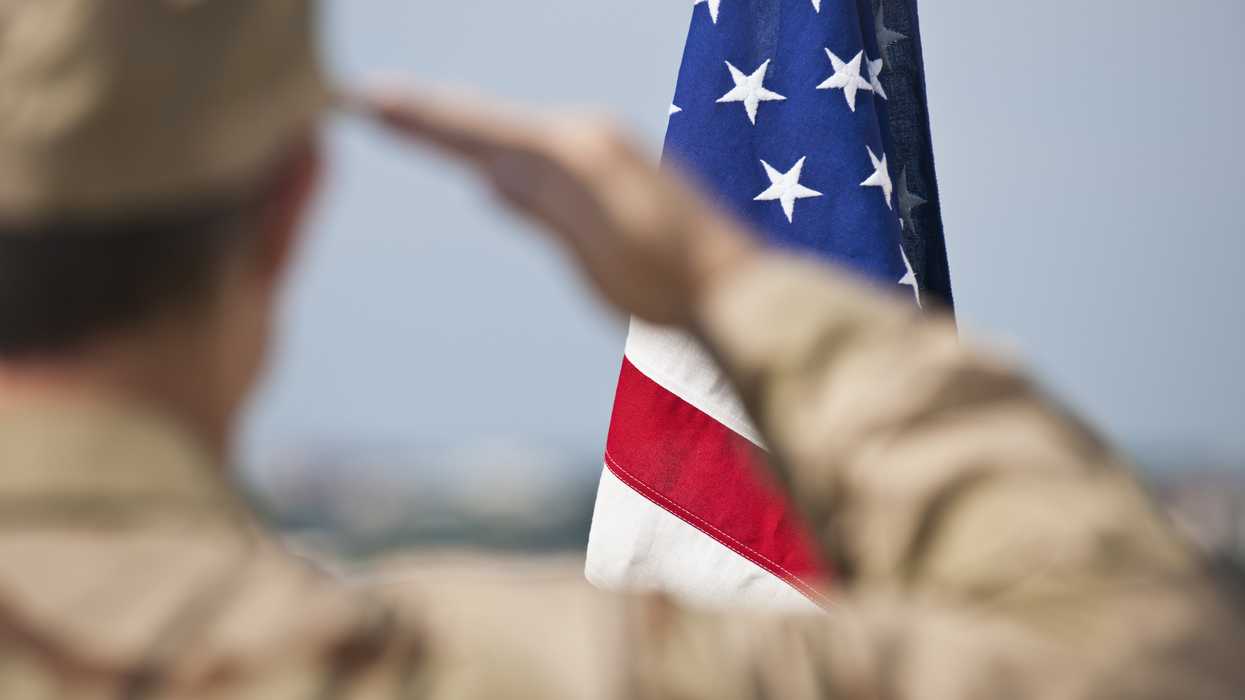

Exactly one year ago today, I resigned my commission as a Lieutenant Commander in the United States Navy. For fourteen years, I had voluntarily accepted the standard bargain of military service that included signing away a substantial portion of my First Amendment rights. I reclaimed them just in time.
Upon entering civilian life with a decade of active-duty observations, I started writing more. Over the past twelve months, I contributed over twenty op-eds to The Fulcrum (in addition to being published by VoteVets, Slate, and The New York Times). The vast majority of my pieces have touched on national security or the military-connected community. Turns out, I have a lot to say. Also, there’s been no shortage of material.
We are currently observing a hostile takeover of the American armed forces. The Trump regime is deliberately engineering the military apparatus to enforce unquestioning obedience to the executive branch, attempting to transform the ranks into what I call a “brute squad of religiously motivated loyalists.” Concurrently, there is reason to believe Trump’s war in Iran is being extended simply to manipulate the markets and create a windfall of self-enrichment for the President and his friends, fundamentally compromising the integrity of military leadership. To accomplish these goals, the administration is actively working to suppress internal dissent and external oversight.
The scope of this effort is broad and alarming. President Trump has bypassed traditional Constitutional checks by committing service members to an ill-defined and illegal war of indefinite length with Iran, all while systematically weakening veteran services. Meanwhile, internal changes at the Pentagon include: the purging of women and people of color from leadership ranks, the restriction of independent press access, the gutting of civilian harm mitigation programs, the manipulation of casualty data, and the indoctrination of white Christian nationalist ideologies.
Perhaps most ominous is Defense Secretary Hegseth’s attacks on the Judge Advocate General (JAG) Corps, or the military’s cadre of lawyers. He just announced a sweeping review of the military justice and legal system, intending to ensure “maximum lethality” rather than “tepid legality.” Given that legality is being framed as an obstacle, this is a highly precarious situation for the force, to say the least. Not every military officer gets a law degree in her free time. Putting the onus on the average service member in a fast-moving battlespace to decipher complex constitutional boundaries or evaluate lawfulness is an immense burden.
Evidently, Trump wants to disempower service members from questioning what is unlawful. In the past year, he tried to convince a Grand Jury to indict several veteran lawmakers after they posted a 90-second video reminding servicemembers of their legal obligation to refuse such orders. Trump called the video “SEDITIOUS BEHAVIOR AT THE HIGHEST LEVEL,” branded the lawmakers “traitors,” demanded they be “ARRESTED AND PUT ON TRIAL,” and called their actions “punishable by DEATH!” When the President is threatening sitting Congressmen executions for simply restating the law, what 18-year-old kid is prepared to actually challenge an order? A leader anticipating illegal activity may hope that the question is rhetorical. Fear and intimidation help secure compliance.
Even I, as a relatively anonymous veteran, have been advised countless times this past year, in response to my advocacy, to “be safe.” There is a pervasive, palpable anxiety that public criticism of the current administration–especially of its military policy–carries real personal danger. I recognize both the privilege and the danger that come with using my voice as a veteran to advocate for those still serving. And though I do not claim to represent the views of all servicemembers, nor will the entirety of the force agree with my analyses, my inbox has been filled with messages over the past year from active-duty personnel offering quiet thank yous.
Trump and Hegseth do not represent the views of all service members either. There are plenty of folks serving who wish they could quit, which might be why the number of military personnel inquiring about conscientious objection has risen by 1,000% since the start of the Iran war. Many joined for the promise of stability and upward mobility, and now they are stuck in an organization run by a draft dodger who “finds the notion of military service difficult to understand, and the idea of volunteering to serve especially incomprehensible” and keeps putting off making a deal with Iran, claiming he could fight forever, flippantly suggesting there will likely be more deaths while referring to fallen Americans as ‘losers’ and ‘suckers’. I will keep fighting for them, and for this republic.
Veteran voices are obviously critical to these conversations, but Trump and Hegseth are actively seeking to stifle them. As dozens of retired high-ranking military leaders warned in an amicus brief submitted by the Vet Voice Foundation, it could easily become “unclear what constitutional protection would remain for veterans wishing to express public disagreement with a present Administration…” We need backup. Unfortunately, a profound civilian-military divide has allowed the public to often overlook the structural vulnerabilities of the force. I empathize with those who have kept the military at arm’s length out of anti-war sentiment or otherwise, but we cannot afford to abandon the actual human beings within it now. Leaving vulnerable service members to navigate a lawless command structure alone may allow the military to be turned into a weapon against our own democracy.
An understanding between civilians and veterans could go a long way in strengthening the forces of reform anyway. Take healthcare reform or student debt cancellation. Because our volunteer military relies heavily on the “poverty draft,” where access to higher education, comprehensive medical care, and basic financial security is leveraged as a recruitment tool, robust civilian social safety nets would take away the best carrots the armed forces have to dangle. As a result, we cannot meaningfully discuss these domestic social policies without simultaneously analyzing how our military model relies on these structural inequities. When we talk about almost any issue facing this country, the state of the military-industrial complex is relevant.
Ultimately, we cannot separate the fate of the troops from the fate of our own domestic battles. If we let those who swore an oath to support the Constitution fall, what will be left? Let’s not find out.
If you are a veteran, you possess a unique credibility on these issues, and I hope you join me in leveraging it. But if you are a civilian, I hope you recognize that the subversion of the military threatens the architecture of our democracy and join us too. We could use your help.
There is a new call of duty now, and we must answer. Our voices will be louder together.
Julie Roland was a Naval Officer for ten years, deploying to both the South China Sea and the Persian Gulf as a helicopter pilot before separating in June 2025 as a Lieutenant Commander. She has a law degree from the University of San Diego, a Master of Laws from Columbia University, and is a member of the Truman National Security Project.