

Like a wolf in sheep’s clothing, America’s president is undermining the Republic by evading checks, consolidating power, and attacking democratic norms. He disguises his malicious intentions as innocence while dismantling policies and programs that would help citizens.
In earlier opinions, I wrote about three forces that corrode democracy: hypocrisy, corruption, and confusion. Hypocrisy creates a false image of leadership; corruption erodes public trust and suppresses voter participation; confusion keeps the public from seeing the truth. Together, they weaken the Republic.
A president who once declared, “I alone can fix it" now demands concentrated power while the country crumbles. He presents himself as a stabilizing force yet governs through intimidation. He speaks of restoring order while undermining the institutions that make order possible.
This fable of The Wolf in Sheep’s Clothing applies to public life. In the story, the wolf disguises himself as a sheep to confuse the flock and move freely among them. The disguise is not a costume — it is a strategy. It allows the wolf to deceive. The president uses a similar disguise. He wraps himself in patriotic language while weakening systems that safeguard the nation. He claims to defend the country while demanding loyalty to himself. He presents himself as a protector while pursuing power and money.
Confusion is not accidental. It is engineered to dull public judgment. When leaders flood public life with contradictions and manufactured crises, citizens lose the ability to distinguish governance from performance. A leader who creates chaos then presents himself as the one strong enough to control it. This strategy is not hidden. Project 2025 — a blueprint for consolidating executive power — is a public declaration of intent. Yet Congress, the branch designed to check presidential overreach, remains silent. Silence is not neutrality. Silence is permission — and it leaves citizens relying on their own judgment to see what leaders refuse to confront.
On January 20, 2025, he raised his right hand, repeated the oath, and immediately began performing duties that bore no resemblance to service to the people. Beneath the disguise, consequences were immediate: Families were separated and jailed. A violent immigration crackdown spread across the country. Innocent Americans were killed by ICE agents. DEI programs were dismantled. Journalists were humiliated and imprisoned. Personal voting data was collected. He pretended to protect the people but governed to protect himself. He pretended to be a reformer but dismantled systems that safeguard fairness.
The pattern extended beyond domestic policy. He invaded Venezuela in January 2026 and ordered strikes on Iran in February 2026, bypassing congressional authorization — a sweeping assertion of executive power. He pretends to be strong but relies on confusion, cover‑ups, and spectacle. His actions reveal a pattern of power without accountability. It is a performance — a fraudulent one — yet his loyalists ignore and excuse his overreach and abuse of power.
Americans watched as he built a cabinet designed for obedience. Nominees were individuals whose wealth insulated them from accountability and prevented them from challenging him. Those appointed to key positions were chosen not for experience, but for their role in crafting Project 2025 — a plan designed to concentrate presidential power by weakening the institutions meant to check him. These were not ordinary appointments; they were strategic placements. The very people who helped write the plan were positioned to carry it out. The intent was unmistakable: reshape the federal system so that loyalty to the president would outweigh loyalty to the Constitution.
Those strategic placements had consequences. Cabinet members and leaders in Congress have a responsibility not to the president, but to the Constitution and Americans. Yet many chose to reinforce the president’s falsehoods, applaud his distortions, and shield him from accountability. Rather than offering honest counsel and transparency, they echoed his claims. Rather than checking his excesses and overreach, they enabled them. Their silence — and their applause — do not protect us. They protect him.
On February 24, 2026, he delivered the longest presidential address in modern history — a marathon of exaggerations, self‑congratulation, and false claims. He boasted that he had taken prescription drug prices from the highest in the world to the lowest. He bragged about accomplishments that never materialized. He never mentioned unkept promises: relief on housing, food, or healthcare. And yet, despite the spectacle, his approval rating remained low — a sign the public no longer buys his lies. His loyalists applauded anyway, not because they believed him, but because loyalty has replaced judgment. That loyalty came at a cost.
He ignored the Epstein victims’ search for truth and closure, offering no acknowledgment of their suffering, while praising the hockey players he suggested had “fought on his behalf”. This is not leadership. It is favoritism disguised as strength.
Democratic decline rarely begins with a dramatic collapse. It begins with smaller fractures: norms stretched before they are broken, oversight criticized before it is weakened, elections questioned before they are undermined, institutions attacked before they are ignored. When a president claims the power to decide which laws apply to him, the public loses the ability to hold him accountable — unless citizens exercise independent judgment.
When he undermines the legitimacy of elections, the people lose their voice. When he attacks independent institutions, the nation loses its safeguards. Concentrated power does not return what it takes. It must be stopped — to prevent deepening inequality, to protect democratic processes, to guard against tyranny, and to preserve liberty itself. That is why constitutional clarity matters.
But the Constitution does not give the final word to any president. It gives it to the people. Democracy is not the property of any party or state — red, blue, or purple. For the Republic to endure, citizens must exercise their constitutional rights, demand that Congress use its power of checks and balances, and engage in civic responsibility.
Americans must see leaders as they are and refuse to surrender their judgment to noise, division, fear, or personality. Political judgment is about choosing sides. Citizen judgment is about choosing the Republic. Political judgment asks, “Which team am I on?” Citizen judgment asks, “What protects the Constitution and the common good?” One is driven by loyalty, personality, or party identity; the other by responsibility, research, and reflection.
Political judgment rewards performance, outrage, and allegiance. Citizen judgment evaluates whether leaders tell the truth, respect limits on power, and uphold their oath. Political judgment applauds a leader’s claims because he is “ours.” Citizen judgment checks whether those claims are real — and whether they strengthen or weaken democratic institutions.
Political judgment narrows the lens to winning. Citizen judgment widens it to safeguarding the Republic.
Judgment matters most when public life is clouded by confusion and spectacle. It requires research, self‑awareness, and reflection on how past choices shape the present. Voters must examine how their decisions affect the Republic, resist tactics meant to distract or divide, and demand accountability and transparency from every public official. Congress must prevent the concentration of power, exercise oversight, and uphold its constitutional responsibilities.
Citizens must vote, hold peaceful protests, challenge federal overreach, support a free press, and insist on separation of powers and judicial independence.
We must not allow the wolf to destroy our democracy. We strengthen the Republic when we let him know that we see who he is — and refuse to be misled. Democracy is not self‑correcting. It is citizen‑correcting. Judgment is not just a civic duty; it is the last line of protection between a free people and the concentrated power that seeks to weaken them.
_____________________________________________________________________
Carolyn Goode is a retired educational leader and national advocate for ethical leadership, civic responsibility, and institutional accountability. She writes about democratic norms, public trust, and the moral responsibilities of citizenship.

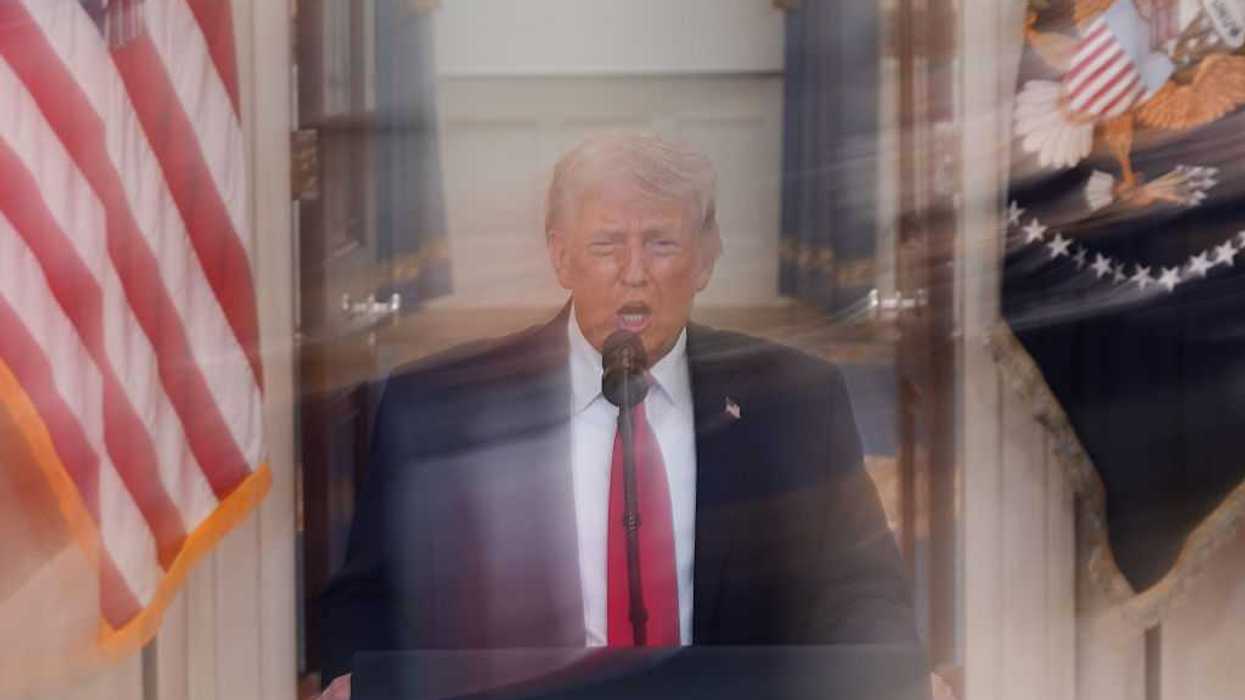





U.S. President Donald Trump speaks during a“ Steel Across America” event ahead of the 25th anniversary of the Sept. 11th attacks on the Ellipse near the White House on Sept. 8, 2026 in Washington, D.C. President Trump welcomed 9/ 11 first responders to the Tunnel to Towers Foundation’ s“ Steel Across America” event featuring a 16,900- pound, 21- foot steel beam recovered.
For Trump, even 9/11 is an opportunity
There was a reason organizers of the 9/11 ceremony in Manhattan told President Trump he could not speak at this year’s memorial service.
A good one, it turns out.
Because in a speech he gave on Tuesday in Washington, he did exactly what they were presumably worried about — he made it about himself.
According to The New York Times, Trump had wanted a speaking role at the service, but the National Sept. 11 Memorial and Museum, which oversees the site, said no, as they’ve maintained for the past decade-plus that the venue and event should be nonpartisan.
Trump has long used awful tragedies to either puff himself up, trash political opponents, or sell lies to the American people.
He blamed a deadly plane crash at Washington National Airport last year on diversity, equity and inclusion policies. He blamed Puerto Ricans for the devastation they endured after Hurricane Maria in 2017. He reportedly considered withholding disaster relief after the California wildfires based on the way affected regions voted. In an interview on Fox News meant to commemorate the 75th anniversary of D-Day in Normandy, he used the occasion to slam former House Speaker Nancy Pelosi…with graves of the dead behind him.
And now, as we approach the 25th anniversary of what many New Yorkers consider the darkest day in modern history, Trump has done it again.
He told a rambling, nonsensical story — one he’s told before — about going to Ground Zero just after terrorists flew two commercial jets into the twin towers. In the story, which no one has been able to verify, despite multiple attempts, he says firefighters had to carry him out of One Liberty Plaza, also known as the U.S. Steel Building, because they thought it was about to collapse.
As CNN fact checker Daniel Dale notes, there’s no evidence Trump went into this building, especially at a time when NYPD and NYFD had locked down the area. There’s no evidence that building was collapsing — in fact, it was deemed structurally sound and reopened within two months of the attacks. There’s no evidence he was carried out of it by firefighters.
But the lie isn’t even the worst part. Pretend it was all true — why would the leader of our country, and a New Yorker, decide to make that tragic day about himself?
Because that’s who Donald Trump is. He’s a malignant narcissist.
He’s also, incidentally, a terrible and ineffectual president, who’s made ill-fated decisions that he has to keep defending, and there’s nothing he won’t do to make himself look and feel better.
Within the first two minutes of his speech, he was cravenly using 9/11 to justify and promote his dumb war in Iran — two events separated by 25 years and 6,000 miles.
“And I will tell you, we’re right now fighting because we have a certain nation that wanted a nuclear weapon, they were very close to getting it, and now they have no chance at getting it. They will never have a nuclear weapon. Iran will not have a nuclear weapon. And they’ve been punished greatly. As you know, we’ve really taken it to them.”
As a New Yorker who lived through 9/11, still one of the worst days of my life, I’m utterly sickened by Trump’s crass, political, and self-promotional framing of that awful day.
And I’m relieved he won’t be given a platform to do it again on Friday’s anniversary in lower Manhattan.
Because for Trump, everything is his for the taking, and absolutely nothing is sacred.
S.E. Cupp is the host of "S.E. Cupp Unfiltered" on CNN.