

On April 29, 2026, the Supreme Court decided Louisiana v. Callais. Louisiana had been ordered by a federal court to draw a majority-Black congressional district. It drew one. The Court held the drawing unconstitutional and rewrote the Section 2 standard, raising the evidentiary burden for successful challenges and immunizing maps that satisfy a state’s stated partisan goals. As Justice Kagan wrote in dissent, the trap closes perfectly. States cannot draw majority-minority districts, and the mechanism that would require them to cannot be satisfied under the new standard.
Shelby County v. Holder (2013) removed Section 5 preclearance — the preventive mechanism. Callais has removed Section 2 enforcement — the remedial mechanism. Both statutory pathways to voting rights protection are now closed.
This is the third time. The republic tried to establish voting rights in the Fifteenth Amendment in 1870. The Supreme Court dismantled the enforcement mechanisms within thirty years. The republic tried again with the Voting Rights Act of 1965. The Supreme Court has dismantled those in two rounds, thirteen years apart. What statutes give, courts can take away — twice in the same century, specifically against voting rights, with the same result.
This is one failure, replicated across generations that have tried to correct it through ordinary channels. The question is what happens when the ordinary channels run out.
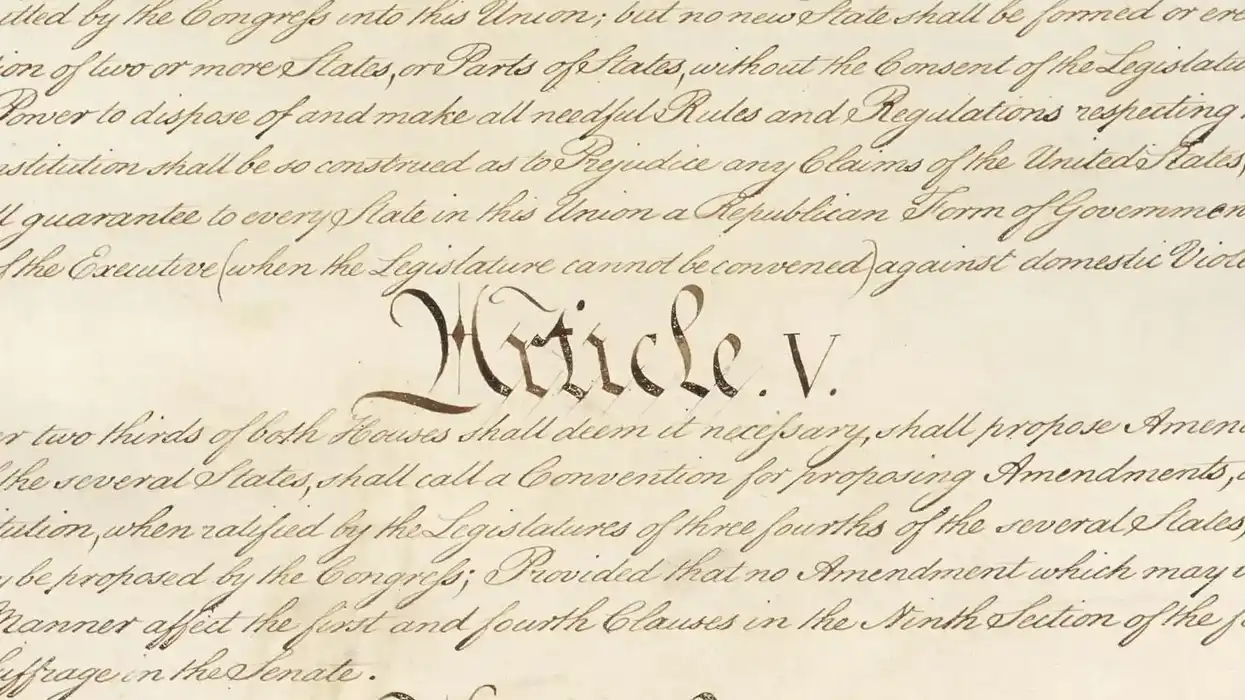
The answer is in Article V. It was deliberately put there.
Article V provides two routes for constitutional amendment. The route everyone knows runs through Congress: a two-thirds vote in both chambers, and three-fourths of the states ratifying. The route almost no one uses runs through the states: two-thirds of state legislatures — thirty-four — apply to Congress for a constitutional convention, which proposes amendments that must still be ratified by three-fourths of states — thirty-eight. Hamilton described this second route in Federalist 85 as “peremptory,” not optional, not discretionary, but obligatory when the states demand it. Madison designed it for the moment we are in: the institution most in need of change is the institution that controls the first route. A Congress whose members spend four to five hours a day on donor calls in a building across the street from the Capitol, which they are not allowed to use for fundraising, will not reform the campaign finance system that sustains them. An unaccountable Court cannot be appealed. The convention route bypasses both.
The objection that a convention could exceed its mandate, as the 1787 convention did, producing an entirely new constitution rather than revising the Articles, deserves a direct answer. I do not claim the risk is zero. What I claim is that in 1787, there was no existing ratification threshold attached to whatever the convention might produce. Today’s process requires thirty-eight state legislatures to approve any proposal. The “runaway convention” is a fear about what could be proposed. The 38-state threshold is the safeguard that determines what actually becomes law. Whatever a convention proposed — abolish the Second Amendment, install a parliamentary system, impose a balanced budget — would face ratification votes in state legislatures that would not approve it. Any amendment that clears thirty-eight states has achieved genuine supermajority consensus across the ideological range that ordinary legislation cannot reach. The 38-state threshold is not a technicality. It is the mechanism that makes constitutional modernization compatible with constitutional continuity.
What that compatibility looks like in practice is worth being concrete about. An amendment that clears the thirty-eight-state ratification threshold — whether proposed by Congress or by a convention — enters the Constitution by the same mechanism that produced the Bill of Rights, the Reconstruction Amendments, and the Nineteenth Amendment. The continuity is in the threshold itself: whatever clears it inherits the legitimacy of what cleared it before, and whatever cannot does not become law, regardless of how passionately a single coalition might press for it. The mechanism is conservative in design and modernizing in effect. That is not a paradox. It is the original design working.
Three amendments follow directly from what Callais and Shelby County exposed: an affirmative right to vote, independent redistricting, and a campaign finance amendment.
An affirmative right to vote. The Constitution contains no such provision. What exists is a series of amendments prohibiting denial of the vote on specific grounds (race, sex, age, poll tax), none of which creates an affirmative, judicially enforceable right. Under the current framework, when the government restricts the franchise, challengers must prove a specific statutory violation, and courts can narrow the standards for that violation. An affirmative constitutional right inverts the burden: the government restricting the franchise faces a presumption of unconstitutionality and must justify the restriction against a fundamental right. The amendment does not guarantee courts will interpret it correctly. It guarantees that the constitutional question, when litigated, is the right one.
Independent redistricting. The Supreme Court’s 2019 decision in Rucho v. Common Cause held that partisan gerrymandering is a “political question beyond the reach of federal courts” — a conclusion Justice Kagan called, accurately, abdication. In the 2024 cycle, gerrymandering gave one party approximately sixteen additional House seats in states it controlled after the 2020 census. Michigan implemented independent redistricting through a 2018 voter initiative and turned one of the country’s most extreme gerrymanders into genuinely competitive districts in a single election cycle. A constitutional provision requiring independent commissions for congressional seats would accomplish what Rucho explicitly placed beyond the reach of the judiciary. The United Kingdom, Canada, and Australia use independent bodies as a matter of course; none regards this as a radical arrangement.
A campaign finance amendment. Citizens United v. FEC rests on a doctrine of corporate personhood whose foundational precedent is not a judicial holding but a headnote; a summary written by a former railroad executive after a ruling whose own Chief Justice had told him the Court had “avoided meeting the constitutional question.” It was cited as settled law for a century and became the foundation for a decision that produced $4.5 billion in outside spending in the 2024 federal election cycle, $1.9 billion of it from sources that cannot be publicly traced. The amendment I would propose is narrow: it establishes that the government may regulate the expenditure of money in elections to prevent corruption or its appearance, and that this authority extends to corporations and non-natural persons. It restores the regulatory capacity that the Court removed in a decision built on a headnote.
Each of these proposals fills a gap between what constitutional democracy requires and what the current text provides. The organizing principle is completion. The Bill of Rights established what the government cannot do to you. What we have never established, what we have been trying to establish through statute for a hundred and fifty years and losing each time, is what democracy owes you: a vote that counts equally, elections free from unlimited money, maps drawn without a stake in the outcome, a legislature that cannot profit from the power it holds, and courts accountable to democratic time.
Any coalition serious about calling a convention must commit to refusing one thing: a balanced budget amendment. The Convention of States movement, with twenty states past the threshold, lists a BBA among its primary objectives. The intuition is understandable — federal debt exceeds $38 trillion, and annual interest payments now exceed defense spending. The constitutional remedy is wrong. In 2009, a $1.4 trillion countercyclical deficit prevented an economic collapse that economists across the spectrum agree would have been far worse without it. A constitutionalized balanced budget requirement would have made that response impossible. A convention producing a BBA would be worse than no convention at all, and anyone serious about calling one should enter that fight with clear eyes.
As of May 2026, twenty states have passed Convention of States applications — fourteen short of the calling threshold. Wolf-PAC, working the same threshold from a campaign finance direction, has resolutions currently active in three state legislatures. These movements disagree about almost everything. What they share is the recognition that ordinary legislation has failed, and that the convention mechanism exists for this very purpose.
The cross-partisan coalition required to ratify amendments through thirty-eight states is not a coalition of Democrats or Republicans. It is a coalition of Americans who have read the diagnosis the same way: that a court whose recent rulings have undone two generations of statutory voting-rights protection, and a Congress whose conditions of office crowd out the reforms most needed, are eroding the conditions a functioning constitutional republic requires — and who understand that the framers, who anticipated this failure clearly enough to build a bypass for it, left that bypass in Article V. Hamilton called it peremptory. He meant: this is what it is for. The question is whether this generation has the seriousness to use it.
Grayson Royal is a writer based in Winston-Salem, North Carolina. He writes long-form essays on democratic reform and civic argument. An Eagle Scout, he is not a constitutional lawyer—a fact he considers either the central weakness of his arguments or their most honest feature. He publishes at graysonroyal.substack.com.