




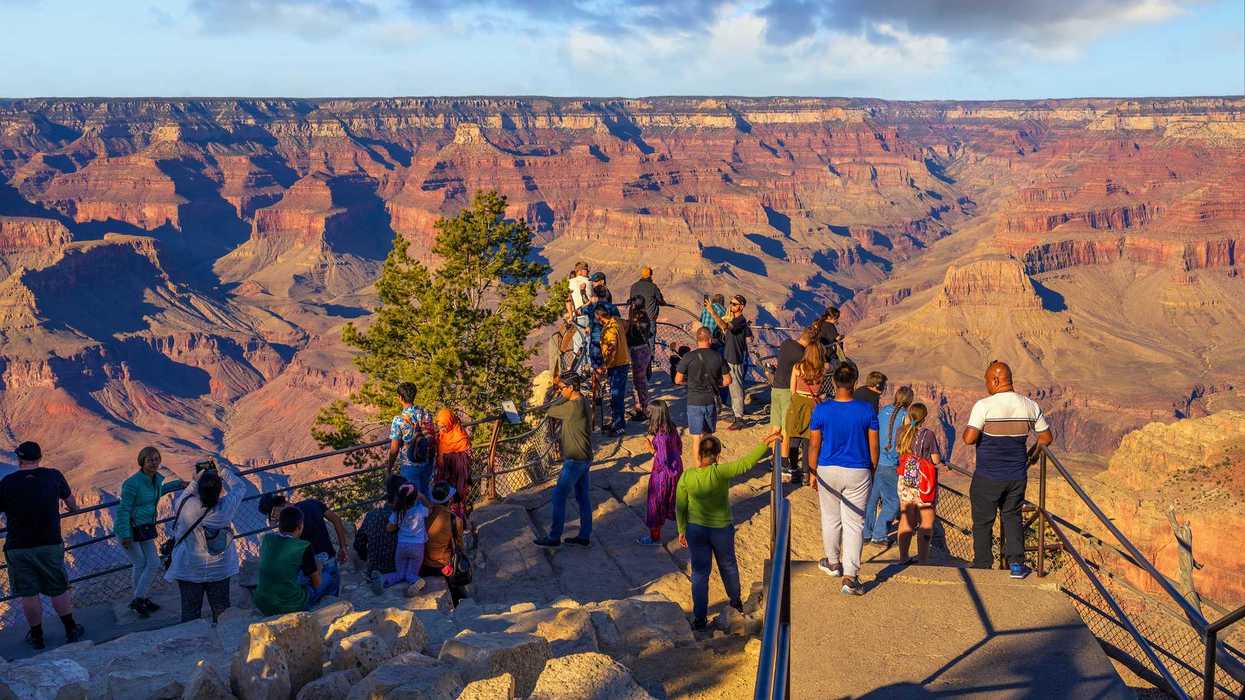

This summer, before dawn, the Liu family from Buffalo will load up their SUV, coffee in hand, bound for a long-planned trip out west. The Grand Canyon has been on their list for years, something to do before the kids get too old and schedules get too tight. They expect crowds. They expect long lines at the entrance. That is part of the deal. In recent years, national parks have drawn more than 325 million visits annually, near record highs.
What they do not expect are shuttered visitor centers and closed trails, not because of weather but because there are not enough staff to maintain them. What they do not see is the budget decision in Washington that made those trade-offs, quietly, indirectly, and without much debate.
The cuts to the National Park Service may look like another line item in a sprawling federal budget. They reveal something deeper about how the country is now governed. Increasingly, public institutions are not dismantled outright. They are allowed to thin out, with fewer resources, less capacity, and lower expectations, until decline begins to feel normal.
This is governing by neglect. Rather than make explicit arguments against shared national resources like our national parks, policymakers sidestep the fight. Congress fails to provide clear direction or sustained investment, and the executive branch makes discretionary decisions about what gets funded, delayed, or scaled back. The result is not a dramatic shift but a steady erosion that shifts costs onto families, especially middle-class and lower-income households, weakens public trust, and leaves institutions with less capacity than they once had.
How the Cuts Actually Happen
The erosion of the National Park Service is not the result of a single vote. It often unfolds through quieter mechanisms: continuing resolutions, vague appropriations, and the absence of sustained congressional direction. Instead of passing detailed budgets that specify how funds should be used, Congress relies on stopgap measures that keep funding levels nominally stable while leaving key decisions unresolved. Over the past decade, Congress has passed continuing resolutions in most fiscal years, normalizing short-term budgeting.
That ambiguity matters. When funding lacks specificity, the executive branch gains discretion over how resources are used in practice. Agencies can delay hiring, defer maintenance, or scale back services without formally announcing a cut. The public experiences the consequences, but the policy choice is obscured. The result is a system that rewards inaction. Visible cuts carry political risk; slow decline does not.
In this environment, neglect becomes a governing strategy. It avoids backlash that would come with openly targeting popular institutions like national parks. No one campaigns on closing trails or reducing ranger presence. Yet underfunding produces similar outcomes over time, with fewer services, reduced access, and a gradual decline in quality that is easy to attribute to circumstance rather than policy.
The result is a shift in how these shared resources are managed. Instead of clear legislative priorities backed by stable funding, institutions absorb uncertainty. As that uncertainty compounds, even well-functioning systems begin to look strained or inefficient, conditions that can then be used to justify further retrenchment.
Why Neglect Is Politically Attractive
Neglect has one decisive advantage: it is hard to see and even harder to assign blame. Closing a park outright would provoke immediate backlash. Letting it deteriorate, with fewer rangers, longer lines, and reduced hours, rarely does. The experience worsens, but the cause is diffuse.
For lawmakers, this ambiguity is useful. There is no single vote to point to, no clear moment when access was reduced. Funding levels can be defended as stable, even as real capacity declines. Responsibility is spread across committees, agencies, and fiscal cycles, allowing elected officials to claim credit for keeping parks open while avoiding accountability for their gradual erosion.
For the executive branch, discretion fills the gap. When Congress provides limited guidance, agencies make trade-offs behind the scenes, deciding what to staff, what to defer, and what to close temporarily. These choices are framed as operational necessity rather than policy, which further obscures their political origins.
The strain is already visible. The National Park Service has lost roughly 15 to 20 percent of its workforce over the past decade, even as annual visits exceed 325 million. Deferred maintenance has grown past $20 billion. Fewer staff are managing more visitors across an aging infrastructure. The effects show up in everyday ways: shorter hours, closed trails, and parks pushed beyond their limits.
In practice, this approach has become a governing strategy for many Republicans: reducing the size and scope of government without openly cutting programs that remain broadly popular. This pattern is visible in repeated budget proposals that reduce funding for agencies like the National Park Service while avoiding direct votes to eliminate services, allowing capacity to shrink without a clear moment of accountability. Rather than vote to end programs outright, policymakers allow funding and capacity to erode, producing similar outcomes with far less political cost. Institutions are not dismantled; they are allowed to fade, one budget cycle at a time. As the Talking Heads song “Nothing But Flowers” suggests, the hope is that as things fall apart, no one pays attention.
Beyond the Parks: Why This Matters for Everyone
It is easy to see these changes as a problem for vacationers. But the effects reach much further. National parks are not just destinations; they are part of a broader public infrastructure that supports local economies, preserves national heritage, and reflects a shared commitment to collective investment.
Gateway communities depend on park traffic for jobs and revenue. National parks generate tens of billions of dollars annually in visitor spending and support hundreds of thousands of jobs in surrounding regions. When services are reduced, and visitor experiences decline, those local economies feel it quickly, in fewer bookings, shorter stays, and lost income for small businesses. What looks like a budget decision in Washington becomes a pay cut in towns that rely on seasonal tourism.
There is also a quieter loss. National parks are one of the clearest examples of what government can do well: protect common resources, make them accessible, and sustain them over time. When that capacity erodes, public expectations change. Surveys consistently show national parks among the most trusted federal programs, which makes visible strain especially consequential. If even the park system feels unreliable, it reinforces the idea that the government cannot manage complex responsibilities effectively.
That shift matters. As confidence declines, calls for further cuts become easier to make, not because the public has rejected these shared resources, but because weakened performance makes them seem less worth preserving. Underinvestment becomes its own justification, extending far beyond the parks themselves.
Conclusion
When the Liu family arrives at the Grand Canyon, the view will still be there. The scale, the silence, the sense of something enduring. Those do not easily diminish. But the experience around it may feel different. Fewer rangers to guide them, longer waits, and parts of the park just a little less accessible than they should be.
That difference is easy to overlook. It does not announce itself as a policy failure or a political choice. It feels like an inconvenience, like bad timing, like the cost of popularity. But it is something else: the visible edge of a deeper shift in how the country governs its shared resources.
Governing by neglect does not require dramatic decisions. It works slowly, through underinvestment and ambiguity, until decline begins to feel normal. The danger is not only what is lost in places like the national parks. It is what that loss teaches us to accept.
If even the most widely supported institutions can thin out without clear debate or accountability, the same pattern can extend elsewhere. What begins in the parks does not stay there. It becomes a model for how public life is managed, quietly and incrementally, with fewer expectations of what government should provide.
The question is not whether Americans value their national parks. They do. The question is whether the political system still has the capacity, or the will, to sustain them.
Robert Cropf is a Professor of Political Science at Saint Louis University.












The President Invited Iran to Bomb My Home