

WASHINGTON — At a tenuous moment for the U.S.-Iran war, President Trump rejected Tehran’s terms for a truce proposal Monday. With negotiations stalled and concessions on a ceasefire deal dragging on, exiled Crown Prince Reza Pahlavi emphasized that regime change still could happen.
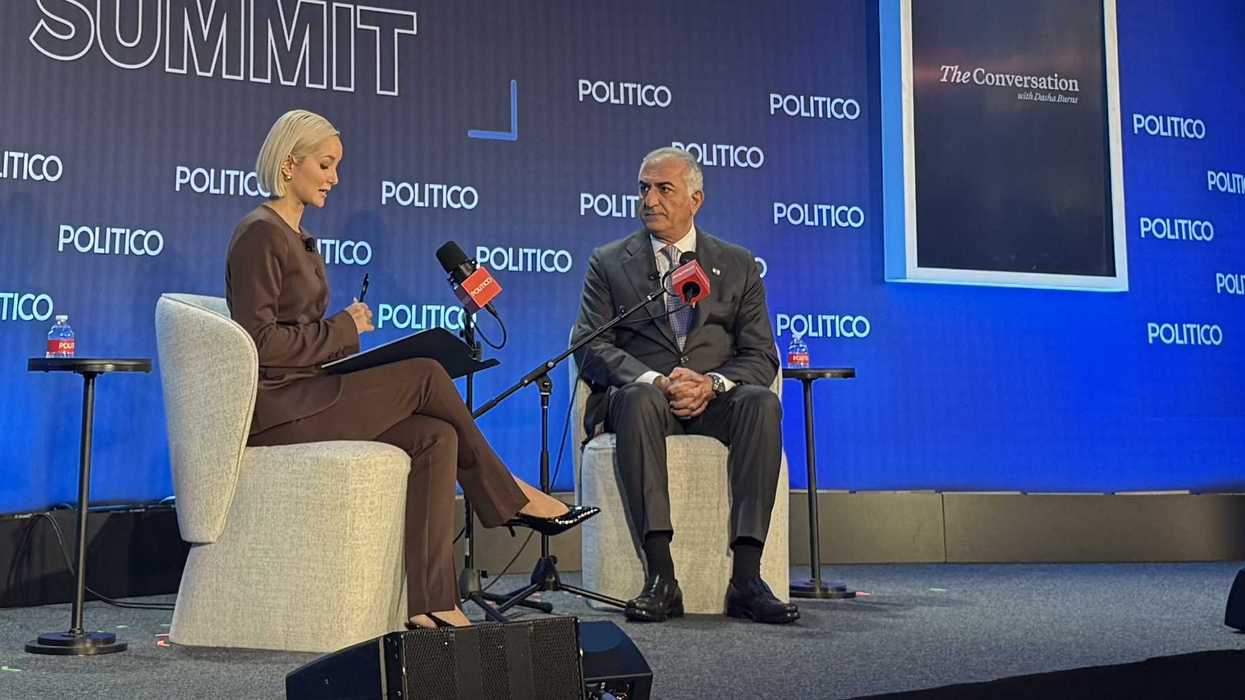
“Of course, it (a regime change) is a possibility, but more than a possibility, it is a necessity,” Pahlavi said in a security panel hosted by Politico on Tuesday.
Pahlavi characterized Iran’s government as weakened, leaving room for a successful uprising against the theocratic regime, which has been in power since Pahlavi’s late father, Mohammad Reza Pahlavi, was overthrown in the Islamic Revolution of 1979.
“And therefore, when we say that now that you have a wounded beast, this is not an opportunity that you should let go,” said Pahlavi, 65, who has lived with his family near Washington for most of his adult life.
U.S.-Israel attacks in February killed the Supreme Leader Ayatollah Ali Khamenei, but since his son, Mojtaba Khamenei, stepped in as Iran's current leader, many experts cautioned that Iran’s political system remained entrenched and regime change seemed unlikely.
Gordon Gray, a former U.S. diplomat who teaches at George Washington University, said he did not think Iran’s Islamic Revolutionary Guard Corps would allow an opposition to rise up.
“I don't think they're unable to unite if given the chance. The problem is that the Islamic Revolutionary Guard Corps isn't going to give them the chance,” Gray said.
Pahlavi, who has lived in the United States since he was 19, echoed the views of several Iranian grassroots organizations. They support a regime change led by Iranians themselves through mass mobilization and the overthrow of the country’s theocratic government, paired with U.S. political support. But they oppose a U.S.-backed military operation.
Pahlavi wants to serve as the temporary leader while Iran establishes democracy.
“What I am offering as transitional leader is precisely a mechanism or process whereby it's for the people of Iran to decide what they want and who they want as their leaders,” said Pahlavi.
However, some Iranian-American organizations, such as the Organization of Iranian American Communities, do not want him as a transitional leader.
“It is not as simple as someone who has no legitimacy in the form of Pahlavi to be able to be installed into our power from outside,” Majid Sadeghpour, the political director of the Organization of Iranian American Communities, said. “That's impossible in reality, and the people of Iran will reject it anyway and will rise up against it,” the human rights activist added.
Pahlavi has aligned himself with U.S. conservatives. However, the Trump administration does not deem Pahlavi as well-positioned to lead.
The President said in March that Pahlavi could be a possible option, but not an optimal one.
“Some people like him; we haven't been thinking too much about that," Trump said in a press briefing during his meeting with German Chancellor Friedrich Merz. “Somebody from within would be more appropriate.”
Sadeghpour said the National Council of Resistance of Iran, an exiled coalition of Iranian resistance groups from across the world, would be a better option. It was founded in 1981 and is now led by Maryam Rajavi, who proposed a 10-point plan for a future secular Iranian government, focused on democratic ideals and granting power to the people.
“The goal of the Iranian Resistance that we support is to overthrow the Iranian regime,” Sadeghpour said. “For that to occur, the Iranian people will have to overthrow this regime on their own, they will need U.S. and Western political support, they need us and they need Western political condemnation of Iranian regimes, killings and atrocities.”
Is a regime change attainable?
In recent months, some people thought that the time might have been right for such a change.
The U.S. imposed significant sanctions on Iran last year after Iran failed to renew a deal that limits their nuclear program. The value of Iran’s currency, the rial, fell sharply, sparking public outrage over rising inflation. In late December, people took to the streets and demonstrated against the government.
Iran is a diverse country of 92 million people and has over 20 ethnic groups.
“The Islamic Republic has spent decades ensuring that Iran’s citizens cannot unite against it… Any movement building has been defeated through the most brutal violence,” experts said in a report by the Human Rights Foundation.
During just two days of protesting in January, as many as 30,000 people may have been killed in the streets of Iran, Iranian health officials told Time Magazine.
Gray, who was the U.S. ambassador to Tunisia during the 2011 Arab Spring, said that the overthrow of the Tunisian government was possible then, because civil society successfully came together and overthrew a leader who “wasn't as repressive or as willing to use force against against his people, as as we see in Iran today.”
Gray said that the Iranian regime is brutally repressing anyone standing against it. The regime has engaged in widespread persecution of dissidents following the protests and the outbreak of the war. At least 22 political prisoners have been executed between March and April, according to the Center of Human Rights in Iran.
“I don't think there is a power vacuum. I think the Islamic Revolutionary Guard Corps has a pretty strong hold on power. It may not be the only power center in Iran, but I would say they're the predominant,” said Gray.
Georgia Epiphaniou is the foreign affairs and national security reporter with the Medill News Service.