



Skip to content
Search

Latest Stories

Follow Us:
Top Stories

Republicans aren’t willing to call the war in Iran what it is

Opinion

Republicans aren’t willing to call the war in Iran what it is

Secretary of Defense Pete Hegseth (left) and Admiral Charles Bradford "Brad" Cooper II, Commander of US Central Command, speak during a press conference at US Central Command (CENTCOM) headquarters at MacDill Air Force Base in Tampa, Florida, on March 5, 2026.

(Octavio Jones/AFP via Getty Images/TNS)

Let's state the obvious: We’re at war with Iran.

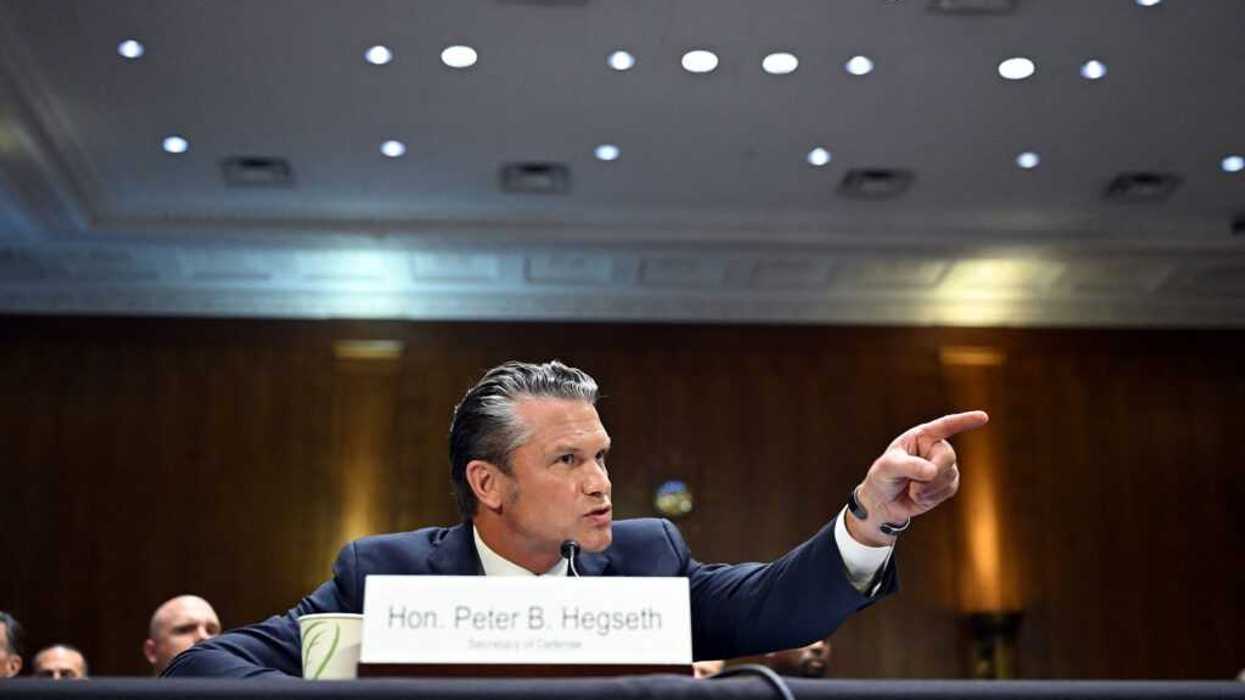
My evidence? Turn on your TV. U.S. forces, working with Israel, killed the supreme leader of Iran and many of his top aides. We sunk Iran’s navy and destroyed most of their air force. We bombed thousands of military sites across the region. President Trump, the commander in chief, has demanded “unconditional surrender” from Iran. He routinely refers to this as a “war.” Pete Hegseth, who calls himself the secretary of war, also describes this as a war daily, such as last week when he said, “We set the terms of this war.”


The truth that we are at war is so simple, only politicians and lawyers could make it seem complicated.

Indeed, a slew of Republican legislators insist we’re not actually at war. House Speaker Mike Johnson: “We’re not at war right now. We’re four days into a very specific, clear mission and operation.” Florida Rep. Brian Mast: “Nobody should classify this as war. It is combat operations.” South Carolina Sen. Lindsay Graham: “I don’t know if this is technically a war.” Oklahoma Sen. Markwayne Mullin: “This isn’t a war. We haven’t declared war.” Florida Rep. Anna Paulina Luna: “Strategic strikes are not war.”

Pearl Harbor was a strategic strike too.

Then there’s the claim that we’re not at war with Iran but Iran is at war with us. This is half true, insofar as Iran has been committing acts of war against the U.S. since it took our embassy staff hostage in 1979. But waging a war in response doesn’t make it any less of a war.

One is tempted to invoke George Orwell’s “1984,” in which the existence or nonexistence of war hinges on what the Ministry of Truth (or Truth Social) puts out on a given day. But nothing so literary is at play. This is (mostly) legalism run amok.

The main reason congressional Republicans reject the W-word is simple. If it’s merely a “combat operation” or “strategic strike” in response to an “imminent threat,” then the president has the authority to do it without congressional approval. If it’s a war, then it’s arguably illegal and unconstitutional within the framework of the War Powers Resolution or the Constitution itself, because under the Constitution declaring war is the sole responsibility of Congress. And the last thing this Congress wants to do is take responsibility for anything.

This at least partly explains why Trump insists he had a “feeling” Iran was about to attack us. He has even suggested that Iran was just weeks away from having a nuclear weapon and that he prevented an imminent “nuclear war.”

The War Powers Resolution — nominally rejected by every president since it was passed in 1973 — was intended to restrict the president’s ability to use force without Congress’ consent. It backfired. It says the president can respond militarily to threats as he deems necessary, but then must go to Congress within 60 days for approval to continue hostilities. The result: Presidents have a free hand to wage war for roughly two months, unless Congress stops them.

But congressional Republicans don’t want to stop Trump. That’s tactically defensible, if you believe this war was necessary. But the tactic forces Congress to say, in effect, “Don’t believe you’re lying eyes. This isn’t a war.”

For those who only vaguely remember what they learned in high school about the War Powers Resolution — or for that matter, the Constitution — this riot of legalism only fuels confusion.

But there’s another factor driving the evasion. Trump made the idea of staying out of “forever wars” a central tenet of America First. There’s no textbook definition of “forever war” — always a ludicrous term — so you can understand why some people believed it was code for “Middle East war” or just plain war of any kind. The irony is that Trump could make a plausible case that this war is allowable under the Authorization to Use Military Force George W. Bush received in 2001. But symbolically that would mean Trump is continuing Bush’s “forever war.”

Regardless, Republicans aren’t just under a legal clock to get this thing over with, but a political one too. Polling shows that Americans, including many Republicans, have no thirst for a long conflict, which makes sense given that they were not asked to prepare for this war at all. Hence, the insistence that this war will be short and tidy.

The problem is that Iran knows this. Which is why they don’t have to win, they just have to ride out the bombings until the public or Trump loses patience with this very real war.

Jonah Goldberg is editor-in-chief of The Dispatch and the host of The Remnant podcast. His Twitter handle is @JonahDispatch.

Read More

A TSA employee standing in the airport, with two travelers in the foreground.

A Transportation Security Administration (TSA) worker screens passengers and airport employees at O'Hare International Airport on January 07, 2019 in Chicago, Illinois. TSA employees are currently working under the threat of not receiving their next paychecks, scheduled for January 11, because of the partial government shutdown now in its third week.

Getty Images, Scott Olson

Nope. Nevermind. Some DHS agencies still shut down.

House Republicans reject clean bill to open shut-down DHS agencies (March 28 update)

House Republicans (and three Democrats) rejected the Senate's clean bill to end the shutdown late Friday night. Instead, the House passed a different bill that fully funds every agency in the Department of Homeland Security (DHS) but for only 60 days with the knowledge that this short-term continuing resolution will not pass in the Senate.

Both chambers are out until April 13 so the shutdown is expected to last until then at least. Hope that no major weather disasters occur before then because FEMA is one of the DHS agencies out of commission (though some of its employees may be working without pay). It's possible that air travel security lines won't get worse since the President signed an Executive Order authorizing DHS to pay TSA workers. New DHS Secretary Mullin says paychecks will start to go out as early as Monday. How long can this approach continue? Unknown. Leaving aside the questionable legality of repurposing funds in this way, DHS may not be willing to keep paying TSA from these other funds long-term.

Keep ReadingShow less
Protestors holding signs, including one that says "let the people vote."
Attendees hold signs advocating for voting rights and against the SAVE America Act at a rally to outside the U.S. Capitol on March 18, 2026 in Washington, DC.
Getty Images, Heather Diehl

The Senate Was Meant to Slow Us Down—Not Stop Us Cold

The Senate is once again locked in a familiar pattern: a bill with clear support on one side, firm opposition on the other—and no obvious path forward.

This time it’s the SAVE Act, framed by its supporters as a safeguard for election integrity and by its opponents as a barrier to voting access. The arguments are well-rehearsed. The positions are firm. And yet, beneath the policy debate sits a more revealing truth: in today’s Senate, the outcome of legislation is often shaped long before a final vote is ever cast.

Keep ReadingShow less
Clarity Is Power: The Three Pillars That Keep the People in Charge
man in white robe holding a book statue
Photo by Caleb Fisher on Unsplash

Clarity Is Power: The Three Pillars That Keep the People in Charge

American democracy does not weaken all at once. It falters when citizens lose clarity about how power is being used in their name. Abraham Lincoln warned that “public sentiment is everything… without it, nothing can succeed.” When people understand what their leaders are doing, they can hold them accountable.

But when confusion takes hold, power shifts quietly, and the public’s ability to act begins to erode. Clarity enables citizens to participate fully in democratic life and shape a government that responds to them. Confusion is not harmless; it erodes the safeguards, public awareness, and civic action that make self‑government possible. Clarity strengthens all three pillars at once — it protects our constitutional safeguards, sharpens public awareness, and fuels civic action.

Keep ReadingShow less
CONNECT for Health Act of 2025
person wearing lavatory gown with green stethoscope on neck using phone while standing

CONNECT for Health Act of 2025

How does a bill with no enemies fail to move? That question should trouble anyone who cares about Medicare, about rural health care, and about whether Congress can still do straightforward things.

In plain terms, the CONNECT Act would permanently end the outdated rule that limits Medicare telehealth to patients in rural areas who travel to an approved facility. It would make the patient's home a covered site of care. It would protect audio-only services, critical for seniors without broadband or smartphones, especially for behavioral health. It would ensure that Federally Qualified Health Centers can be reimbursed for telehealth, and it would lock in the pandemic-era flexibilities that Congress has been extending on a temporary basis since 2020. In short, it would turn five years of emergency workarounds into permanent, accountable policy.

Keep ReadingShow less