




While some believe that being a judge is an easy gig that requires only a dartboard, it is a challenging position that takes courage, especially when a judge must render an unpopular decision. There are many examples of judicial courage throughout history, such as the biblical King Solomon, whose decision to cut a baby in half must have caused quite a commotion, at least until the true mother’s selfless concern for her baby rendered his judgment unnecessary.
In recent years, many judges have been criticized for issuing decisions that don’t sit well with the present administration in Washington, DC. Many are plagued by death threats and bomb scares. (See Jaffe, “Judges Face Rising Threats but Are Barred from Responding,” Our Town, Oct. 18, 2025, https://www.ourtownny.com/voices/judges-face-rising-threats-but-are-barred-from-responding-EN5179240) (providing statistics on judicial threats). Consequently, courage is an essential judicial trait.
But suppose a judge is not threatened but ridiculed? Does a judge need courage to stand up to ridicule? Having been subjected to ridicule for giving the Nonhuman Rights Project (“NhRP”) a chance to be heard on their application for a writ of habeas corpus on behalf of two chimpanzees being held at a research lab, I feel qualified to address what it takes for a judge to stand up to ridicule.
After reading the NhRP’s papers in support of the application, including the supporting affirmations of prominent experts on primate intelligence, and copies of identical applications that had been dismissed without a hearing by judges in other New York counties, I signed the order to the extent of directing both sides to appear before me to argue the merits of the application. Research revealed, however, that an appellate court in a different judicial district had upheld a lower court’s refusal to sign an identical writ sought by the NhRP on the ground that chimpanzees are not “persons.” Although I presided in a Manhattan trial court, I was bound by that appellate ruling absent a contrary appellate decision in my judicial district. As ordering a hearing on an application did not constitute the ultimate relief sought by the NhRP, I determined to proceed with oral argument.
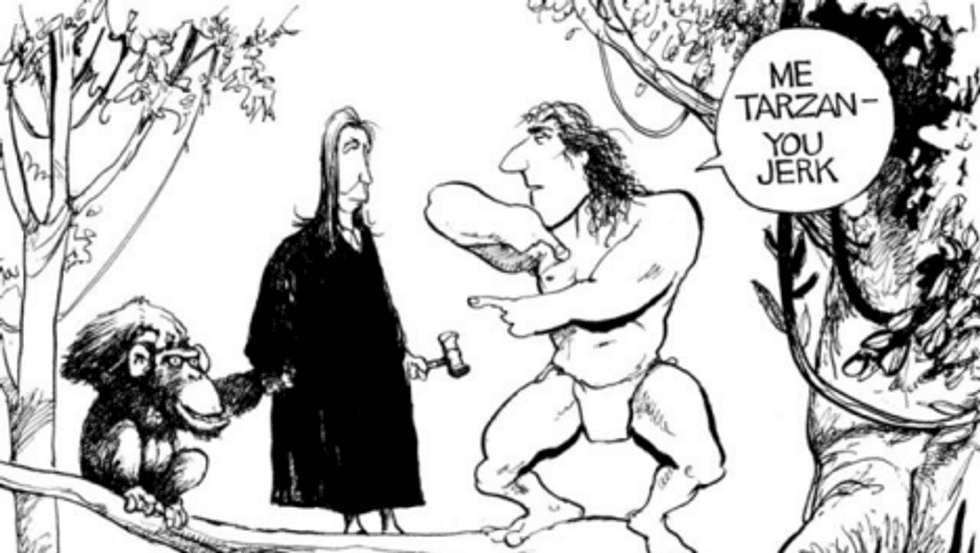
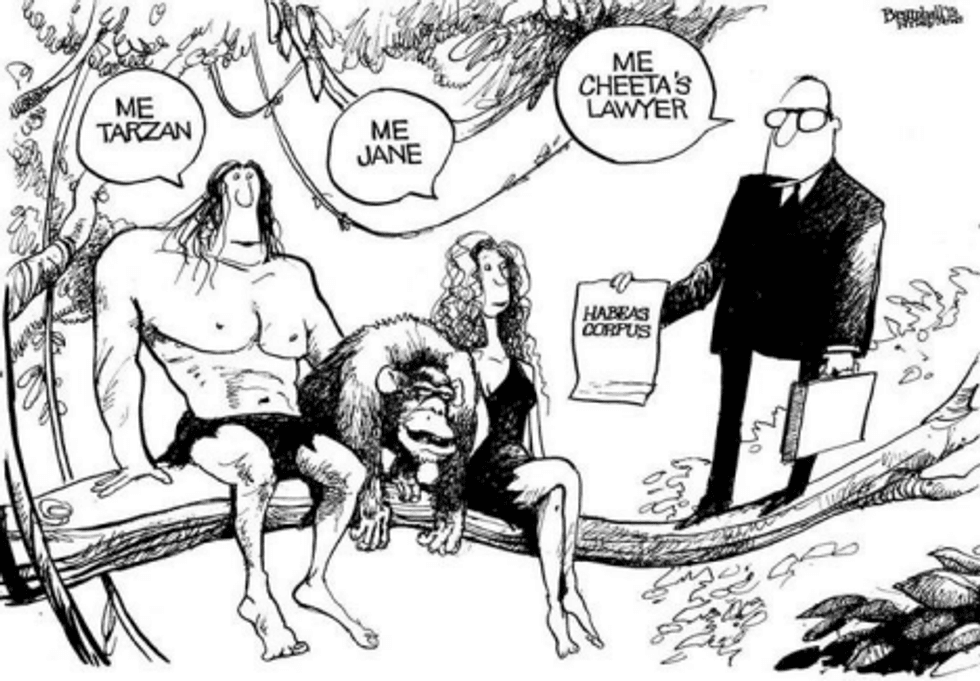
My order attracted worldwide attention, most of which was respectful. Around the courthouse at 60 Centre Street, however, the word “bananas” was liberally bandied about. The New York Daily News got in on the fun by publishing a cartoon depicting me in judicial robes standing on a tree branch hand-in-hand with a chimpanzee and confronted by Tarzan, who points at me and says, “Me Tarzan- you jerk.” (See below). Some months earlier, the cartoonist had depicted lawyer Steven Wise, the founder of the NhRP, also standing on a tree branch with a chimpanzee and Jane, but Tarzan does not call him a jerk. (See below).
I was otherwise ridiculed by those who laughingly contended that I would next grant chimpanzees voting rights. Others said I’d be the first judge to perform marriage ceremonies for all kinds of animals. Such contentions reflect an inability to perceive not only that I had only held oral argument on the application, but also that while chimpanzees are autonomous in some regards, they certainly can neither vote nor marry. Fear inspires irrationality and nervous jocularity. I was ultimately obliged to deny the writ, given the aforementioned appellate decision.
Those unfamiliar with American history should know that when Americans bought and sold Africans for the slave trade, similar writs on their behalf were also dismissed on the ground that they were not “persons.” While a slave is indeed a person, and a chimpanzee is not, the point is that human beings were once treated as nonpersons. And as those human beings were once considered nonpersons only to later be considered persons, why can’t a nonhuman be considered a person for purposes particular to it?
Given recent discoveries in animal intelligence, may judges confidently conclude that such beings will never be found to be intelligent? Aren’t judges ethically obligated to at least consider whether we should treat animals in a manner consonant with their abilities? Shouldn’t the protection of the “Great Writ” of habeas corpus be extended to sentient, autonomous, and self-aware nonhumans? And may we assume that future generations will not denigrate us as some now denigrate those who upheld as legal the African slave trade?
While the courage required to persevere in the face of death threats is far greater than that required to stand up to public ridicule, the need to render decisions that might seem ridiculous to some also demands courage informed by the lessons of history. There is nothing ridiculous about being willing to consider issues viewed by some as “ridiculous.” What is ridiculous is that I was ridiculed for affording a nonhuman the fundamental right to be heard, if only through human agency.
I gratefully acknowledge the late D.A. Pennebaker and Chris Hegedus, who produced and directed the documentary film “Unlocking the Cage,” about the legal process attending this case (The Nonhuman Rights Project v Stanley).
Justice Barbara Jaffe is retired from the New York State Supreme Court, New York County.













The President Invited Iran to Bomb My Home