



There is an old saying: If anyone insists something definitely is not about money; it is definitely about money. The Supreme Court’s right-wing majority claims that its recent election districting rulings are not about abetting racism or siding with MAGA politics, but they are definitely about both.
The Court’s recent Louisiana v. Callais decision cynically demands that anyone challenging election districts as violating the Voting Rights Act must “disentangle race from politics” and show that intentional racial discrimination, rather than politics, was the motivator when minority communities are divided and segments are placed into majority white districts.
Race and politics have been inextricably entwined since this country was founded, and they continue to be. Disentanglement is impossible, and demonstrating intentional racial discrimination rather than discriminatory impact is almost impossible. The Court’s new requirements are like multiplying 0 times 0.001; that provides a zero chance of prevailing.
Practically speaking, now if a state - or local - legislature claims that it split up concentrations of African American, Latino, Native American, Asian or other minority residents to make election districts that maximize a party’s electoral advantage or ensure an incumbent’s reelection, that allows the abridgment of the minority population’s ability to elect representatives of their choice.
That’s a true Devil’s Cocktail: Pour political partisanship together with racial discrimination and: Presto, racism allegedly disappears. And, there is more to the mix.
The Court further decloaked its favor for MAGA political advantage by scampering to put the Callais ruling to immediate effect, rather than allowing the normal period for that. The consequence of its rush was Louisiana - under the immediate spurious “emergency” order of its governor - halted early primary voting so that the state could eliminate one of its two congressional districts held by an African American.
Several Southern states quickly started uprooting their electoral processes to eliminate so-called minority opportunity congressional districts to gain MAGA political advantage. It is estimated that one-third of Congressional Black Caucus’ members may be forced out of Congress in the wake of the Callais ruling, and it will have dramatic consequences as state and local election districts are redrawn.
Added to that, immediately after its Callais ruling the Court approved a shadow docket petition to fast track Alabama implementing a congressional district map declared discriminatory by the Court in 2023, sending the case back to the lower federal court to consider in light of the Callais ruling. On May 25, the federal district court blocked use of the 2023 map, stating that it is “tainted by intentional race-based discrimination”. Another shadow docket “emergency” appeal will likely put the map - and the question of whether racism can be demonstrated - before the Supreme Court in the weeks ahead.
It’s an understatement to say that the immediate impact of the Court’s Callais ruling is confusion, if not a chaotic primary period, for candidates, election administrators and voters. In some of the affected states filing deadlines had passed, ballots composition was set, and in one case ballots were cast.
That all defies the Supreme Court’s “rule” that courts not issue decisions so close to elections as to cause such confusion - the so-called Purcell Principle, from its 2006 case Purcell v. Gonzallez. The uneven history of applying the Purcell Principle has often disadvantaged minority voters, but the Callais ruling demolished the principle altogether.
At base, the Callais decision has to be taken together with Shelby County, Alabama v. Holder, decided in 2013, and the lesser known 2021 holding in Brnovich v. Democratic National Committee. In combination, those rulings knocked out the viability of the VRA. The false premise of those decisions is that VRA tests for racial discrimination became outdated due to dramatic social progress.
While the Callais decision eviscerated the protections against racial discrimination in drawing election districts, Brnovich gutted VRA challenges to discriminatory barriers against voting. The Shelby decision decimated sections of the VRA that prevented jurisdictions with flagrant histories of racial discrimination in elections from making changes to voting laws and procedures without preclearance from the US Justice Department or the federal district court in Washington, DC.
A remaining element of the not yet fully buried VRA concerns the power of private individuals and organizations to lodge cases under it. That practice, which is responsible for the majority of VRA cases, was negated by the US Eighth Circuit Court of Appeal in its 2023 Turtle Mountain Band of Chippewa Indians v. Howe ruling. On May 18, the Supreme Court vacated that ruling and, rather than reversing it as Justice Jackson called for in her dissent, sent the case back to the 8th Circuit to consider in light of Callais. If the 8th Circuit’s radical view were to prevail only the US Justice Department could bring VRA cases, and that Department is now firmly under MAGA control.
The systematic destruction of the VRA is an historic setback. It echoes the destruction of the political progress of post-Civil War Reconstruction, while abrogating gains of the Civil Rights Movement. Combatting the MAGA attack against civil rights and democracy requires connecting with the historic movements that fought racism and advanced American democracy.
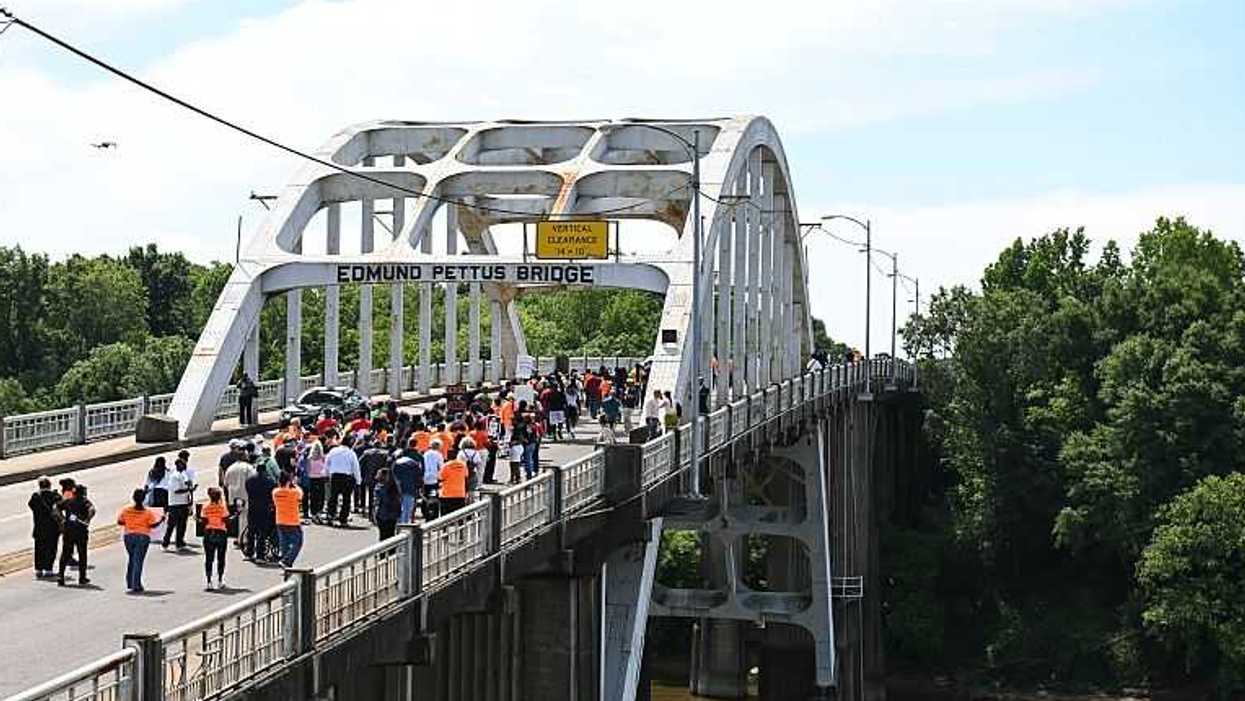
On Saturday, May 16, thousands demonstrated in Selma and Montgomery, Alabama, standing against MAGA-Gerrymandering and the broader push against minority rights and democracy. The demonstration, attended by civil rights, religious and other leaders, kicked off the All Roads Lead to the South campaign, which among other things is targeting five southern state legislatures where current electoral maps are being shredded. And, the NAACP’s new Out of Bounds Campaign is calling on Black athletes and their supporters to boycott public universities in states that change maps to diminish African American voting rights and representation.
Dynamic and creative campaigns are needed, applying the energy and lessons of 1964’s Freedom Summer, across the South and more widely to counter the effects of voter suppression, map-rigging, and MAGA organizing. Like Freedom Summer, the effort must be multifaceted and sustained over a long run. And, a lesson of Freedom Summer and every democracy movement is that to be successful a broad coalition, converging various popular interests, is needed.
We will need civil rights, immigration rights, interfaith, labor, women’s, LGBTQ+, legal, and other organizations to raise the demand for voting rights and trustworthy elections to secure honest outcomes in 2026 and beyond. Possibilities for Supreme Court reform, renewing the VRA, passing state VRAs, and addressing other urgent issues depend on that. Groups and candidates that support democracy must reach out broadly and enlist large numbers of people in electoral defense actions if that is to happen.
May the Court’s VRA decisions cause a powerful counter reaction, stimulating an overwhelming response against racism and MAGA domination. We all have a responsibility to help make that so.
Pat Merloe provides strategic advice to groups focused on democracy and trustworthy elections in the U.S. and internationally.










The President Invited Iran to Bomb My Home