

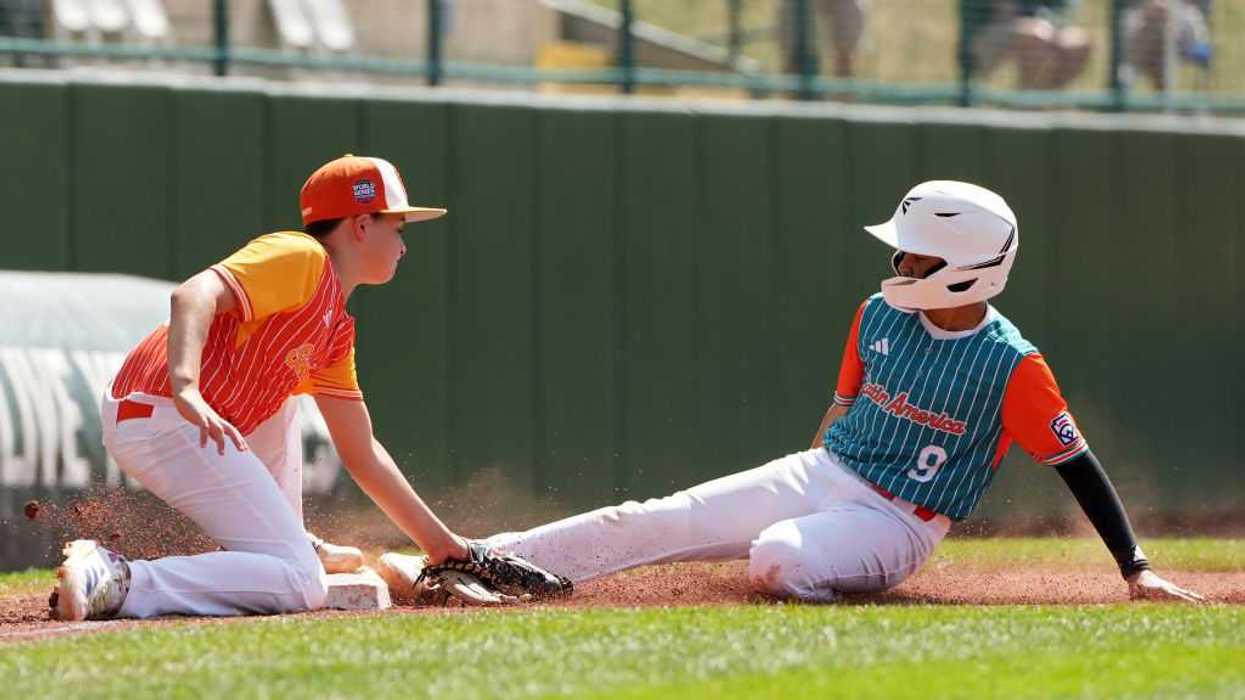

Late August in America has a certain sound and scene. For me, it is an ESPN broadcast and the persistent drone of a camera somewhere above a baseball diamond in Williamsport, Pennsylvania. Beneath it: a collection of 11- and 12-year-olds doing something completely ordinary and, these days, increasingly extraordinary. They are playing baseball.
The Little League World Series, as I understood it as a kid, wasn't merely a sporting event. It was a fever dream. Kids from Seoul, Tokyo, Curaçao, and Texas suddenly occupied the same outfield. Different uniforms. Different languages. Same sweat. Same tears. Same inexplicable desire to chase a high fastball with two strikes.
And somewhere at home, millions of kids like me imagined Williamsport wasn't really that far away. Yes, too, I was one of them—in mind, if never quite in body. My own All-Star run ended mercifully. Though I never traveled that magic road to Williamsport, my aspirations never truly died.
Years later, adulthood deposited me in Williamsport on business. It was the offseason. No bunting. No television cameras. The fields sat empty, like theaters between performances. Still, standing near Howard J. Lamade Stadium, I felt it again. You could almost see the ghosts: children who briefly became international celebrities and then returned to seventh grade; kids whose baseball careers would end before high school graduation; others whose dreams became different dreams. Thus, making Williamsport more interesting than nostalgia. Because youth sports have changed.
The average American sports family spent $1,016 on a child's primary sport in 2024, which is 46 percent more than in 2019, according to research from the Aspen Institute's Project Play. Even families of children ages 6 to 10 averaged more than $1,000. Just a generation ago, most kids played seasonal sports close to home, with costs rarely stretching beyond a new glove or a pair of cleats. Now, expenses like travel teams, private lessons, and weekend tournaments have fundamentally shifted youth sports into something much more costly and selective. And children from households earning at least $100,000 are twice as likely to participate in travel sports as children from households earning under $50,000.
Parental hope, it turns out, is an extraordinarily lucrative natural resource. There is always another tournament. Another camp. Another private instructor. Another hotel weekend. Another promise that your child is one investment away from becoming elite. And baseball is especially susceptible.
Project Play found it was the most expensive of America's three most-played youth sports in its latest parent survey, with families spending more on registration, travel, lessons, and camps than their counterparts in soccer and basketball.
Interestingly, we have professionalized the pursuit of becoming a professional before many kids have figured out who they are. Then there’s Williamsport. Not as some pristine sanctuary untouched by money. Let's not get carried away. The 2026 Little League Baseball World Series has a presenting sponsor. Little League has official banking, automobile, apparel, beverage, restaurant, and even snacking-vegetable partners. ESPN's broadcast relationship with Little League extends through 2030.
Williamsport isn't outside the machine.
It is something more interesting: evidence that the machine doesn't have to consume the kids.
Little League tournament rules still contain peculiar restraints that sound almost radical in our optimization-obsessed sports culture. Every eligible player is placed in the continuous batting order. An 11- or 12-year-old pitcher gets 85 pitches in a day, maximum, with mandatory rest determined by workload. Games can end under 15- and 10-run rules; in other words: winning matters. But some things matter more.
A Japanese team stretches in astonishing synchronization. American kids invent increasingly elaborate handshakes. Players trade pins. Somebody builds something structurally unsound out of batting helmets. Then watch the handshake lines. Sometimes awkward. Sometimes tearful. Often both.
There is something almost subversive about watching children who may not share a language discover that they share disappointment. Or exhilaration. Or the universally miserable experience of striking out with the bases loaded.
Before adults teach children all the sophisticated reasons they are supposed to distrust one another, sports can teach them something simpler:
You are more like me than I thought.
That is what keeps bringing me back.
Not innocence exactly. Innocence is too easy.
Williamsport is an interruption.
In the late summer heat, the machinery slows just enough for us to remember what existed before we built all of this around it. Play. The wonderfully inefficient act of doing something because doing it brings joy.
For most of these kids, Williamsport will be the athletic summit of their lives. We have been conditioned to hear something sad in that sentence. Every childhood achievement is supposed to become the first chapter of a larger success story: Little League. Varsity. College. Draft. The Show. But almost nobody's life works that way.
Most of these players will become teachers and engineers and nurses and pastors and accountants and parents who someday embarrass their children by explaining, for perhaps the 700th time, that they once got a hit on ESPN. And there is something magnificent about that. An experience does not become less meaningful because it doesn't become a career. Nor is a childhood dream a failure because adulthood eventually replaces it.
At a moment when families are spending more, traveling farther, and specializing earlier, the Little League World Series offers a modest act of resistance—not because money is absent, but because money has not yet entirely swallowed the thing itself. The game remains visible. So does the joy.
I don't know what youth sports will look like in another decade. Potentially, every 10-year-old shortstop will have a sponsorship package, an analytics dashboard, and somebody advising him on engagement metrics. We are inventive people. If there is another inch of childhood available for monetization, somebody will find it.
But there is still Williamsport. Because for two weeks, Williamsport gives us a glimpse not of sports as they once were, but of sports as they might still be: Messy. International. Unoptimized. Joyful. Human. And, for one more summer, still belonging to the kids.
Rev. Dr. F. Willis Johnson is a spiritual entrepreneur, author, and scholar-practitioner whose leadership and strategies around social and racial justice issues are nationally recognized and applied.