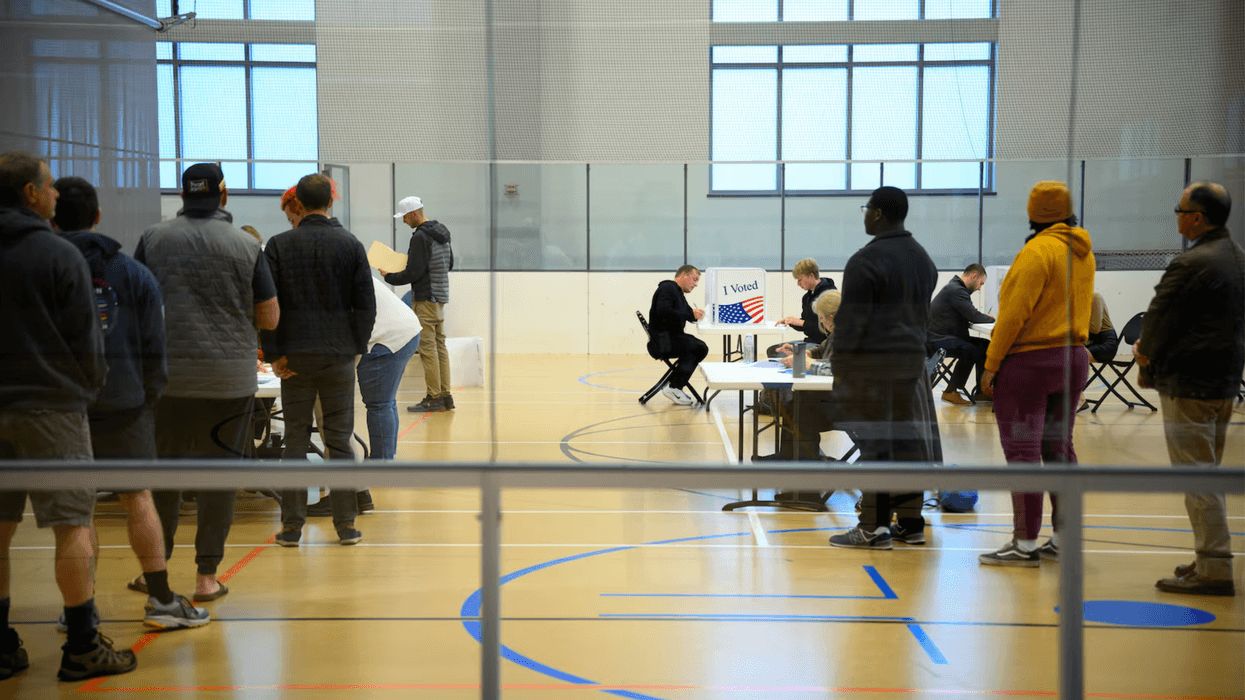





Health care was a deciding issue in the Nov. 3 midterm elections. In KFF's survey of voters, 54% said Trump administration policies had made their own health care costs worse, and those voters backed Democratic House candidates 82% to 16%. Voters trusted Democrats over Republicans to handle health care, 49% to 30%.
But the voters who sent that message are not the Americans who will feel the next round of health policy most. Starting in January, millions of adults on Medicaid will face new paperwork to keep their coverage. All of them have low incomes, and in my research, poor health is one of the main reasons low-income Americans stay away from the polls. As states build that new paperwork, they have both a chance and a legal duty to make it easier for these Americans to register to vote.
As a political scientist who studies health politics, I used the Census Bureau's Current Population Survey for every national election from 2000 through 2024, covering about 1.16 million citizens, to examine why people say they did not register or vote. In midterm elections, Americans in the bottom third of family income were about 18 to 21 percentage points less likely to report voting than those in the top third. Illness or disability accounts for about one-sixth of that gap.
This is not just an excuse. Low-income citizens are nearly three times as likely as high-income citizens to report a serious difficulty with tasks such as hearing, seeing, walking, remembering or caring for themselves. Among low-income registered voters who did not vote and cited illness or disability, more than half reported such a difficulty, compared with about 1 in 5 low-income voters. A second survey, the Cooperative Election Study, which checks answers against voter records, points the same way. Among registered voters who skipped a midterm and gave a reason, about 17% of those in the bottom third of income said sickness or disability kept them home, compared with about 10% of those in the top third.
Now the rules are changing for many of the same people. Beginning in January, adults covered through the Affordable Care Act's Medicaid expansion in 41 states must renew their coverage every six months instead of once a year. Many must also show 80 hours a month of work, school, job training or community service, or at least $580 in monthly household income. People who are medically frail are exempt, but they have to qualify for the exemption, and starting in 2028, states must collect documentation when their own data fall short. Urban Institute researchers project that 4.9 million to 10.1 million people could lose Medicaid in 2028, depending on how states carry out the new rules.
Coverage and participation are connected. After the first states expanded Medicaid in 2014, political scientists found that voter registration rose in expansion states, especially in counties with the most newly eligible residents. Losing coverage, and spending hours proving eligibility, could push in the other direction.
There is a tool already on the books. The 1993 National Voter Registration Act is best known as "motor voter," and motor vehicle offices handled about a third of registration transactions in the 2024 election cycle. But a DMV reaches people who drive. In my data, low-income Americans who do not vote are far more likely than affluent ones to cite transportation problems. The same 1993 law also requires every office that provides public assistance, including Medicaid, to distribute a voter registration form "with each application for such service or assistance, and with each recertification, renewal, or change of address form."
Six-month renewals mean twice as many renewals. States are now preparing new systems for those renewals and for reporting work hours. They can make the registration offer part of every renewal packet, online portal and call-center script, as the law already requires for renewal forms. They can also report each year how many people register through Medicaid offices, so the public can see whether the offer is reaching anyone. And they should keep renewing coverage automatically whenever their own data allow, as federal rules require, so that sick people are not buried in forms in the first place.
Registration is not the same as voting, and not everyone offered a form will use it. In my analysis, the largest single part of the income gap comes from people who say they are not interested. But illness is a different kind of barrier. It is concentrated among the poor, it can be measured, and Medicaid offices will soon review these Americans' coverage twice a year.
This is not a partisan fix. Medicaid expansion covers adults in red and blue states alike, and the registration requirement has been law for more than 30 years. Health care voters made themselves heard on Nov. 3. The Americans who will feel the next changes most should not be the ones least likely to be heard.
Jiyue Wang is a PhD student in political science at Rutgers University–New Brunswick, where he studies health politics and political behavior.