
Bruno Rodríguez Parrilla did not wait for his turn. While Mike Waltz held up photographs of Cuban leaders wearing luxury watches, Cuba's foreign minister rose from his seat, advanced on the American ambassador, and called him a liar in the General Assembly hall. Waltz told him to back away. Within a day, Washington had expelled a Cuban diplomat it accused of shoving an American colleague, and the annual vote against the US embargo had produced its weakest result in three decades.
The resolution passed, as it has almost every year since 1992. The tally was 130 in favor, 17 against and 25 abstentions. A year ago it drew 165. In 2015 and 2017 it drew 191. Germany and Italy abstained for the first time in 34 years, and Colombia, Costa Rica and Ecuador were among the no votes.
Miguel Díaz-Canel called it a victory. Washington can claim one too, because the world has stopped accepting Cuba's favorite excuse. That reading is correct. It should also worry the White House more than anything Rodríguez shouted.
For 34 years the vote did two jobs. It gave Cuba's rulers an alibi for every empty pharmacy shelf. It also gave Washington cover: as long as most of the planet blamed the embargo, the blame for Cuba's misery was at least shared with the regime that runs the island. Talk the world out of blaming your embargo, and you have talked it into watching what you do next.
What Washington does next is no secret. After the US ousted Nicolás Maduro on January 3, Trump threatened tariffs on any country shipping oil to Cuba. By February the Venezuelan, Mexican and Russian cargoes had stopped coming to an island that produces only 40 percent of its own fuel. The national grid has collapsed at least six times since. After the September failure, 5 percent of Havana had power by dusk. By March, 96,000 Cubans were waiting for surgery, 11,000 of them children.
Waltz has a case, and it deserves a fair hearing. Waltz told the Assembly that Cuba's wealth had not vanished but had "changed hands" to a military-run business monopoly, and that American firms sold the island $876 million in goods in the first eight months of this year. Both points hold up. Neither runs a dialysis machine. Waltz says there is no blockade. Havana's water pumps say there is no diesel.
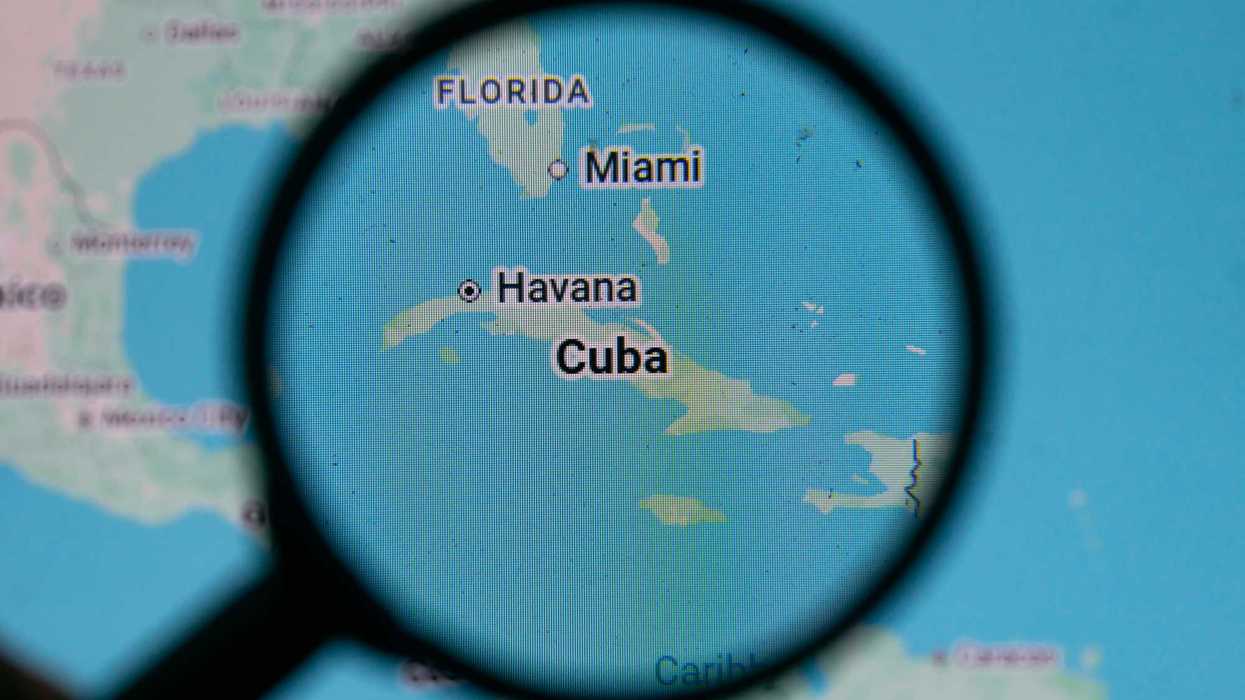
Venezuela is the comparison the administration would rather not draw. At a rally in Corpus Christi on Tuesday, Trump pointed to a tanker carrying one million barrels of Venezuelan crude bound for Texas refineries. Venezuela came with a cushion: once Maduro was gone, its oil could flow north and pay for the transition. Cuba has no crude to sell. It has 9.4 million people by official count and 90 miles of water between them and Florida. Marco Rubio said on Monday that Cuba is "completely different" from Venezuela. He is right. His policy has not caught up with him.
The migration arithmetic now belongs to Washington. Cuba's statistics office counted 245,264 emigrants in 2025, after 251,221 the year before. The Mariel boatlift carried 125,000 Cubans to Florida over six months in 1980 and dogged Jimmy Carter through his reelection fight. The exits are narrower now. Wet foot, dry foot ended in 2017, and the Coast Guard returns interdicted rafters to the island. An island with no power, no exit and no foreign scapegoat is what maximum pressure looks like. It is also what Cuba looked like in the summer of 1994, when Fidel Castro opened the coast and some 35,000 people took to the sea.
Trump has already sold Florida the ending. "We'll take care of Cuba on our way back from Iran," Trump told a rally in Fort Myers last Friday, promising to send Rubio in "to finish up the deal." Rubio invited Cubans to a "discreet partnership with the CIA." A UnidosUS poll found 57 percent of Latino voters oppose military intervention in Cuba, while more than six in 10 Cuban Americans favor it. That split is the trap. The midterms are five days away. A promise made in Fort Myers falls due on November 4.
There is a cheap way to keep the win from turning into a liability. The Treasury could license fuel cargoes for hospitals and water pumps, plus enough to hold the grid's base load, consigned to the UN agencies already running a $94 million emergency plan on the island, with every tanker tracked and every barrel logged. The military conglomerate Waltz described will try to skim it. That is an argument for UN custody of the fuel, not for keeping it off the water. Washington would give up no leverage, and it would gain what no speech in New York can supply: proof that the people rationing Cuba's light sit in Havana.
Refuse that, and the next count will not be taken in the General Assembly hall. The Coast Guard will take it off Key West.
Imran Khalid is a physician, geostrategic analyst, and freelance writer.