


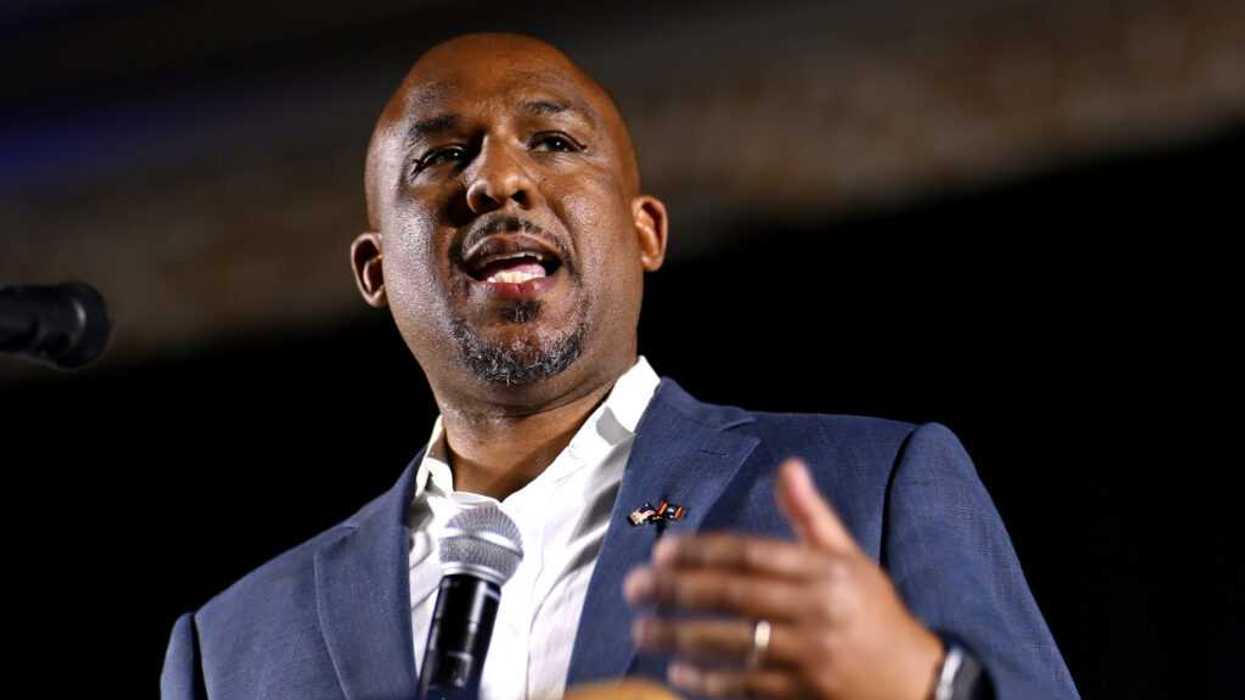

On CNN this weekend, Mississippi Sen.-elect Scott Colom said that his recent victory suggests we’ve made a lot of progress “in the journey to have people judged by the content of their character and not the color of their skin.”
Colom is the state’s first Democrat to win a Senate seat since 1982, and the state’s first Black senator since Reconstruction. That statement was a symbolic win for conservatives.
Of course, I mean actual conservatives, and not some racist cranks on the fever-swamp right. For decades, conservatives have infuriated the ideological left by arguing that a colorblind policy on race was consistent with Martin Luther King Jr.’s call to judge people by the content of their character and not the color of their skin. Now a newly elected star Democrat concedes the point, at least rhetorically.
That’s not all Colom conceded. He’s praised President Trump for securing the border, and he supports 2nd Amendment rights.
We’ll soon see whether his rhetoric matches his votes, but the simple fact is that Colom needed to say these things to be elected in a conservative southern state. I’ll give him the benefit of the doubt on his sincerity, but if Colom deviates wildly from his stated positions, he’ll have a rough time being re-elected.
But this piece isn’t about Colom. It’s about the political dysfunction of the last 25 years, which has been fueled in no small part by the activist bases of both parties. The hard-core left and the fanatical right have convinced themselves that the way you win elections is to capture the party’s nomination and then try to force your nominee on the broader electorate.
This strategy works in regions of the country under one-party rule. The Democratic Socialists of America successfully turned many blue districts, cities and some states even bluer by winning the nomination. In places like Boulder, Colo.; New York City; Los Angeles, etc., if you have a D after your name, you win. Until this month, in Texas, Kansas and, of course, Mississippi, if you had an R you won.
A version of this strategy has dominated most presidential contests as well. Win the nomination by capturing enough of the base and then work like hell to secure a narrow victory by turning out your base. The Democrats’ massive victory in the midterms broke that pattern.
Whether the Democrats seize the opportunity bequeathed to them by Trump’s staggering unpopularity remains to be seen. If they overread the returns and overreach — try to pack the Supreme Court, abolish the filibuster, etc. — expect the GOP to recover far more quickly than the “extinction-level event” rhetoric suggests.
It boils down to a failure of imagination. The red and blue zealots have internalized the idea that the parties are vessels for their ideological purity. I still chuckle at a 2021 fundraising email I received from the No Excuses PAC — founded by former staffers of Rep. Alexandria Ocasio-Cortez — promising that if they could just beat centrist Democratic Sen. Joe Manchin in the West Virginia primary, they would be able to deliver “the next AOC” in West Virginia. That state was no more going to elect an AOC-style candidate in 2022 than Mississippi was in 2026.
Senate Majority Leader John Thune knows how to read election returns. He recently said that if the GOP is to recover, “We’ve got to start talking to independent voters.” The response from Kevin Roberts, president of the Trumpified Heritage Foundation, was to lambaste Thune for his “swamp talk.”
“Running to the middle is not what got Trump popularly elected in 2024,” Roberts jeered, “but it is what got Republicans crushed in the midterms. Bold conservatism is what will attract independent voters and win elections.”
Actually, Trump got 49.8% of the vote in 2024, and would have lost without independents.
What partisan purists miss is that ideological victory isn’t synonymous with electoral victory. The point of ideological movements isn’t to win elections, but to win arguments. The surest sign your side has won an argument — even temporarily, as most victories in politics are temporary — is when the other side agrees with you.
That’s the irony of the midterms; die-hard Republicans have virtually nothing to cheer for because they measure success in electoral victories. But for principled conservatives, there’s a silver lining. Democrats in red states won by moving their parties rightward. Conversely, progressives should reflect on what it says that their margin of victory came at the expense of Democratic candidates distancing themselves from their ideological priorities.
Obviously, Democrats still have much to celebrate. But when the celebrations are over, it will be time to make arguments. Because that’s what politics is about.
Jonah Goldberg is editor-in-chief of The Dispatch and the host of The Remnant podcast.