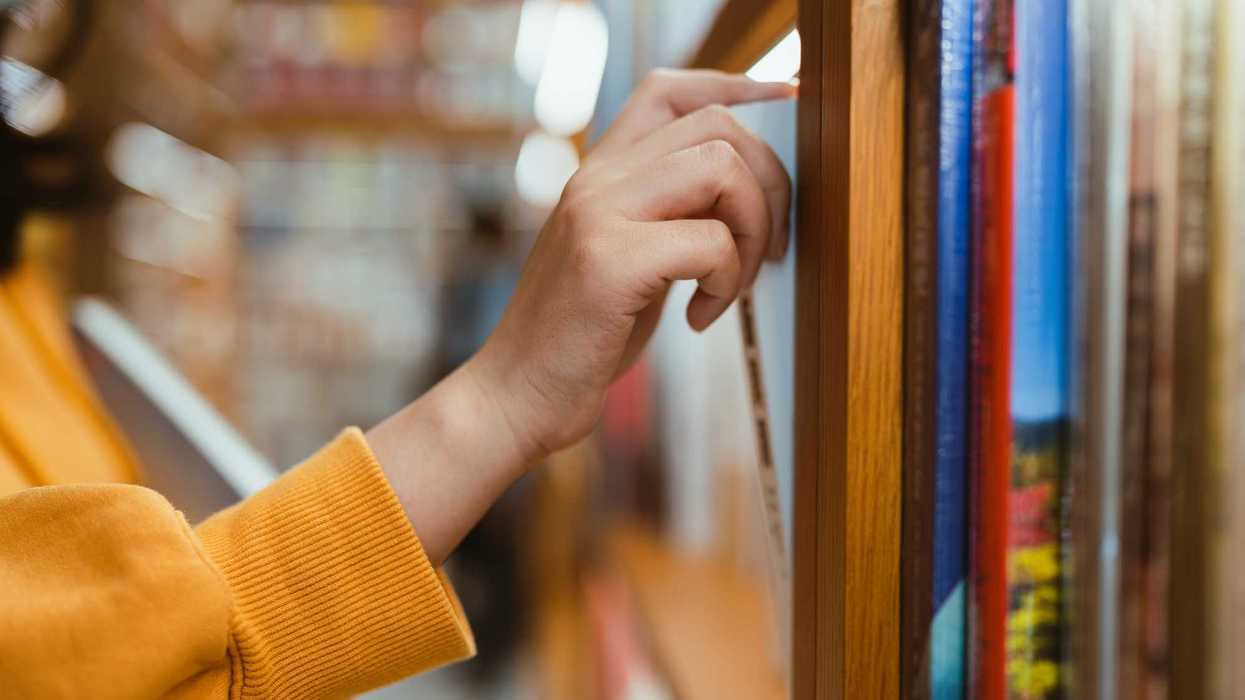
At the start of this school year, a Texas schoolteacher from my home school district went nationally viral. In a video, Darius Williams sobbed as he explained that after he “gave them the answers,” his high school seniors still could not complete an exercise comprising two sentences to read and one to write. But even as reading scores in the country languish at a twenty-year low, officials in Texas and other states have renewed vows to pull purportedly “dirty, filthy, and vulgar” books from shelves.
Since 2021, book bans have reached a level “never before seen in the life of any living American” (34,000 total in public schools across the country, according to PEN America). Some institutions are even preemptively removing materials to avoid controversy, a phenomenon termed “soft censorship.”
To justify these bans, many decision-makers cite the need to police “inappropriate” content. But the types of books yanked from shelves tell a different story: they tend to center people of color, LGBTQ+ characters, or neurodivergent or disabled ones.
Before my parents immigrated to the United States in 1993, they lived through a severe book ban themselves. China’s Cultural Revolution included a campaign to rid the country of symbols and artifacts that did not comport with Maoist thought. My dad was born into a village recovering from famine. He grew up toiling in the fields. At school, which he was fortunate to attend at all, he read propaganda materials and traded a handful of war novels favorable to China with his friends.
The efforts to keep other reading materials out of circulation separated his family from the communities and the events occurring over the mountain pass. My maternal grandparents in the city, meanwhile, were compelled to carry the Little Red Book to work every day.
Elsewhere, the Red Guards burned illicit titles—both Western literature and ancient Chinese texts were considered “bourgeois.” And they terrorized and killed the intellectuals who were their keepers.
Historically, censorship tends not to be about morality at all, but power. So, Nazis also destroyed “un-German” materials, and Apartheid South Africa burned books that challenged racial segregation. Today, countries like China and Iran continue to imprison writers who step outside the bounds of permissible thought.
Similarly, there is good reason to believe that bans across the United States are less about policing vulgarity than about targeting legally protected groups.
Far from corrupting me, many of the top banned books shaped my moral center. Reading The Kite Runner, I understood that the world was bigger than the suburbia in which I grew up, setting me up for the years I would spend in the Middle East learning a new language, teaching English, and working on refugee-related issues. Reading Beloved, I meditated on how hard circumstances beget unfathomable choices. Through Slaughterhouse-Five, I understood that some choices, like war, beget total destruction.
Moreover, the obscenity standard cited to remove books has yielded increasingly haphazard results. One Texas school district has banned the Bible. Another has zealously removed over 700 titles, including those by Nobel Laureate Toni Morrison and award-winning authors Judy Blume and Chimamanda Ngozi Adichie. Yet another’s list of “indecent” materials includes the works of Shakespeare, Homer, and three living presidents.
Of course, some materials may legitimately be age-inappropriate at different grade levels. That’s why states must ensure trained educators and librarians have a prominent voice in collections policies.
States might look to Massachusetts, which recently enacted a “freedom to read” law. It requires local school boards to hold transparent public hearings and remove a book only after finding that a title “is devoid of any educational, literary, artistic, personal or social value or is not age appropriate.” Such a standard presumes that reading materials should be let in, not kept out. Finally, to prevent abuse, local school boards should ensure near unanimity about a book’s lack of any value before they ban it.
Libraries are democratizing institutions. Each visitor may share equally in their bounty. Their books help us articulate our values and celebrate our communities—or ponder their pain points. Reading, like democracy, is a way to participate in the big conversation we’re all having.
My family’s experience with book bans convinces me that they have no place in a healthy republic. To keep ideas circulating, donate to your libraries, attend library and school board meetings, volunteer for reading initiatives, support independent bookstores, press for “freedom to read” laws, and take the time to enjoy a good book.
Katherine Fang is an attorney and graduate of Yale Law School. She is a Public Voices Fellow of the OpEd Project in partnership with the Paul & Daisy Soros Foundation. This op-ed reflects personal views only.