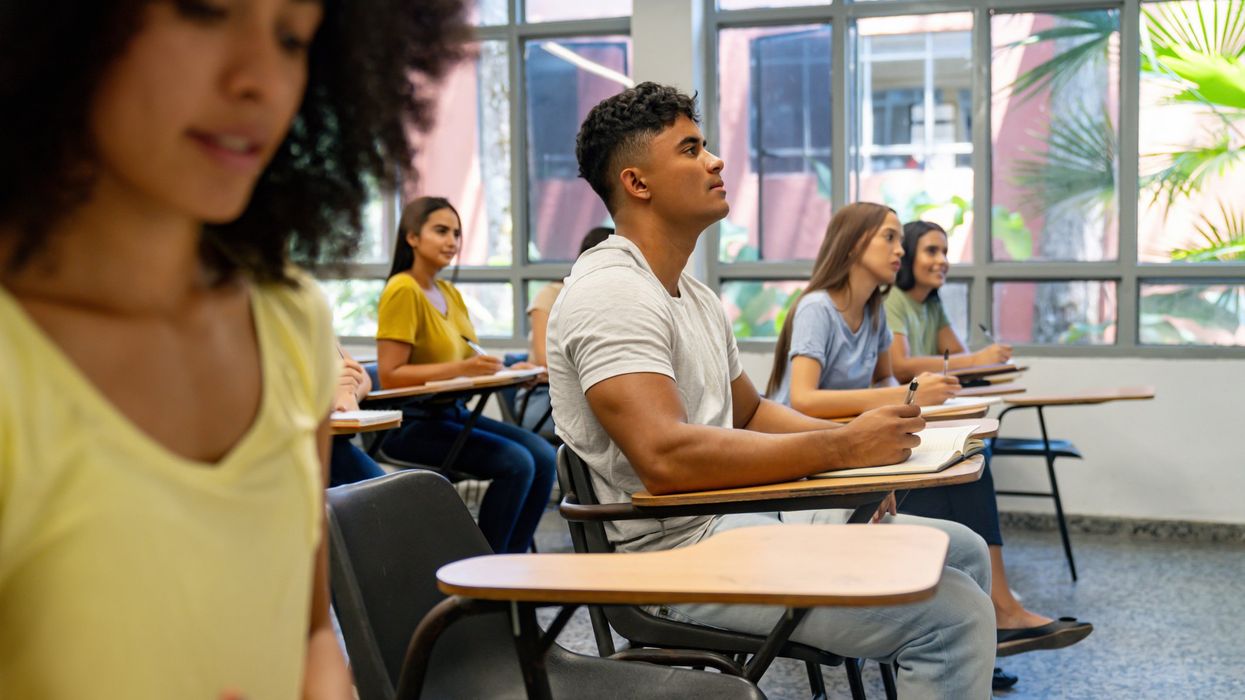



On a beautiful fall day at Fairmont State University in West Virginia, I watched four students take on a lively challenge: suggesting a 28th Amendment to the U.S. Constitution as part of a Constitution Day celebration. The students’ ideas ranged from regulating AI to capping campaign spending to ending criminal immunity for elected officials. After they provided an overview of their idea, they answered questions from the crowd and cheered for their fellow peers’ presentations. Fairmont State’s event empowered students to describe how and why they want to improve their world.
As Director of Campuswide Immersion at C&S, I get to hear about college students engaging in this kind of work all the time. For those unfamiliar with C&S, we are a national nonprofit that sparks young people to create bold, fresh civic solutions that move our country forward. C&S convenes College Presidents for Civic Preparedness, a coalition of more than 140 college and university presidents committed to ensuring every student graduates with the skills to have productive conversations, use credible information, and collaborate to create solutions in their communities. Campuswide Immersion is an offering for coalition members that helps campuses infuse civic learning throughout every aspect of campus life so that graduates are ready to contribute in their workplaces and communities.
Far from the stereotype that young people are checked out or can’t handle hard conversations, I see college students leaning in. They want their voices to be acknowledged for the depth of knowledge, courage of conviction, and serious contemplation they’re bringing to civic issues. I also see faculty redesigning courses to promote civic skill-building, student affairs professionals creating opportunities for civic engagement outside the classroom, and presidents making civic learning a campus-wide priority.
Rather than prescribing one “right” way to bring civic learning to colleges and universities, C&S is collaborating with 60 coalition campuses to customize the approach that works best for them. For instance, at Otterbein University, I saw how career readiness – which draws from the same skills democracy depends on – can be woven throughout the entire student experience through their annual READY program. Denison University asks students to contribute to a blog that tests assumptions about the campus when it comes to topics like politics, religion, and perceptions of discrimination, helping students form a habit of checking beliefs against evidence. At James Madison University, civic engagement is becoming part of how students understand daily interactions within a civic lens, embodied in initiatives like the first learning and living community in Virginia, Alger Hall.
Faculty, too, are doing deep work to bring this learning into their classrooms. At Towson University, faculty fellows built a coaching program that emphasizes dialogic reasoning, collaboration and vulnerability, so faculty can better help students navigate difficult conversations. Benedict College hosted a campuswide Faculty Institute so that faculty spanning multiple disciples could learn from and with each other, while faculty at the University of Denver have implemented Debate Across The Curriculum in over 150 classrooms, spurring students to navigate complex topics with confidence.
This year, College Presidents for Civic Preparedness coalition campuses participating in Campuswide Immersion did something unprecedented: they collected information from more than 20,000 students to create a shared baseline for how students build civic skills. Why was this an important step? Because the results helped those same campuses track their progress toward helping every student think deeply about civic learning, invest more heavily in what works, and learn from one another. This year’s baseline data shows that students at coalition campuses participating in Campuswide Immersion are more likely than their peers nationally to listen regularly to people with different beliefs: 64% do so at least monthly, compared with 49% of college students and 43% of U.S. adults. In fact, these students listen to people who disagree with them more often than most Americans listen to people who agree with them.
The results also showed that 80% of these students say understanding different beliefs matters, compared with 69% of college students nationally and 61% of Americans.
The implication? Young people are ready to have complex conversations and solve problems together; they just need a little support. In a separate C&S survey of 1,002 young people ages 14 to 22, 77% said they engage civically through face-to-face talks. But they’re not always sure where to start: 37% report uncertainty about how to get involved.
Colleges have both an opportunity and a responsibility to show them where to start, and not just the students already raising their hands. That’s where College Presidents for Civic Preparedness comes in, and we invite more college presidents to join us and help make civic preparation a defining part of every student’s experience. Communities can help too, by supporting internships, projects, and classes that benefit the local area, giving students opportunities to step outside the higher-education bubble and shape the world beyond it.
I keep thinking about those four students at Fairmont State. Individually, they demonstrated the courage to research, develop, and publicly defend ideas that touched on some of our country's most complex and contested questions. Yet what struck me most was that they didn't experience that work as courageous because they were part of a community that expected students to think boldly, supported them when they did, and genuinely wanted to hear what they had to say. Fairmont State, like all of our coalition campuses, is intentionally building environments where students feel empowered to take intellectual risks, test new ideas, and imagine new possibilities. When students graduate prepared to engage across differences, use credible information, and solve problems with others, they leave campus ready not just to navigate the future, but to shape it.
College Presidents for Civic Preparedness welcomes new members, and any president ready to make this part of every student’s experience can join us.
—
Cathy Copeland is the Director of the College Presidents for Civic Preparedness Campuswide Immersion Program at C&S, where she partners with colleges and universities to build, assess, and strengthen their approaches to productive conversations, information literacy, and collaborative problem-solving. Before joining C&S, Cathy served as Director of the American Democracy Project at the American Association of State Colleges and Universities and has taught writing, rhetoric, and literature courses at several universities and developed multidisciplinary collaborative problem-solving courses.