

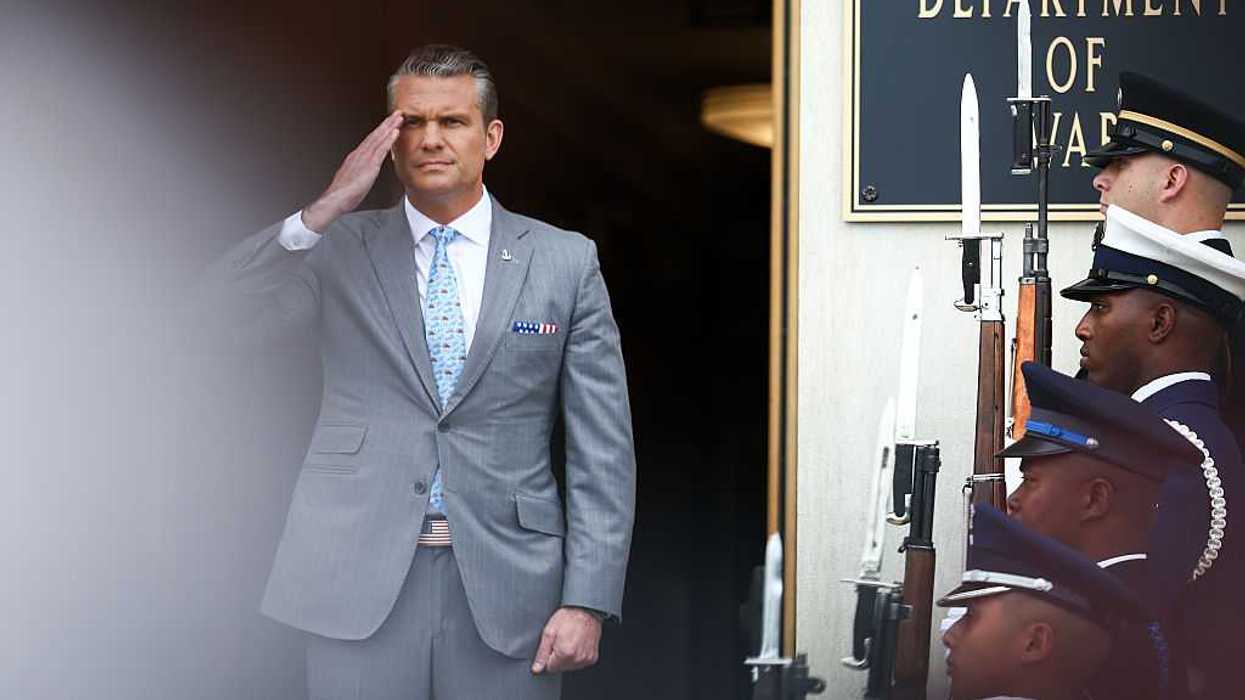

Yesterday, Secretary of Defense Pete Hegseth fired another round of shots in his war on higher education, and once again he fought it in his own backyard. After pulling books off the shelves of the Naval Academy and cutting the Pentagon’s ties to graduate programs at Harvard and Princeton, he signed a memo ordering the service academies to stop granting tenure to civilian professors, effective immediately. Tenure, he wrote, breeds “academic stagnation, faculty complacency,” and belongs to a broader academic structure that serves to “dilute our focus on lethality.” This assault on the academy is a mistake, both wronging the scholars who teach at the academies, and leaving the cadets and midshipmen who learn from them less prepared for war.
In his depiction of the tenure system's shortcomings, Hegseth mischaracterizes it as a finish line, where receiving tenure marks the moment a professor stops running. Granted, there is a grain of truth here: a study of over 12,000 American faculty members published in the Proceedings of the National Academy of Sciences found that in non-lab-based fields like political science and sociology, publication rates do fall once tenure is secured. Lab-based fields, meanwhile, sustain high research output. More importantly, however, the same study found that after receiving tenure, scholars turn toward newer, riskier questions, also known as the kind that occasionally transforms a field.
That trade is the whole point of tenure. Robert Putnam had it when he spent years gathering evidence for Bowling Alone where he introduced the seminal concept of “social capital” to describe the challenges facing American democracy. My thesis advisor at Harvard, Theda Skocpol, had it when she wrote Protecting Soldiers and Mothers, which upended the accepted story of a country that came late to the welfare state. Neither project was a safe bet. Job security bought the time and the freedom to risk being wrong in public.
Calling such people complacent insults a profession, and the academies will pay for the insult. Civilians make up roughly half of the faculty at Annapolis alone, and Vice Admiral Yvette Davids, a former Superintendent of the United States Naval Academy, told senators last year that tenure is among the school’s best tools for recruiting top scholars. Take it away and promising young scholars become much less incentivized to accept an offer at the academies. Those who accept an offer will know that a lecture or journal article that irritates the wrong official could cost them their jobs. People in that position play it safe. If stagnation is what the secretary fears, then he has just ordered more of it.
However, the decision to end tenure also creates a deeper problem for national security. Secretary Hegseth argues that civilian academic norms have watered down the need to promote lethality. Lethality, though, begins with the mind. The foundational texts in the military profession say as much. One of Sun Tzu’s best-known counsels is to know the enemy and know yourself, while Clausewitz described war as a contest against a reactive opponent in a fog of uncertainty that only trained judgment can cut through. Neither man believed victory went to the side with the most comfortable assumptions. To understand an enemy, an officer must be able to share perspective with a way of thinking they find foreign, perhaps even repugnant, long enough to predict what it will do next.
These critical thinking skills are built in the classroom through arguments a cadet might rather not have. Suppose Secretary Hegseth is right that some civilian professors teach ideas their students reject. Good. A 20-year-old who has to critique an argument they disagree with, in front of a professor free to push back, is rehearsing for the day an adversary refuses to behave the way the briefing slides predicted. Last year, the former Superintendent of the United States Military Academy, Lieutenant General Steven Gilland, told senators that the academic program exists to give future officers “the intellectual agility needed to make critical decisions in the chaos of war.” Agility comes from being stretched.
Conformity does the opposite. Officers who have heard only the views they already hold learn to mistake agreement for truth, a habit they may carry into the field. The enemy will never arrange a fight for our comfort. Our classrooms shouldn’t either.
Secretary Hegseth has said he wants more uniformed officers teaching at the academies and fewer civilians. He can have that without touching tenure. Roughly three of every four West Point faculty members are already active-duty soldiers, and he can assign more tomorrow. Ending tenure adds nothing. All it changes is whether the civilians who remain feel free to think out loud, and thinking wins wars. He should rescind the memo. If he won’t, Congress should do it for him. Our national security depends on it.
Conner Huey was a Fulbright Scholar in the Netherlands, where he researched education policy and democracy. He previously worked as a civic education researcher at the Allen Lab for Democracy Renovation hosted by Harvard University, where he graduated with a Bachelor of Arts in Government and History in 2025.