


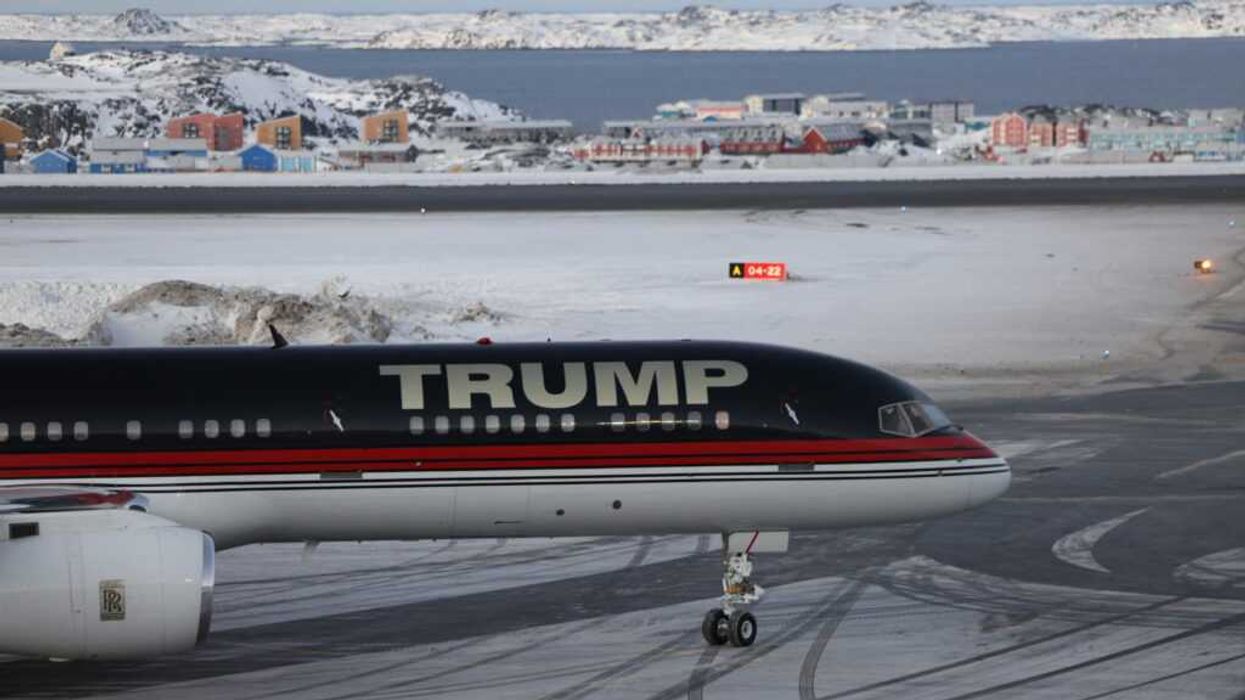

In early 2025, before Donald Trump was even sworn into office, he sent a plane with his name in giant letters on it to Nuuk, Greenland, where his son, Don Jr., and other MAGA allies preened for cameras and stomped around the mineral-rich Danish territory that Trump had been casually threatening to invade or somehow acquire like stereotypical American tourists — like they owned it already.
“Don Jr. and my Reps landing in Greenland,” Trump wrote. “The reception has been great. They and the Free World need safety, security, strength, and PEACE! This is a deal that must happen. MAGA. MAKE GREENLAND GREAT AGAIN!”
Upon returning, one of Trump’s so-called reps, an influential MAGA podcaster, told his audience that it was absolutely imperative that America acquire Greenland. Why?
“It makes America dream again, that we’re not just this sad, low-testosterone, beta male slouching in our chair, allowing the world to run over us. It is the resurrection of masculine American energy. It is the return of Manifest Destiny.”
Wow. What an endorsement.
The idea that America is, essentially, owed Greenland as ordained by God, and that acquiring it was going to accomplish nothing short of resurrecting both the American dream and “masculine American energy” was quite the preposterous promise. But it was made in earnest by someone Trump voters loved and trusted: Charlie Kirk.
It was a huge shift in a very short period of time from the way Kirk and other MAGA acolytes had been talking. Kirk had long bought into Trump’s “America First” marketing pitch, and he often used it as a cudgel against all sorts of liberal ills.
“American citizens should come first,” he’d insist, arguing for a total halt to immigration at times. “The last thing America needs right now is a new war,” he’d argue as it pertained to foreign policy and meddling in other countries’ affairs. He believed the United States was founded as an “America First” Christian nation. And he warned that a vote for Kamala Harris was a vote for WWIII.
As Trump touted an end to “forever wars” while on the campaign trail, Kirk and others in the manosphere — including previously Trump-skeptical media personalities — decided “America First” was Trump’s calling card, his raison d’être, his most compelling doctrine. Gone were the days of George W. Bush’s cowboy neoconservatism — real men minded their own business. And if you couldn’t abide the other more sordid stuff — say, the fact that Trump was a convicted criminal — putting an end to America’s interventionist foreign policy should trump it all.
That was the pitch to voters made for years by MAGA influencers who promised nothing was more morally imperative than America retreating from the world.
Until it wasn’t.
Kirk was hardly alone in flipping the script to suddenly defend the thing they’d been told would never happen. Now, they were telling us, intervention, threatening to invade sovereign nations, maybe even getting involved in some foreign wars, and even Trump’s tariffs — an economic interventionist policy — were not only OK, they were crucial to making America great again. (And men, too.)
The shameless abandonment of principles is so utterly comical in its scope and speed, calling it “hypocrisy” almost gives it too much intellectual heft. They simply don’t care.
This week Sen. Rick Scott is boasting that Trump, in addition to toppling the Nicolás Maduro regime in Venezuela, will also see to the toppling of the Cuban government “this year,” after spending years touting Trump’s America First agenda.
Sen. Lindsey Graham, another of Trump’s “America First” foot soldiers, is now brazenly warning the leader of Iran that Trump is going to kill him — “Change is coming to Iran.”
After lambasting just two months ago our “endless cycle of regime change,” DNI Tulsi Gabbard is now offering “kudos” to the Trump administration for the capture of Maduro in a constitutionally questionable operation that ended with Trump insisting “we’re in charge” now.
These people were either never serious about America First, ending forever wars, and minding our business, or they are so wholly owned by Trump that his unhinged whims just matter more.
But, as he threatens to take Greenland and Canada, and invade Colombia and Mexico and Cuba, it’s very clear Trump was never serious about America First. Just as he was never serious about releasing the Epstein files. Or making America affordable again. Or draining the swamp. Or replacing Obamacare. Or myriad other slick slogans he pitched to get elected.
But are his voters serious about America First? While MAGA falls in line to defend Trump’s imperialist warmongering and oil-grabbing, many of his voters did not sign up for this. Midterms are around the corner. We’ll know their answer soon enough.
S.E. Cupp is the host of "S.E. Cupp Unfiltered" on CNN.









The President Invited Iran to Bomb My Home