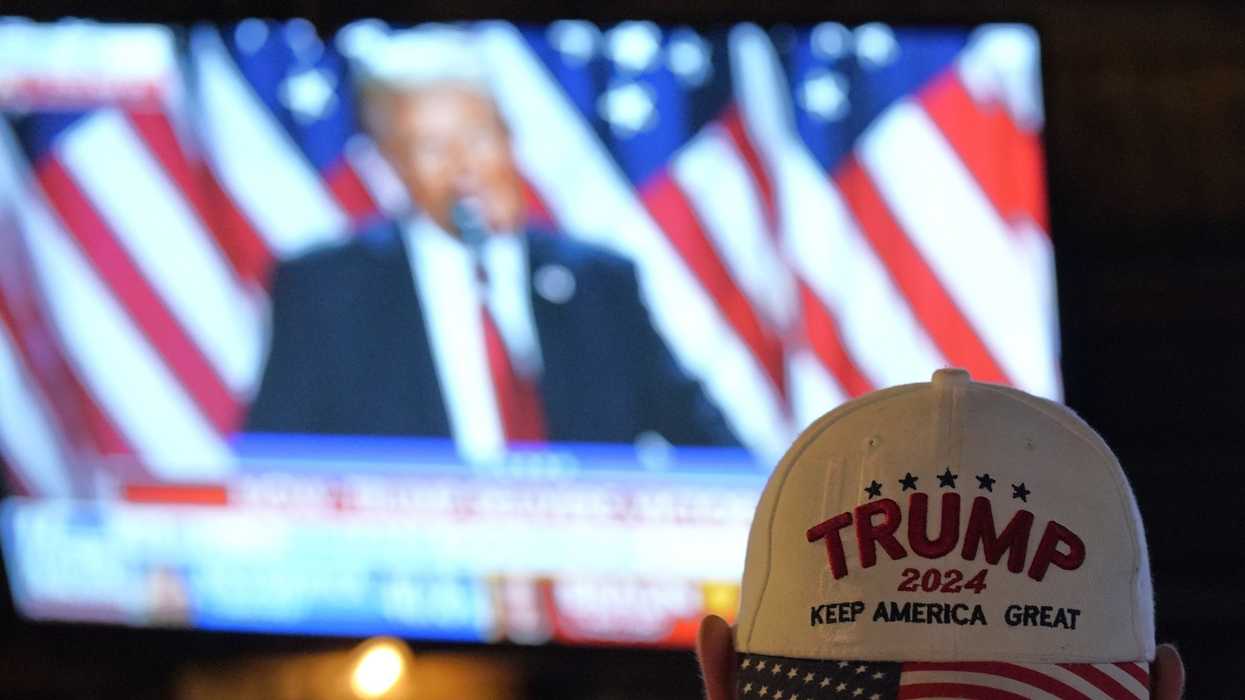


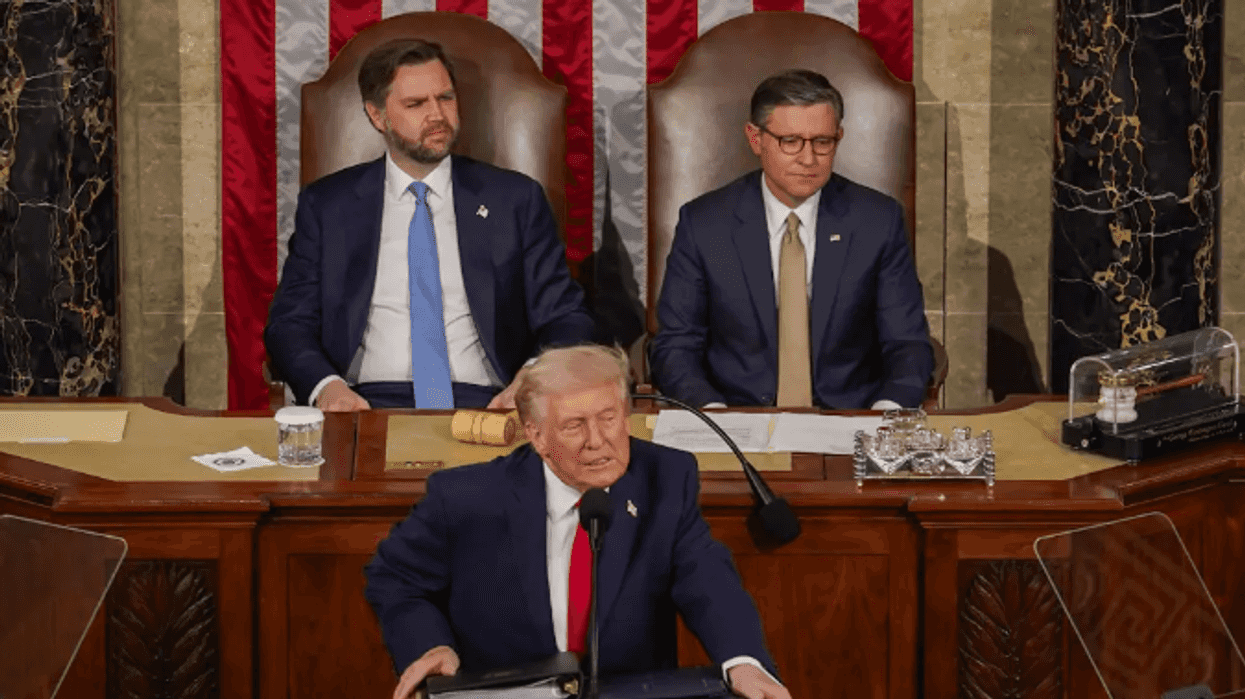
WASHINGTON — President Donald Trump delivered the longest State of the Union in history at almost 108 minutes Tuesday night. He began the address to Congress, which totaled more than 10,000 words, by stating that America is the “hottest country” in the world.
Trump centered his fourth official State of the Union address — the first of his second term — on economic, immigration, and international policy. He framed his accomplishments around America’s 250th birthday.

“Our nation is back,” Trump said. “Bigger, better, richer, and stronger than ever before.”
The president also joked about “winning too much” and welcomed the Olympic gold-winning U.S. men’s hockey team, amid controversy surrounding FBI Director Kash Patel’s celebration with the team and public backlash to the players’ laughter about the women’s hockey team during a phone call with Trump.
According to a Medill News Service analysis, Trump spent more time praising the hockey players and American athletics than he did talking about Israel, Gaza, Russia, Ukraine, and Iran combined.

Policy at the forefront
Trump spent more than a quarter of the address promoting new policy measures and touting his past accomplishments.
With midterm elections on the horizon, Trump focused roughly 10 minutes on the Republican Party’s roadmap for the next two years. He spoke about regulations for artificial intelligence data centers, nationwide voter identification laws, new retirement plan options, and further restrictions on insider trading.
However, Trump spent twice as much time touting what he viewed as the successes of his second administration.
“I do think a lot of the success outlined in the State of the Union will be a part of the Republican message in the fall,” Sen. Eric Schmitt, R-Mo., told the Associated Press.

One reference to affordability
Trump spent about 10 minutes on one of the key issues in the upcoming midterm elections: the economy.
According to a February AP-NORC poll, 59% of people disapprove of Trump’s handling of the economy, compared to just 39% that approve.
Trump only said the word “affordability” once in his entire speech — and it was to attack Democrats, not explain his own economic policies. However, he highlighted increased stock market growth and American oil production, as well as lower inflation and prices on various goods, including gas and eggs, to support his record.
In the Democratic response to the State of the Union, Virginia Gov. Abigail Spanberger, who ran on an “affordable Virginia” agenda, argued that Trump’s policies are not helping American families.
“Is the president working to make life more affordable for you and your family?” Spanberger said. “Is the president working to keep Americans safe, both at home and abroad? Is the president working for you?”
Trump also said it was “unfortunate” that the Supreme Court on Friday struck down his tariffs, a large part of his economic agenda. He added that existing deals with countries and businesses will hold because “a new deal could be far worse for them.”
10 minutes on immigration
In the middle of a Department of Homeland Security shutdown over Immigration and Customs Enforcement funding — and while two-thirds of Americans say ICE agents’ actions have gone too far — the president spent less than 10% of his speech on the topic.
But when he did talk about his immigration crackdown, he didn’t change his usual rhetoric.

Trump did not use the word “immigrant” once during his entire speech. But he mentioned the border 16 times and referred to immigrants as “criminals,” “aliens,” and “illegal” 25 times in total.
The president spent around two minutes of his address attacking Somali residents of Minnesota, calling them “pirates” and accusing them of corrupting the state. Rep. Ilhan Omar, D-Minn., who is the country’s first Somali-American legislator, heckled Trump during his speech.
“You have killed Americans,” Omar yelled across the chambers, in a reference to the fatal shootings of two Americans by ICE agents in her home state this year.
Trump spent another four minutes promoting his immigration policy by telling stories of Americans who were harmed by “illegal aliens.”
The state of Venezuela
After focusing on his domestic agenda for roughly an hour and 15 minutes, Trump pivoted to foreign policy by highlighting the “eight wars” he claimed to have ended in his second term.
“We’re proudly restoring safety for Americans at home, and we are also restoring security for Americans abroad,” Trump said. “Our country has never been stronger.”
In total, Trump spent less than 20 minutes discussing foreign policy.

He used more than half of this time on Venezuela, where U.S. forces captured President Nicolas Maduro and his wife in January. Trump recognized a freed Venezuelan politician and awarded the Congressional Medal of Honor to an American pilot who participated in the operation.
Trump spent just three minutes discussing Iran and preventing the development of nuclear weapons.
The President added that he wanted to “solve this problem through diplomacy.” The Associated Press reported that the U.S. has assembled the largest force of aircraft and warships in the Middle East since 2003.
Everything else
Trump spent the second-most time, about 26 minutes, introducing non-policy-related guests.
For about seven minutes, he gave a Purple Heart to Staff Sergeant Andrew Wolfe and the parents of Sarah Beckstrom, a West Virginia Army National Guard specialist. An Afghan national was charged with killing Beckstrom and injuring Wolfe in a Washington, D.C., shooting in November.
Trump also recognized Erika Kirk, the widow of late right-wing political activist Charlie Kirk, two World War II veterans, and a rescuer and survivor of the 2025 Texas floods.
Trump spent almost the same amount of time celebrating the Olympic U.S. men’s hockey team as he did criticizing Democrats for their handling of the economy and immigration. He did not criticize any Republicans who have spoken out against him.
He also praised Secretary of State Marco Rubio for approximately a minute and First Lady of the United States Melania Trump for almost two.
Marissa Fernandez covers politics for Medill on the Hill.
Ben Shapiro is a Politics & Policy Reporter for Medill News Service.
The Fulcrum is committed to nurturing the next generation of journalists. Learn how by clicking HERE.